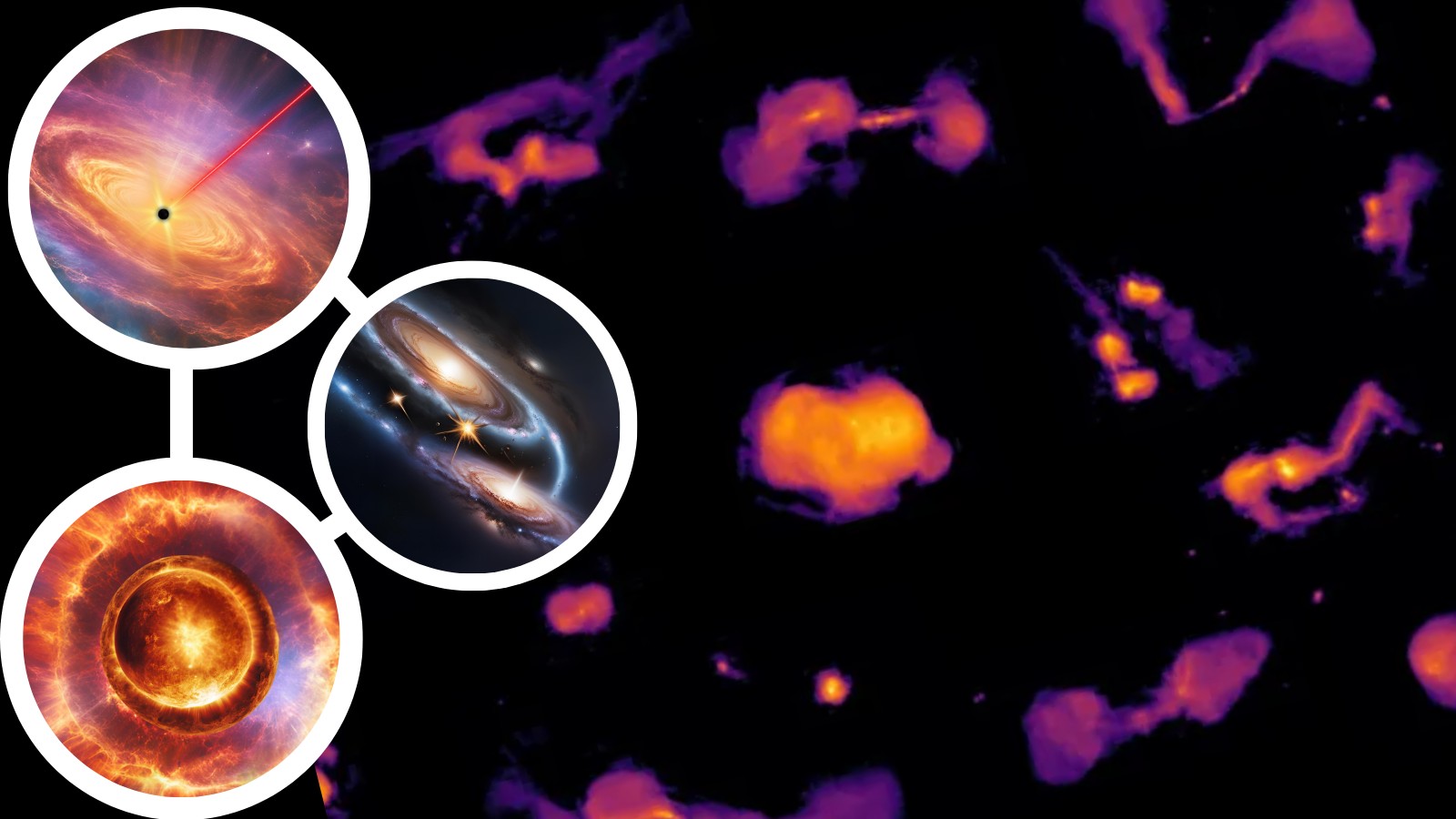
Astronomers have released the largest low-frequency radio map of the sky to date, cataloging 13.7 million cosmic objects and events. The survey, conducted using the Low-Frequency Array (LOFAR), provides an unparalleled look at high-energy phenomena like supermassive black hole jets, colliding galaxies, and supernova remnants.
This is significant because the universe’s most energetic processes are often best observed in radio wavelengths, which reveal activity that is invisible to optical telescopes.
Supermassive Black Holes at the Center of Activity
The data highlights the diverse behavior of active supermassive black holes (AGNs). When surrounded by an accretion disk—a swirling mass of matter falling inward—these black holes become powerful engines. Instead of consuming all material, much of it is ejected in the form of twin jets, traveling at near-light speed. These jets shape galaxies by injecting energy into their surroundings.
The study shows how these jets evolve over time, depending on the black hole’s mass, surrounding environment, and galactic properties. This is crucial for understanding how galaxies grow and change over cosmic timescales.
Beyond Black Holes: Mapping Galactic Collisions and Stellar Explosions
LoTSS-DR3 doesn’t stop at black holes. The radio waves detected also trace merging galaxies, supernova explosions, and other high-energy events. This allows astronomers to measure star birth rates in millions of galaxies.
The data reveals that shocks and turbulence drive particle acceleration and strengthen magnetic fields across vast cosmic distances, suggesting these processes are more common than previously thought. The upgraded LOFAR 2.0 is expected to double the survey speed, leading to even more detailed high-resolution data.
Peering Inside Our Own Galaxy
The survey also provides unprecedented insights into the Milky Way’s magnetic fields. Being located inside the galaxy makes mapping these fields challenging, but LOFAR’s unique wavelength range allows for unprecedented accuracy. The team also detected radio emissions from interactions between exoplanets and their host stars, opening new avenues for exoplanetary research.
“LoTSS-DR3 is not an endpoint, but a major milestone.” – Wendy Williams, Square Kilometer Array Observatory scientist.
The release of LoTSS-DR3 marks a turning point in radio astronomy, promising more detailed cosmic maps in the future with the help of improved telescope technology. This survey will undoubtedly shape our understanding of the universe’s most energetic phenomena for years to come.