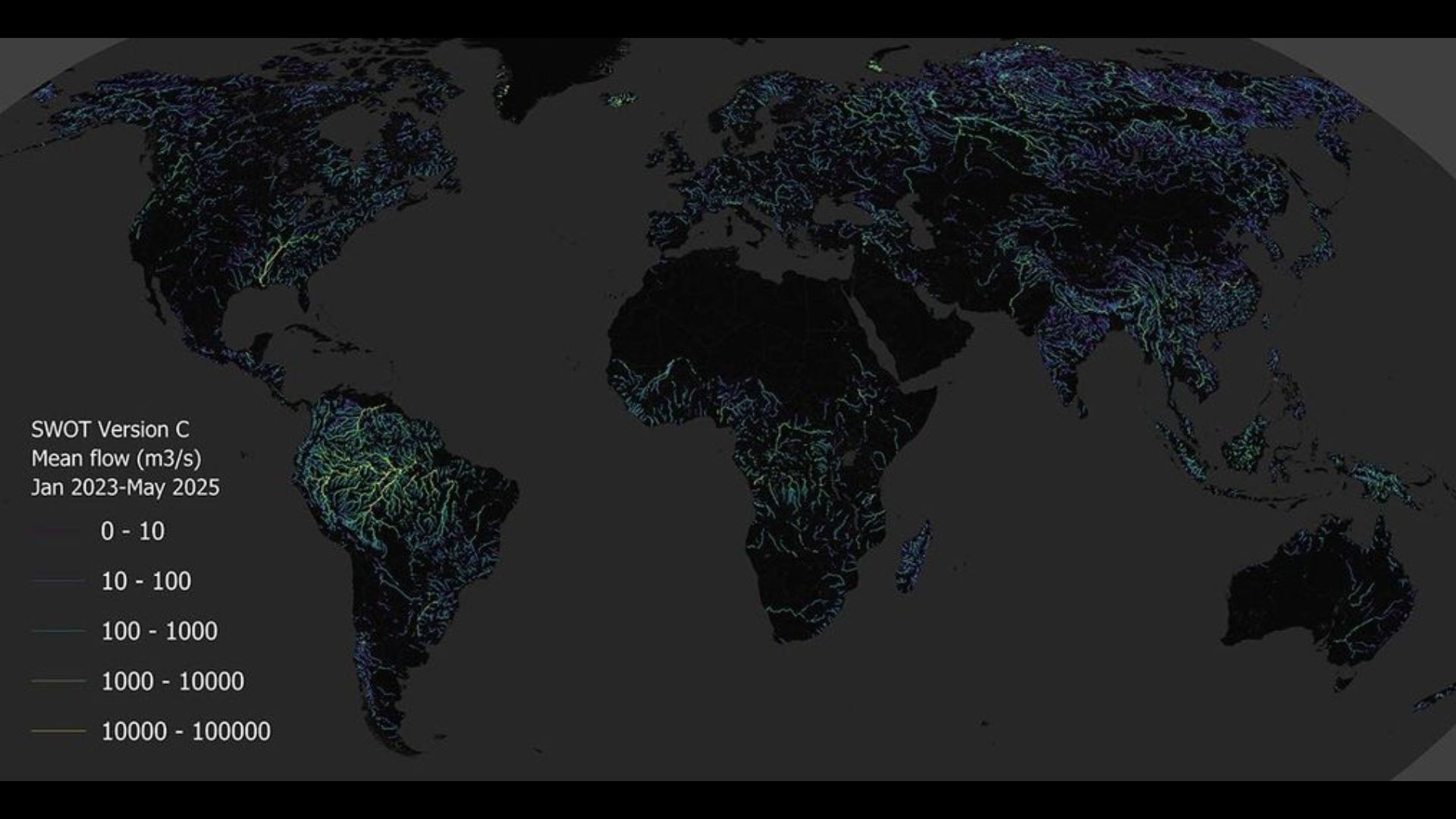
Earth’s rivers, the lifelines of ecosystems and human civilization, are now being monitored like never before thanks to the Surface Water and Ocean Topography (SWOT) satellite mission. For the first time, scientists have created a comprehensive global map estimating river discharge – the volume of water flowing through waterways – using data collected from space. This breakthrough fills critical gaps in water monitoring, particularly in remote regions and politically sensitive areas where ground-based measurements are scarce.
The Challenge of Measuring Global Water Flow
Accurately measuring river discharge is crucial for predicting floods, managing water resources, and understanding environmental impacts. However, traditional methods relying on river gauges are unevenly distributed, leaving large portions of the planet unmonitored. This poses significant challenges, especially in regions where rapid changes in water flow can have devastating consequences.
The SWOT mission, a collaboration between NASA and the French space agency CNES, addresses this issue by using a wide-swath radar instrument to measure water height across rivers, lakes, and oceans. Unlike localized gauges, SWOT provides broad, consistent coverage, complementing existing ground networks.
How SWOT Works: A Satellite’s Eye on Water
The SWOT satellite orbits Earth at an altitude of 554 miles (891 kilometers), completing a full orbit every 21 days. Using its Ka-band Radar Interferometer (KaRIn), it measures the height of water surfaces, enabling scientists to estimate discharge rates with unprecedented accuracy. The resulting data is visualized as a global map, with brighter and denser blue-to-green threads representing higher river flows.
According to NASA, this release represents the first-ever global estimate of both river discharge and suspended sediment observed from space — covering every river on Earth wider than about 160 feet (50 meters).
Why This Matters: Beyond Just Water Volume
The implications of this new data extend far beyond simple water volume measurements. Rivers aren’t just conduits for water; they also transport vital nutrients, pollutants, and sediment that shape deltas, influence water quality, and affect entire ecosystems.
“Discharge in particular is the heartbeat of flood forecasting, and having a space-based estimate helps fill gaps where ground sensors are limited or absent.”
The ability to accurately estimate discharge from space will enhance flood prediction models, allowing for better preparation and response in vulnerable regions. Water utilities, irrigation planners, and reservoir managers can also leverage this data to optimize water resource management across seasons and regions.
Looking Ahead: A New Era of Water Monitoring
The SWOT mission represents a paradigm shift in how we monitor and understand Earth’s water systems. By combining space-based observations with ground-based measurements, scientists can gain a more complete and accurate picture of global water flow. This data will not only improve our ability to manage water resources but also provide critical insights into the complex interplay between rivers, ecosystems, and human populations.
The availability of this global dataset marks a significant step toward more sustainable and informed water management practices worldwide.