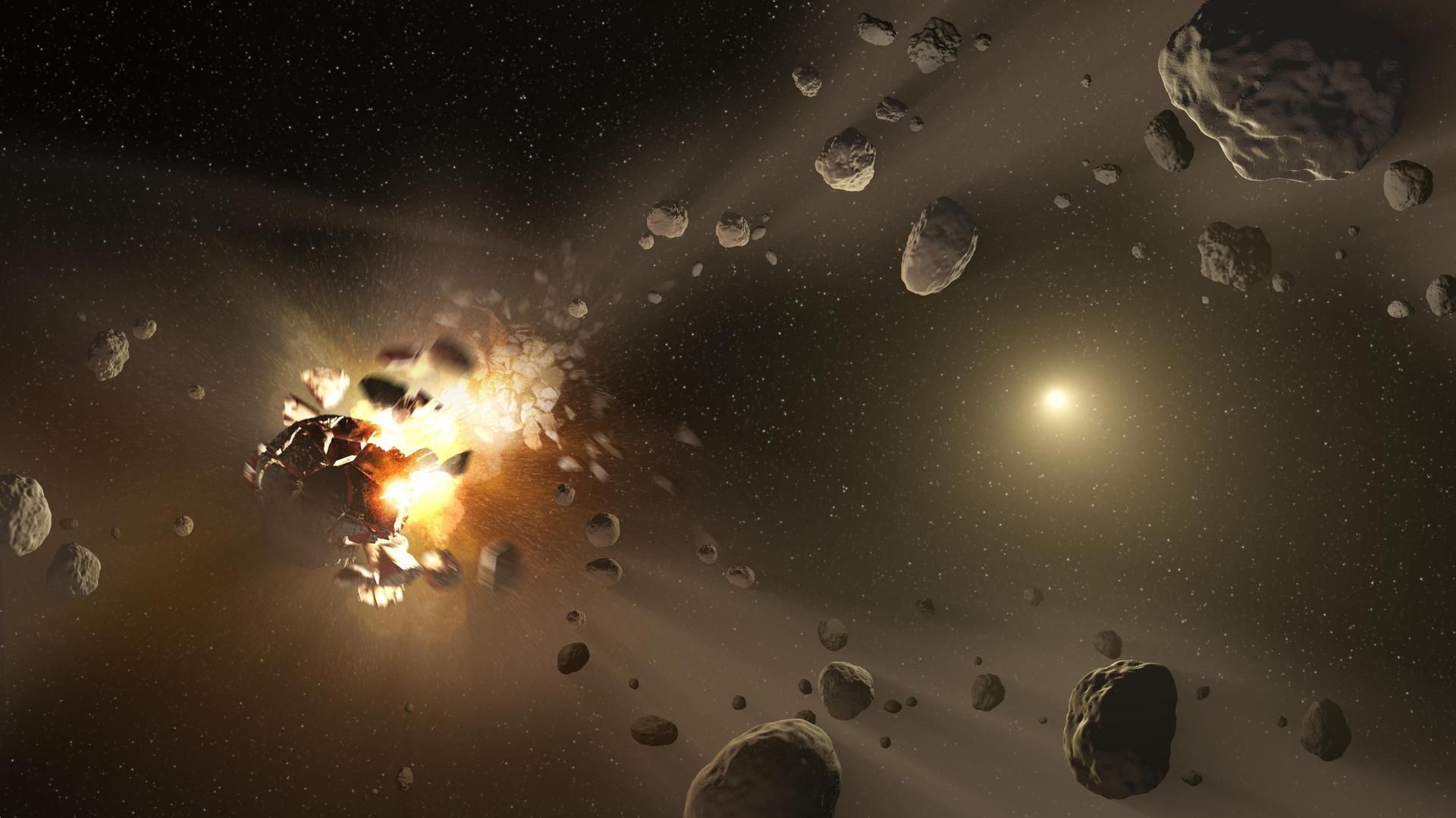
New research suggests that certain bacteria could survive the extreme forces of asteroid impacts, potentially allowing life to spread between planets. A lab experiment published March 3 in PNAS Nexus demonstrated that the resilient bacterium Deinococcus radiodurans can endure pressures mimicking asteroid collisions—pressures up to 29,000 times that of Earth’s atmospheric pressure at sea level—with survival rates as high as 95%.
The ‘Sandwich’ Experiment
Researchers simulated asteroid impacts by trapping D. radiodurans between two steel plates and subjecting them to intense compression. The pressures tested (1.4 to 2.9 gigapascals) were calibrated to reflect the forces that could eject microbes from a planet like Mars during a high-speed impact. Previous studies have shown significantly lower survival rates, but this experiment found that a substantial percentage of the bacteria not only survived but also demonstrated a rapid recovery.
Why This Matters: Planetary Contamination and the Search for Extraterrestrial Life
The implications of this research are two-fold. First, it highlights the need for extreme caution in planetary sample-return missions. If microbes can hitch a ride on asteroids, stringent sterilization protocols become even more critical to prevent forward contamination—the accidental introduction of Earth life to other worlds, or backward contamination—the risk of bringing alien microbes to Earth.
Second, it broadens our understanding of how life might travel through space. D. radiodurans is known for its incredible resilience: it has already survived three years exposed to the harsh conditions outside the International Space Station. This study suggests that asteroid impacts could be a viable mechanism for panspermia, the hypothesis that life can spread throughout the universe via rocks or other celestial bodies.
Recovery and Adaptation
The surviving bacteria exhibited a clear physiological response to the simulated impacts. The team found that microbes exposed to higher pressures prioritized DNA repair and iron uptake over reproduction, suggesting a focus on immediate survival rather than propagation. This behavior illustrates the remarkable adaptability of these extremophiles.
This study doesn’t prove life is traveling between planets, but it does demonstrate that the conditions for it are plausible. The extreme durability of certain organisms suggests that interplanetary transfer is not just possible, but potentially more common than previously thought.
The findings challenge conventional assumptions about the limits of life and open new avenues for exploring the potential for microbial transfer between planetary bodies.