NASA confirmed today that the upcoming Artemis 2 mission to the moon will proceed as planned, despite a significant solar flare that erupted from the sun late Sunday. The flare, classified as X1.4 – the most intense category – initially triggered radio blackouts over Asia and Australia, raising concerns about potential impacts on the April 1 launch. However, space agency officials assure that current conditions pose no threat to the astronauts or spacecraft.
Solar Activity and Artemis 2: No Immediate Risk
The flare also released a coronal mass ejection (CME), a surge of solar plasma heading toward Earth. However, NASA’s Associate Administrator Amit Kshatriya stated during a press conference at the Kennedy Space Center that “we’re not expecting the CME to cause any effects… We’re not tracking concerns for the mission in general.” The decision to proceed with the launch, scheduled for 6:24 p.m. EDT on April 1, was made after a thorough review by the mission management team.
This is significant because intense solar flares and CMEs can be dangerous to astronauts and satellites, exposing them to high levels of radiation. NASA has already prepared for such scenarios by testing a radiation shelter protocol for the Artemis 2 crew. Flight Director Emily Nelson explained that “we’ve got a section of the spacecraft that we would set up in and the crew would stay in that area until we gave them the all clear that the radiation event had passed.”
Historical Context and Mission Details
The Artemis 2 mission marks a crucial step in renewed lunar exploration. It will be the first crewed flight around the moon since Apollo 17 in 1972, and the inaugural test of NASA’s Space Launch System (SLS) megarocket and Orion spacecraft with human passengers. The ten-day mission will carry four astronauts on a trajectory around the moon and back to Earth.
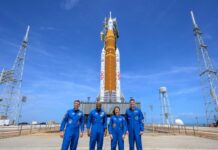
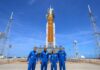
The crew consists of veteran astronaut Reid Wiseman (commander), Victor Glover (pilot), Christina Koch (mission specialist, NASA), and Jeremy Hansen (mission specialist, Canadian Space Agency). The astronauts are currently in pre-launch quarantine and visited the launchpad for a crew photo with their SLS rocket and Orion spacecraft.
Looking Ahead: Clear Skies and a Historic Launch
NASA is optimistic about the weather conditions for launch day, forecasting an 80% chance of clear skies. The timing is particularly striking as the announcement came shortly after a double rainbow appeared over the Kennedy Space Center, seemingly symbolizing the mission’s bright future.
The Artemis 2 mission represents not just a return to lunar exploration, but also a demonstration of NASA’s preparedness for space weather challenges. The agency has protocols in place to mitigate risks, ensuring astronaut safety even in the face of unpredictable solar activity. The April 1 launch will be a landmark event, showcasing the next generation of space travel technology and reigniting humanity’s ambition to explore beyond Earth.