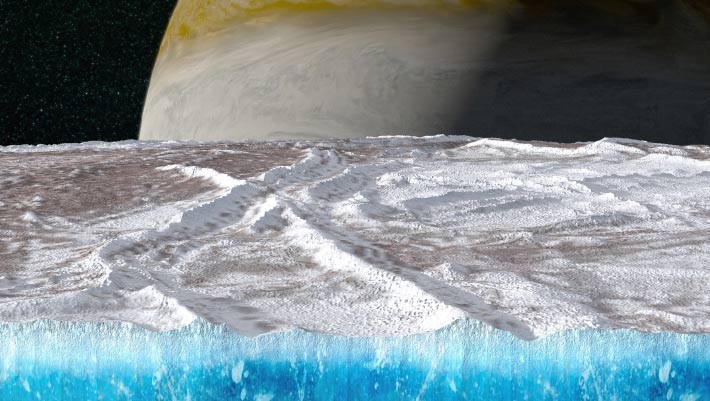
Recent findings from NASA’s Juno spacecraft indicate that Europa, one of Jupiter’s icy moons, possesses a significantly thicker ice shell than previously estimated. The new measurements, gathered using Juno’s microwave radiometer (MWR) during a close flyby in September 2022, suggest an average ice thickness of approximately 29 kilometers (18 miles). This discovery has major implications for understanding the potential habitability of Europa’s subsurface ocean.
Why Europa Matters
For decades, Europa has been a prime target in the search for extraterrestrial life. Evidence from NASA’s Galileo mission revealed a salty ocean beneath the ice, sparking interest in whether this moon could harbor life. The thickness of the ice shell is crucial because it determines how easily chemical compounds from the surface can mix with the ocean below—a key factor for habitability.
Juno’s Breakthrough Measurements
Juno’s MWR, initially designed to study Jupiter’s atmosphere, provided unexpected insights into Europa’s ice. The instrument measures brightness temperatures at various depths, allowing scientists to estimate ice shell thickness. According to Juno project scientist Steve Levin, the 29-kilometer estimate applies to a cold, rigid outer layer of pure water ice. If warmer, convective layers exist beneath, the total thickness could be even greater.
Implications for Habitability
A thicker ice shell presents challenges for life. The longer distance between the surface and the ocean means oxygen and nutrients would have to travel further to sustain potential organisms. However, the MWR data also revealed “scatterers”—small cracks, pores, and voids in the near-surface ice. While these features could provide some pathways for exchange, they appear to be limited in size and depth, extending only hundreds of feet below the surface.
What’s Next?
The findings from Juno provide critical context for upcoming missions: NASA’s Europa Clipper, scheduled to arrive in 2030, and ESA’s Juice spacecraft, set to reach Jupiter in 2031. These missions will further investigate Europa’s subsurface ocean and assess its potential for habitability.
“How thick the ice shell is and the existence of cracks or pores within the ice shell are part of the complex puzzle for understanding Europa’s potential habitability,” stated Juno’s principal investigator, Dr. Scott Bolton.
The research, published in Nature Astronomy on December 17, 2025, marks a significant step forward in planetary science. Despite the challenges posed by the thick ice shell, the prospect of a habitable ocean beneath Europa remains a compelling reason for continued exploration.