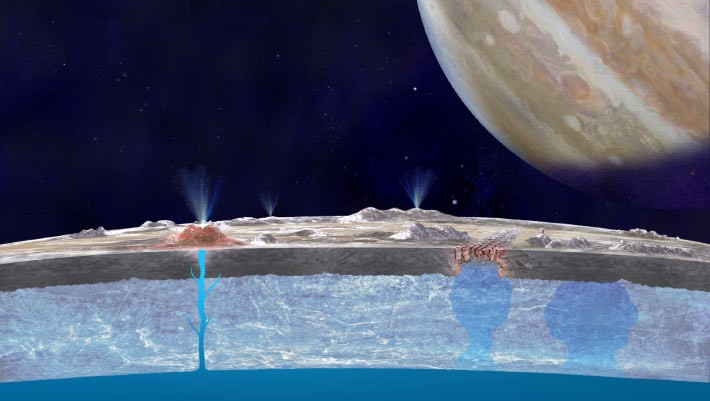
A new study suggests a plausible mechanism by which nutrients generated on the surface of Jupiter’s moon Europa could reach its subsurface ocean, potentially sustaining life. The research, conducted by geophysicists at Washington State University and Virginia Tech, addresses a long-standing question about how Europa’s ocean – which holds more liquid water than all of Earth’s oceans combined – could remain habitable despite being covered by a thick, sunlight-blocking ice shell.
The Problem of Sustaining Life Under Ice
Europa’s ocean lacks direct sunlight, meaning any potential life within it must rely on alternative energy and nutrient sources. Intense radiation from Jupiter constantly bombards Europa’s surface, interacting with salts and other materials to create nutrients that could support microbial life. However, the challenge has been explaining how these nutrients migrate through the thick ice shell to reach the ocean below.
Inspired by Earth: Crustal Delamination on Europa
The researchers drew inspiration from Earth’s geological processes, specifically crustal delamination – where dense portions of a crust sink into the mantle. They theorized that salt-enriched, denser ice on Europa’s surface could similarly detach and sink through the icy shell. Previous studies have already shown that impurities weaken the crystalline structure of ice, making it less stable than pure ice.
How It Works: A ‘Dripping’ Ice Shell
The key is that denser, saltier ice surrounded by purer ice would be unstable and sink into the interior. Computer modeling demonstrates that this process can occur effectively with even minimal weakening of the surface ice. The sinking action provides a way to recycle Europa’s surface materials and deliver nutrients to the ocean. This process is also relatively rapid, making it a viable long-term mechanism for sustaining habitability.
Implications for Extraterrestrial Life
The study’s findings are significant because they address one of the major obstacles to Europa’s habitability. The researchers emphasize that this new model is a positive sign for the potential existence of extraterrestrial life within Europa’s ocean.
“This is a novel idea in planetary science, inspired by a well-understood idea in Earth science,” said Dr. Austin Green of Virginia Tech. “Most excitingly, this new idea addresses one of the longstanding habitability problems on Europa and is a good sign for the prospects of extraterrestrial life in its ocean.”
The research was published in the Planetary Science Journal (Green & Cooper, 2026). This study offers a compelling, testable hypothesis that could reshape our understanding of Europa’s potential to harbor life.