For over a century, astronomers have puzzled over the strange behavior of Betelgeuse, a massive red supergiant star roughly 650 light-years away. This star, famed for its dramatic brightening and dimming cycles, has now been confirmed to have a companion star orbiting within its atmosphere—a revelation that could rewrite our understanding of stellar evolution.
The Mystery of Betelgeuse’s Rhythm
Betelgeuse exhibits a six-year cycle of swelling and fading that doesn’t align with typical stellar instability. The star is nearing the end of its life, but not unstable enough to explain its predictable pulse. The long-suspected answer? Another star circling within its atmosphere, a finding recently confirmed by observations from NASA’s Hubble Space Telescope.
Evidence From Atmospheric Ripples
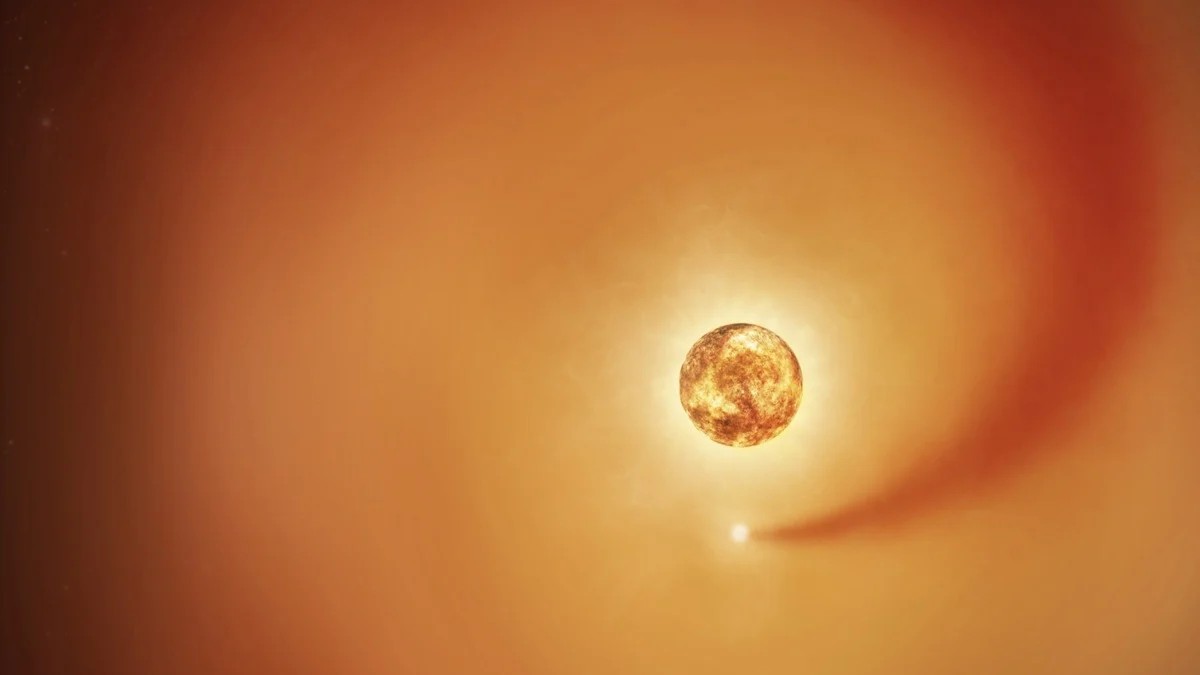
Researchers led by Andrea Dupree of the Harvard-Smithsonian Center for Astrophysics detected ripples in Betelgeuse’s atmosphere, resembling the wake of a speedboat. These disturbances are directly attributable to a passing star, a smaller companion dubbed Siwarha. The findings, soon to be published in The Astrophysical Journal, suggest Betelgeuse is part of a binary system, not a solitary giant.
Why This Matters
The discovery resolves a long-standing paradox: Betelgeuse spins too rapidly for its size. Large stars typically slow down as they age, but Betelgeuse maintains a fast rotation due to angular momentum transferred from its companion. Siwarha, estimated to be between half and 1 ½ times the mass of the sun, accelerates the giant star through orbital interaction.
The Companion’s Impact
Siwarha orbits so closely that it remains within Betelgeuse’s atmosphere, creating a trail of gas as it moves. This wake thickens, heats, and obscures the star, causing the periodic dimming observed from Earth. The entire star system reacts in sync: the surface, atmosphere, and surrounding gas all change on a consistent six-year schedule. Such coordination is unlikely to occur with solar storms alone.
What’s Next
Astronomers expect Siwarha to reappear in 2027 as its orbit carries it back into view. Confirming this binary system provides a clear example of stars spiraling into one another, a common yet elusive death process for stars. The companion star is currently hidden behind Betelgeuse, lost in the glare.
The discovery of Betelgeuse’s companion not only solves a century-old mystery but also offers a rare glimpse into the chaotic final stages of stellar evolution. This observation will reshape our understanding of how massive stars die and interact with their neighbors, confirming that even the most famous celestial objects often hold hidden secrets.