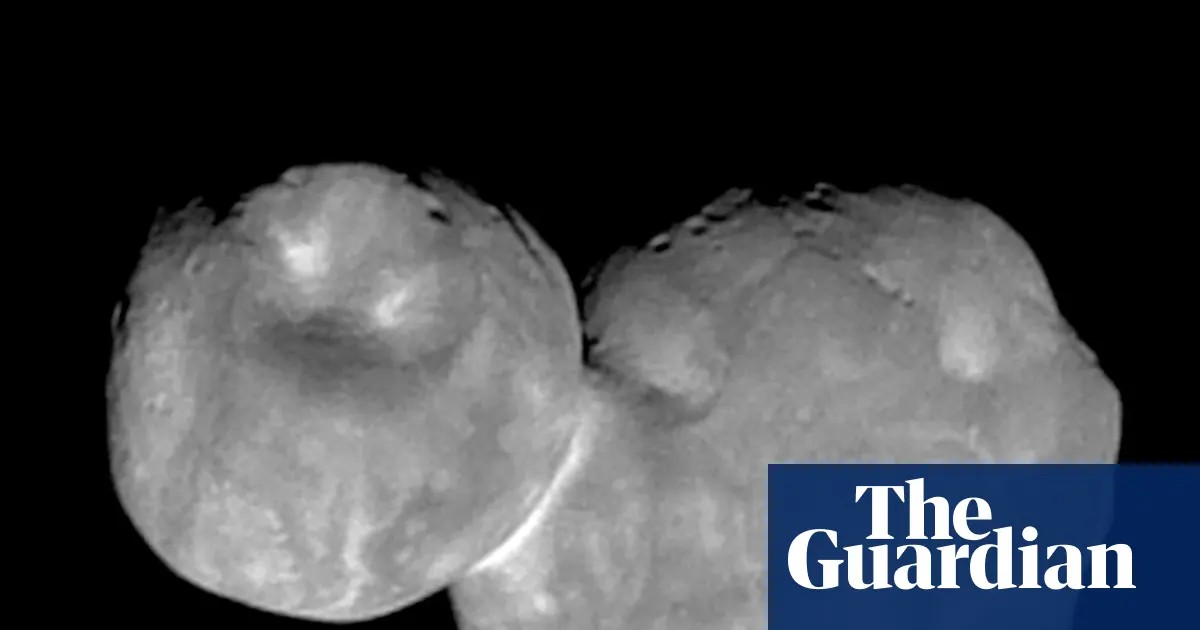
The most distant object ever visited by a spacecraft, Arrokoth, a 4-billion-year-old body in the Kuiper Belt, has provided new insights into the early formation of our solar system. Researchers have used advanced computer simulations to confirm how this unique, snowman-shaped object came to be, and what this means for understanding how planets themselves were built.
The Kuiper Belt: A Time Capsule of the Solar System
Arrokoth resides in the Kuiper Belt, a vast region beyond Neptune filled with icy remnants from the solar system’s birth. This zone is not just a collection of space debris; it’s a treasure trove of planetesimals – the very building blocks of planets. What makes Arrokoth particularly intriguing is its two-lobed structure. Roughly 10-25% of Kuiper Belt objects share this “snowman” or “peanut” shape, raising the question of how they formed.
Gravitational Collapse: The Key to Formation?
Previously, scientists proposed that Arrokoth’s gentle formation, indicated by its shape and lack of craters, resulted from gravitational collapse. The idea is that clouds of pebbles in the early solar system clumped together under their own gravity. But the exact mechanism remained unclear until now. The latest simulations provide strong evidence that this process can create double-lobed objects like Arrokoth.
“It’s so exciting because we can actually see this for the first time,” explained Jackson Barnes of Michigan State University, the lead researcher. “This confirms the entire process from start to finish.”
How the Simulations Work: Pebbles and Gravity
The research team ran 54 computer simulations using 105 particles, each about 2 kilometers in radius, representing a simplified pebble cloud. These simulations showed that small planetesimals could orbit each other and eventually merge at low speeds (around 5 meters per second), forming “contact binaries” – two lobes fused together. Some of these simulated objects bear a striking resemblance to Arrokoth.
What sets this study apart is its inclusion of particle physics, simulating how materials interact upon contact. Earlier models, which lacked this detail, suggested all collisions would result in single, spherical objects. This new approach supports the theory that planetesimals, including Arrokoth, formed through gentle gravitational collapse, rather than violent impacts.
Implications and Future Research
Alan Stern, the principal investigator of NASA’s New Horizons mission, praised the study as aligning with previous work and reinforcing the idea that Arrokoth’s formation was a smooth, non-destructive process. However, other astronomers note discrepancies between simulation results (only 4% of objects forming as contact binaries) and observed frequencies in the Kuiper Belt. Alan Fitzsimmons suggests Mother Nature may have other mechanisms at play, or that even more complex simulations could bridge the gap between theory and observation.
The formation of Arrokoth, though seemingly simple, provides crucial evidence about the conditions in the early solar system. Understanding these processes is key to unraveling how planets—including Earth—came to be.