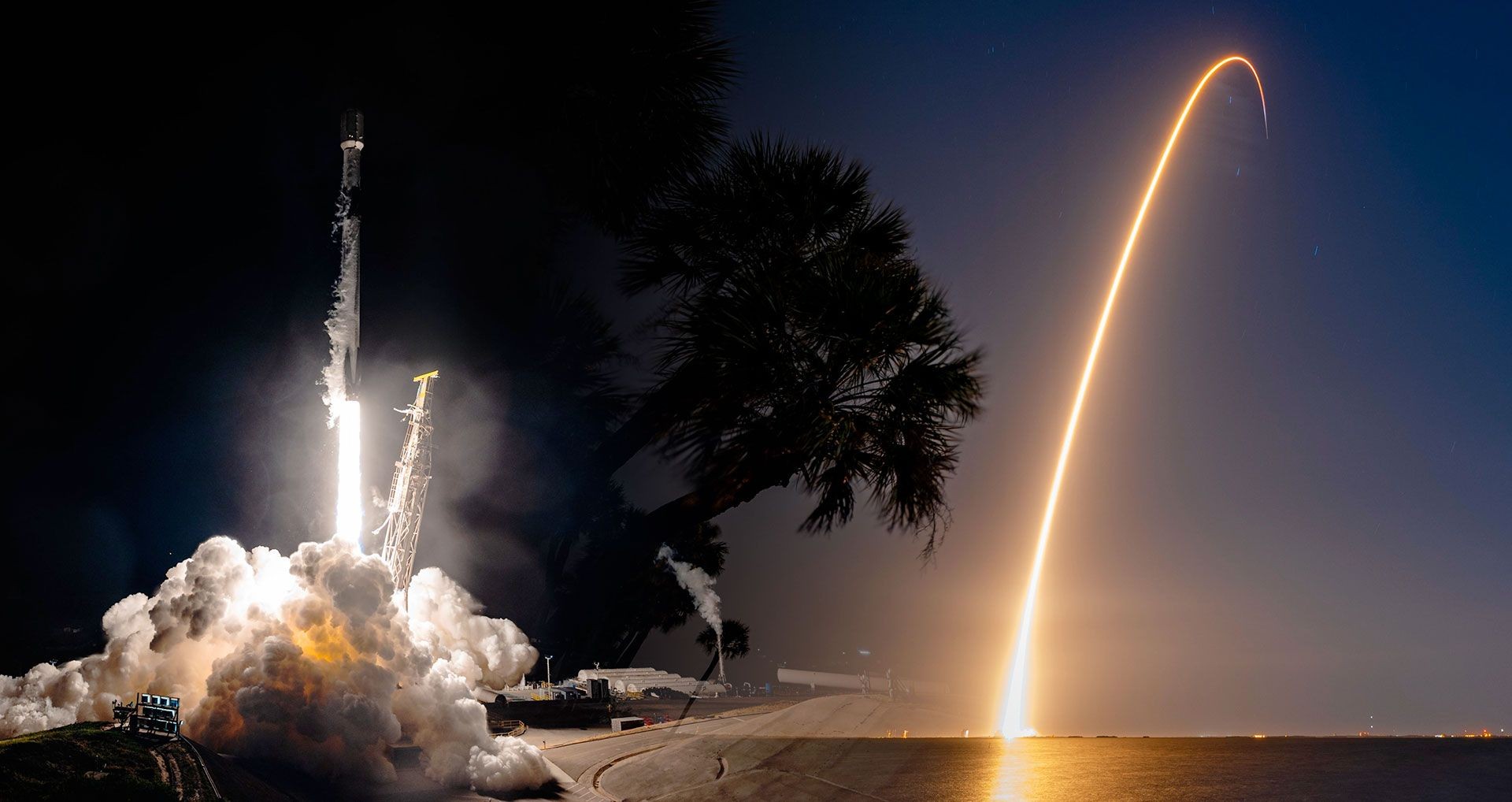
SpaceX accelerated its deployment of the Starlink internet constellation this weekend with two successful launches from both coasts of the United States. The company launched 25 satellites from California and 29 from Florida within a span of just over 12 hours, significantly increasing its presence in low Earth orbit (LEO).
Bicoastal Deployment Strategy
The first launch took place on March 1 at 5:10 AM EST (1010 GMT) from Vandenberg Space Force Base in California, deploying 25 satellites from Group 17-23. Later that day, at 9:56 PM EST (0256 GMT on March 2), another Falcon 9 rocket lifted off from Cape Canaveral Space Force Station in Florida, carrying 29 satellites (Group 10-41). This coordinated effort highlights SpaceX’s increasing operational efficiency and capacity for rapid constellation expansion.
Reusable Rocket Technology in Action
Both first-stage boosters were successfully recovered, demonstrating the maturity of SpaceX’s reusable rocket technology. Booster 1082 completed its 20th flight, landing on the droneship “Of Course I Still Love You” in the Pacific Ocean. Meanwhile, Booster 1078 concluded its 26th launch, touching down on the deck of “Just Read the Instructions” in the Atlantic. This reuse capability drastically lowers the cost of space access.
Growing Starlink Network
With these launches, the total number of Starlink satellites in orbit now exceeds 9,900, according to satellite tracker Jonathan McDowell. This brings SpaceX closer to its goal of providing global high-speed internet coverage, particularly in underserved areas. Sunday’s Florida launch marked SpaceX’s 27th mission this year and its 620th overall mission in company history.
The rapid pace of Starlink deployment underscores SpaceX’s dominance in the commercial space sector and its commitment to building out a massive orbital infrastructure for global connectivity.
The continued expansion of Starlink raises questions about long-term sustainability in LEO, as the growing number of satellites increases the risk of collisions and space debris. However, SpaceX maintains its focus on responsible space operations and is actively developing technologies to mitigate these risks.
SpaceX continues to refine its launch cadence, proving its ability to execute multiple missions in rapid succession. This latest pair of launches serves as a clear example of the company’s growing capabilities and its ambition to reshape the future of space-based internet access.