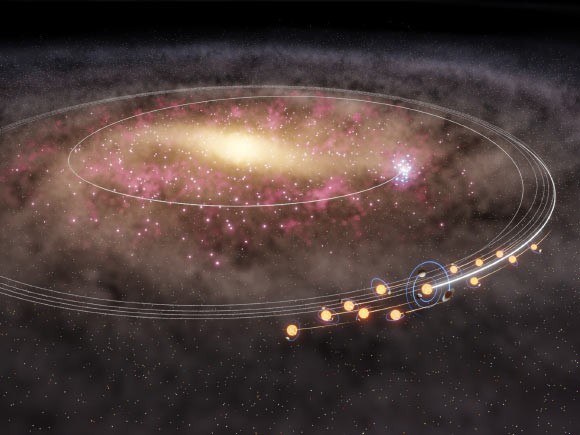
Astronomers have uncovered compelling evidence that our Sun, along with thousands of other stars, embarked on a significant outward journey from the Milky Way’s crowded core roughly 4 to 6 billion years ago. The research, leveraging data from the European Space Agency’s (ESA) Gaia mission, provides fresh insights into the formation of the galaxy’s central bar structure and the early history of our solar system.
The Sun’s Distant Past
For years, scientists have known that the Sun wasn’t always where it is today. Approximately 4.6 billion years ago, it formed over 10,000 light-years closer to the galactic center than its current position. This fact, while established, presented a puzzle: the galactic bar—a dense concentration of stars at the Milky Way’s core—typically traps stars in its orbit, making such large-scale migrations unlikely.
A Catalog of Solar Twins
To solve this mystery, a team led by Daisuke Taniguchi of Tokyo Metropolitan University compiled an unprecedented catalog of “solar twins”—stars with nearly identical properties to our Sun (temperature, gravity, chemical composition). Using the Gaia satellite’s data on 2 billion stars, they identified 6,594 such twins—a dataset 30 times larger than previous surveys.
The Migration Pattern
By analyzing the ages of these solar twins, the astronomers found a striking concentration of stars between 4 and 6 billion years old, all located at roughly the same distance from the galactic center as our Sun. This suggests that the Sun didn’t drift outward randomly; it was part of a coordinated exodus.
Implications for Galactic Evolution
The findings imply that the Milky Way’s central bar hadn’t fully formed when this stellar migration occurred. The bar’s “corotation barrier” would have prevented such a mass movement if already in place, so its formation must have been delayed. This research provides a new timeframe for the bar’s evolution, linking it directly to the Sun’s journey.
The galactic center is a harsh environment for life’s development. Our findings suggest that the Sun’s migration played a role in positioning our solar system in a region conducive to the emergence of organisms.
The study underscores how galactic archaeology—tracing the histories of stars—can illuminate the evolution of entire galaxies. By understanding the movements of stars like our Sun, we gain a deeper understanding of how habitable zones emerge, and how conditions may have favored life’s development on Earth.
This research, published March 12, 2026, in Astronomy & Astrophysics, marks a significant step forward in unraveling the Milky Way’s past and our place within it.