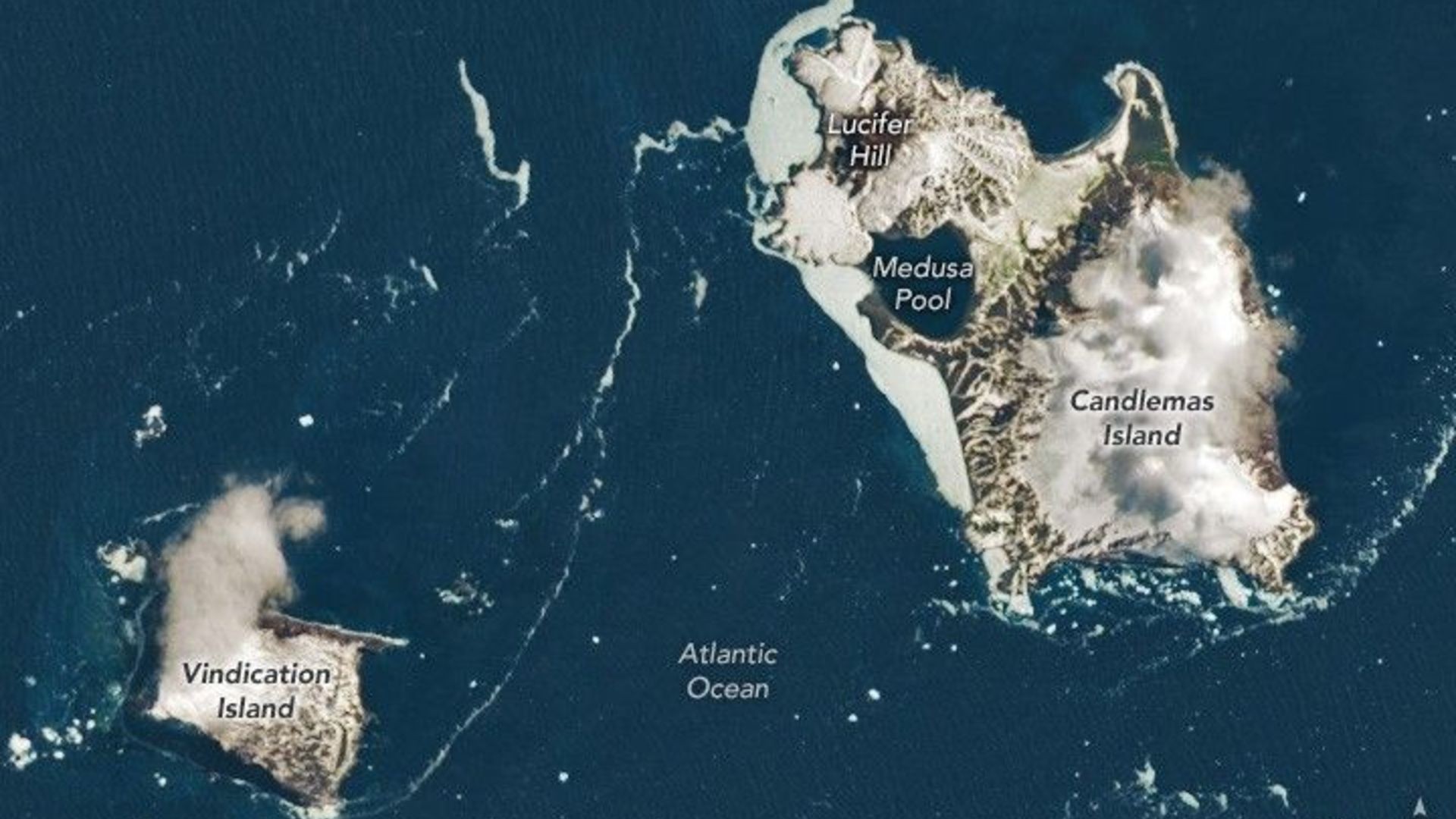
The South Sandwich Islands, a volcanic archipelago in the stormy South Atlantic, remain one of Earth’s most isolated and rarely observed regions. A recent satellite image captured by NASA’s Landsat 9 reveals a clear view of Vindication and Candlemas Islands—a rarity given the persistent cloud cover that typically obscures these remote lands.
The Challenge of Observation
These islands, located over 994 miles (1,600 kilometers) from both South America and Antarctica, have been historically difficult to study. First reported by Captain James Cook in 1775, the South Sandwich Islands remain largely inaccessible due to harsh weather, treacherous seas, and near-constant cloud cover. As a result, satellites are the primary tool for scientists monitoring volcanic activity, glacial changes, erosion patterns, and atmospheric behavior in this uniquely undisturbed environment.
Key Features Revealed
The satellite image showcases distinct features of Candlemas Island, including Lucifer Hill and Medusa Pool. The island itself demonstrates a fascinating geological history. Its southeastern side features an older, heavily eroded stratovolcano covered in ice, while the northwestern portion displays younger lava flows from cinder cones like Lucifer Hill. Historical records indicate volcanic activity as recently as the 20th century, suggesting a long-standing interplay between geothermal heat and glacial ice.
The Power of Erosion
Vindication Island provides a stark contrast, showing no evidence of recent volcanism. Instead, its steep cliffs and shrinking landmass demonstrate the relentless power of erosion from waves, freezing temperatures, and intense storms. This highlights how volcanic landscapes slowly succumb to natural forces once tectonic activity wanes.
Atmospheric Insights
The image also offers clues about the region’s atmospheric conditions. The South Sandwich Islands are known for generating striking wave clouds, formed when strong winds are forced upward by steep terrain. These patterns visible from space provide valuable data for weather and climate studies in this remote oceanic environment.
The ability to observe these islands through satellite imagery is essential because direct observation remains difficult. This data helps scientists understand how volcanic islands evolve in extreme climates and how natural forces reshape them over time.
This rare glimpse into one of Earth’s most isolated regions underscores the importance of satellite technology in studying our planet’s least accessible environments.