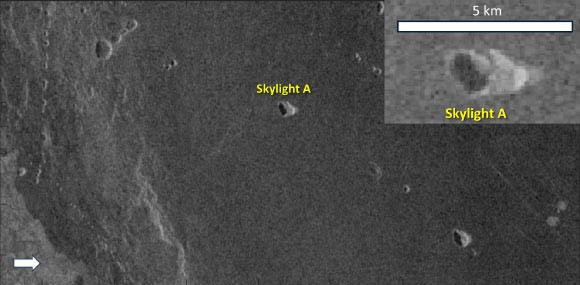
New analysis of archival radar data confirms the existence of a vast underground lava tube on Venus, located beneath the Nyx Mons region. The discovery, made using data from NASA’s Magellan spacecraft, marks the first direct evidence of subsurface voids on Earth’s sister planet.
What are Lava Tubes?
Lava tubes form when low-viscosity lava flows cool and crust over, creating natural tunnels beneath the surface. This process has been observed on Earth, Mars, and the Moon, but remained unconfirmed on Venus until now. The Venusian environment, with its extreme temperatures and pressures, makes direct observation challenging, which is why this radar-based discovery is significant.
Key Findings from the Magellan Data
Researchers led by Professor Lorenzo Bruzzone from the University of Trento re-examined Synthetic Aperture Radar (SAR) images captured between 1990 and 1992. Using advanced imaging techniques to detect subsurface conduits near surface collapses (skylights), they identified a massive cavity near Nyx Mons.
The tube is estimated to have:
- A diameter of approximately 1 kilometer (0.62 miles)
- A roof thickness of at least 150 meters (492 feet)
- An empty void height of at least 375 meters (1,230 feet)
- An observed extension of at least 300 meters (984 feet) from the skylight
Based on surrounding terrain and similar pits, scientists believe the tube could extend for at least 45 kilometers (28 miles). The study confirms that these conduits are not just theoretical constructs but real geological features.
Why This Matters for Venus Exploration
The discovery validates long-held theories about Venusian volcanic processes. More importantly, it has direct implications for future missions, such as ESA’s Envision and NASA’s Veritas. These spacecraft will carry advanced radar systems capable of penetrating the surface, enabling detailed mapping of additional lava tubes.
“Our discovery represents only the beginning of a long and fascinating research activity,” said Professor Bruzzone.
Envision’s orbital ground-penetrating radar (Subsurface Radar Sounder) will be especially crucial, as it can detect voids even without surface openings. Lava tubes could provide shelter from Venus’ harsh surface conditions, making them potential targets for future robotic or even human exploration.
The research, published in Nature Communications, highlights the value of revisiting existing data with new analytical methods. The confirmation of a large subsurface cavity on Venus demonstrates that Earth’s twin planet still holds many secrets waiting to be uncovered.
The study’s findings were published today in the journal Nature Communications. (L. Carrer et al. 2026. Radar-based observation of a lava tube on Venus. Nat Commun 17, 1147; doi: 10.1038/s41467-026-68643-6)