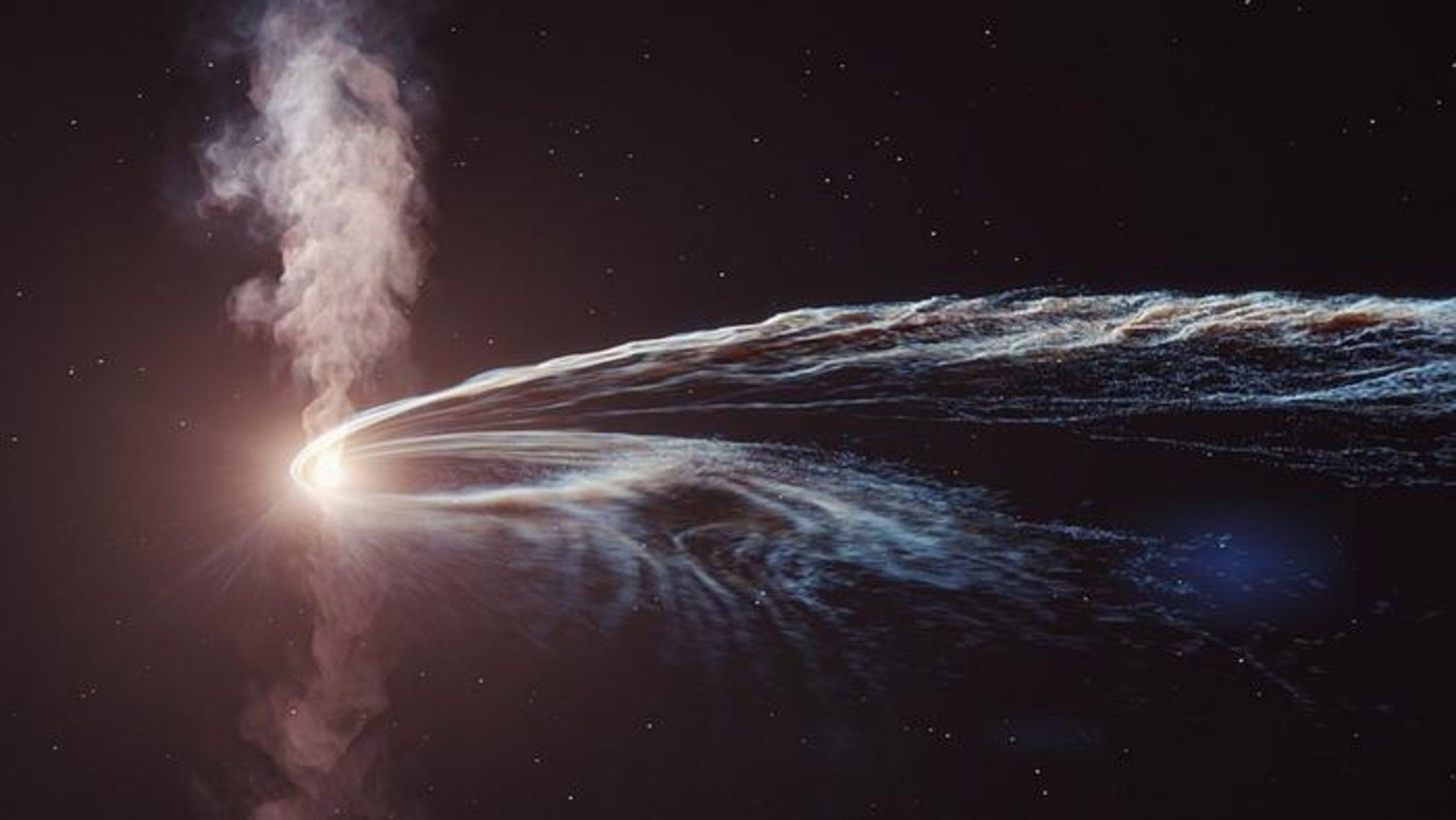
Astronomers have observed a supermassive black hole ejecting a jet of energy so immense that it rivals the destructive power of the fictional Death Star laser from Star Wars. This unprecedented event, cataloged as AT2018hyz, originated from a star torn apart by a black hole 665 million light-years away and continues to intensify years after its initial disruption.
The Unfolding Catastrophe
The phenomenon began in 2018 with a typical tidal disruption event (TDE) – where a star wanders too close to a black hole and is shredded by extreme gravitational forces. Initially, nothing remarkable occurred. However, in 2022, AT2018hyz erupted with intense radio waves, signaling a powerful relativistic jet.
Relativistic jets are rare among TDEs, accounting for only about 1% of observed cases. The other 99% involve slower, spherical outflows. The energy released by this jet is estimated to be between one trillion and 100 trillion times greater than that of the Death Star, according to fan estimates.
Why This Matters
This event is significant because it challenges existing models of black hole activity. TDEs usually fade quickly, but AT2018hyz has been steadily growing brighter, indicating an ongoing, sustained release of energy. The jet is currently 50 times more luminous than it was upon initial detection, and scientists predict it will peak in luminosity around 2027 before slowly declining.
The sustained output raises questions about how accretion disks form around black holes and how magnetic fields channel energy into such focused jets. This process remains poorly understood, as relativistic jets from TDEs are rarely observed.
How It Works
When a star approaches too closely, tidal forces stretch and tear it apart. Some material falls into the black hole, while the rest gets redirected by magnetic fields, forming a high-speed jet.
The jet’s luminosity is increasing as it broadens and aligns more directly with Earth’s line of sight. The reason for the delay between the initial disruption and the jet’s emergence remains unknown, but one hypothesis suggests that the shredded stellar material needed time to form an accretion disk before being ejected.
Future Research
Astronomers, including Yvette Cendes of the University of Oregon, are now searching for similar energetic events. The upcoming Square Kilometer Array (SKA) will provide the sensitivity needed to survey the radio sky and detect more of these powerful jets, both from TDEs and from other active galaxies.
“We anticipate that it will be about twice as luminous at the peak than what it is now.” – Yvette Cendes
This discovery highlights how little we still understand about the extreme physics governing black holes and their interactions with surrounding matter. The ongoing observations of AT2018hyz will provide invaluable data for refining our models and unraveling the mysteries of the cosmos.