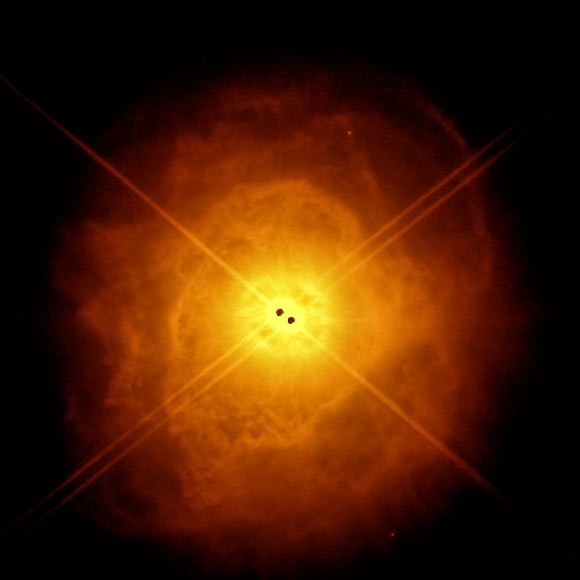
The European Southern Observatory’s Very Large Telescope (VLT) has delivered a groundbreaking image of the AFGL 4106 stellar system, revealing the chaotic yet beautiful final stages of two massive stars. This binary system offers a unique glimpse into how stars shed their mass before collapsing into nebulae, the raw material for future star formation.
Stellar Evolution in Action
AFGL 4106 consists of two stars at different points in their death throes. One star has already expelled significant amounts of gas and dust, forming a dense surrounding envelope. The other is in a more advanced stage of collapse. This process, while destructive for the stars themselves, is critical for galactic evolution. Stars don’t simply vanish; they recycle their material back into the cosmos.
The VLT’s SPHERE instrument, designed to observe faint objects near bright stars, overcame the challenge of extreme light contrast. This allowed astronomers to map the ejected debris and precisely characterize the dying stars for the first time. The images show the stars themselves appearing as black voids—a consequence of their overwhelming brightness saturating the detector.
Companion Star’s Influence
The shape of the nebula surrounding AFGL 4106 is far from symmetrical. The presence of a companion star significantly distorts the gas ejection, pushing clouds of dust and gas away from a perfectly spherical form. This interaction demonstrates how binary systems can dramatically alter the evolution of dying stars. The companion star’s gravity and radiation pressure sculpt the nebula, creating unique and asymmetrical structures.
The research team, led by Dr. Gabriel Tomassini, used SPHERE’s ability to correct atmospheric turbulence, producing exceptionally sharp images. Their analysis constrains the physical properties and evolutionary status of the system.
Implications for Stellar Evolution
This study contributes to our understanding of mass-loss processes in massive binaries and how nebulae around evolved stars are shaped. The findings appear in the journal Astronomy & Astrophysics, providing detailed insights into the final moments of massive stars.
These observations show that stellar death is rarely a solitary event; interactions with companion stars play a crucial role in shaping the remnants and influencing future star formation.
The VLT’s continued observations promise further revelations about the complex interplay of forces that govern stellar evolution and the cycle of matter in the universe.