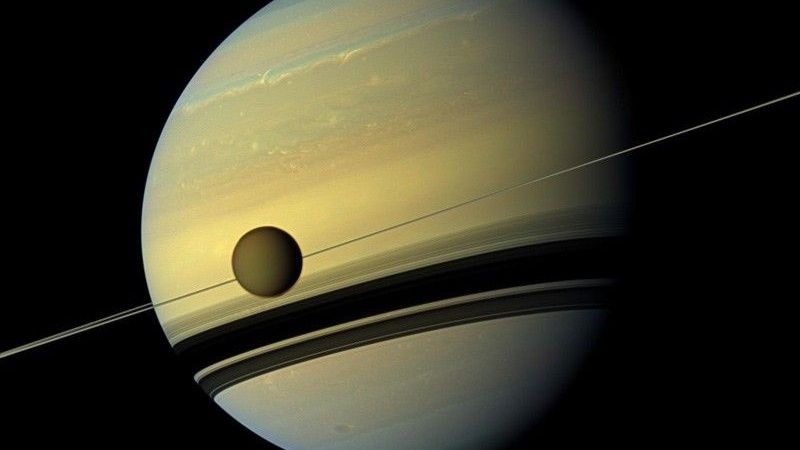
For decades, scientists have puzzled over the origin of Saturn’s spectacular rings and the unusual characteristics of its moons. Now, a compelling new theory suggests that a colossal collision – a merging of two moons – triggered a cascade of events that shaped the Saturnian system as we know it today. The key lies in a moon that may have once existed, named Chrysalis, and its violent encounter with Titan, Saturn’s largest moon.
The Mystery of Saturn’s Rings and Moons
Saturn’s rings are an anomaly; they are remarkably young at approximately 100 million years old, yet their formation has remained stubbornly unclear. The system is also populated by peculiar moons: Titan, the only moon in our solar system with a dense atmosphere; Hyperion, a chaotic, porous body; and Iapetus, with its strangely divided hemispheres and highly inclined orbit. These anomalies all seem linked, suggesting a shared origin.
The Role of Saturn’s Wobble and Internal Mass
The clue came from precise measurements of Saturn’s internal mass distribution made by the Cassini mission. These measurements revealed a slight concentration of mass in the planet’s core, causing Saturn to wobble in a way that doesn’t quite align with gravitational interactions with Neptune. This wobble, or precession, is key to understanding the system’s history.
The Chrysalis Hypothesis: A Collision with Consequences
Scientists initially proposed a lost moon, Chrysalis, was torn apart by Saturn’s gravity around 100 million years ago, forming the rings. Simulations, however, showed that Chrysalis rarely disintegrated cleanly; instead, it almost always collided with Titan. This collision, rather than disproving the theory, opened a new line of inquiry.
Titan and Hyperion: A Gravitational Lock
Titan and Hyperion are locked in a 4:3 orbital resonance, meaning Titan completes four orbits for every three of Hyperion’s. This lock is young, only a few hundred million years old, coinciding with the estimated timeframe of the Chrysalis event. The team suggests that Chrysalis didn’t just disappear; it merged with Titan.
The Collision’s Aftermath: Reshaping the System
The impact would have wiped Titan’s surface clean, explaining its lack of craters. The collision would also have released atmospheric gases from Titan’s interior and forced Titan into a wider, more elliptical orbit, which destabilized other moons, causing further collisions and ultimately contributing to the formation of Saturn’s rings. Iapetus’s high orbital inclination is another consequence of this chaotic period.
The Future of the Theory: Dragonfly’s Search for Evidence
Currently, this remains a hypothesis. But NASA’s upcoming Dragonfly mission to Titan, launching in 2028, could provide the first concrete evidence. By analyzing Titan’s surface composition and searching for signs of a recent upheaval, Dragonfly may confirm that a catastrophic collision indeed reshaped the Saturnian system.
In conclusion, the theory linking a lost moon’s collision with Titan to the formation of Saturn’s rings and the peculiar characteristics of its moons offers a compelling, unified explanation for a long-standing mystery. Further missions will determine if this violent past is, in fact, Saturn’s true history.