


Forget the giants burrowing under the desert floor. Not every sand-dwelling predator needs to be massive to be dangerous. Small, segmented worms like the king ragworm (Alitta virens ) thrive in wet sand. Larval antlions dig funnel pits, burying themselves to wait for insects to slip in.
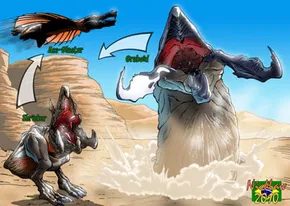
Graboids follow a similar logic, but with a twist. They undergo metamorphosis into drastically different forms.
The Nymph Stage: Graboid Shooters
Graboid eggs can lie dormant in the Earth for years. Eventually, they hatch into an immature stage called a nymph. This stage is known as a shooter.
Shooters look like smaller versions of the larval graboid. They are compact. They are fast. They can launch themselves out of the ground to catch prey.
Shooters develop quickly into full-sized larval graboids. But that is not the end of their evolution. The larval form matures into a cluster of three to 12 bipedal shriekers.
This is where biology gets weird. No other terrestrial organism develops from a single larva into multiple adults. It is a one-to-many transformation.
From Mollusk to Bird-Like Hunter
Larval graboid morphology looks like an invertebrate mollusk. Shriekers look like birds.
Mollusks usually don’t have legs. Two species of tropical octopus do walk bipedally. The coconut octopus (Amphioctopus marginatus ) wraps six tentacles around its body. It uses the remaining two to tiptoe across the seafloor.
The shrieker takes this extreme much further.
Shriekers rarely exceed 3 feet (91 centimeters) tall. They make up for their small size by hunting in organized packs. Their heads resemble subterranean graboids. They have a single prehensile tongue. They unfold a frilly, heat-sensing organ from their heads to identify prey.
Asexual Reproduction: Vomiting Offspring
Shriekers cannot lay eggs. They reproduce asexually.
When a shrieker is well-fed, it vomits up a fetus. This fetus matures rapidly. This ability explains how a single larval graboid spawns more than a dozen shriekers. The larva begins asexual reproduction before it even emerges from its husk. The number of offspring depends on nourishment.
This sounds alien. It sounds gross.
Consider the parasitic mite Acarophenax tribolii. Its offspring reach sexual maturity before birth. The male fertilizes his sisters while they are still inside the mother’s bloated body. He then dies. The sisters develop inside her until she bursts.
The shrieker is not unique in its extremity. It is just more visible. And hungry.


