


The hype surrounding drones has dominated the headlines for years. But the next frontier is not in the sky. It’s underwater.
Türk teknolojisi has just reached a significant milestone by producing its own unmanned underwater vehicle (UUV). The project, known by the acronym IDA, is causing ripples around the world. This is not an imported product. All built by Turkish engineers.
Global Teknik A.Ş. is a company specializing in unmanned systems and a leader in this field. They designed and built IDA from the ground up. line by line of code. Every part of the hull. 100% domestic technology.
Payment? About $3 million.
This number may seem large. But when you break down the value of sovereign capability, the price tag tells a different story. We don’t just make robots. This is about restoring strategic autonomy in key hullping areas.
Why IDA matters
Most people think of a drone as a quadcopter with a camera attached. They’re wrong. The underwater world is complex. High pressure. Saline corrosion. Communication is limited.
IDA meets these challenges with a fully integrated system. Both hardware and software are developed in-house. There is no dependence on foreign countries. This is critical for national security and industrial independence.
“IDA’s design and software are completely Turkish technology.”
This is not just a technical achievement. This is a geopolitical statement. Countries that rely on foreign UUVs face supply chain risks. There is a risk that your system will be disabled or monitored. IDA removes this vulnerability.
Breaking the Monopoly
For many years, the market for advanced unmanned marine systems has been dominated by a few Western countries. The development of these systems requires expertise in hydrodynamics, propulsion and artificial intelligence-based navigation.
Global Teknik A.Ş. This threshold has been exceeded. They proved that mid-sized nation can compete with the best. The $3 million investment goes beyond materials. This is for research and development purposes. For talent. For infrastructure.
This development signals change. We are moving away from a world where underwater surveillance was the exclusive domain of navies. Allowing more countries to project power and collect data without asking for permission.
The technology is ready. Engineers are already in place. The question now is how the rest of the world will react.
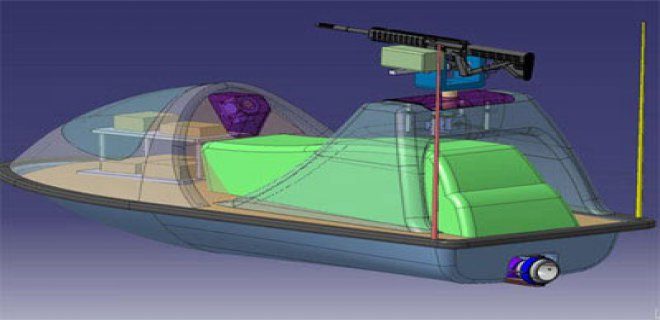
TÜBITAK strongly supports the IDA project, and its goal is to ensure maritime safety without endangering the crew. It works primarily through a satellite link, so it can be controlled remotely from anywhere in the world. However, it is not completely independent in a vacuum. The craft includes a compartment for one person. This hybrid approach means operators are physically in control when the situation becomes critical or complex.
This vessel is equipped with a series of sensors and tools. It is equipped with a radar system for surface detection. It is equipped with an underwater camera that allows you to observe the underwater situation. Also comes with a light machine gun. These features make it a versatile platform for monitoring and actions.
What really sets the IDA apart is its size and durability. The length of the vehicle is about 1 meter. Despite its small size, it is capable of continuous operation for 120 hours. It consumes 300 liters of fuel. This was done on 5 consecutive days. For a single operator or remote team, this durability is a game changer for long-duration patrols.
IDA Why unmanned maritime vehicles are important for coastal defense
Most people think of driverless cars as drones in the sky. Water is a different creature. Salt, waves and limited communication routes make surface operations hard. IDA directly responds to these challenges. By using a satellite connection, it avoids the range limitations of traditional radio control. This means that the Istanbul base can direct ships from the coast of Antalya and further into the Aegean Sea.
Using a human pilot inside the fuselage is a smart compromise. Fully autonomous AI can be forced to make sensitive decisions. Humans can react to unexpected threats in ways that code cannot. Using this option inside a durable, waterproof capsule adds a level of reliability that a clean remote does not have.
Undistinguished main specifications
When we take a look at insansız deniz ağılının çışılışırınınının dızılışının** (unmanned marine vehicle detailed features), the numbers tell a clear story. It’s not just a toy or a prototype. It is a functional tool.
–Length: Approx. 1 meter.
– Fuel volume: 300 liters.
– Active endurance: 120 hours (5 days).
– Control method: Satellite linked remote command with manual override function.
– Crew capacity: 1 person (for emergencies).
– Sensors: Radar and underwater cameras.
– Weapon: Light machine gun.
This configuration suggests a combined intelligence, surveillance and armed action role. It is not suitable for deep sea exploration where silence is important. Designed for visible presence and quick response.
The real impact of satellite surveillance of maritime assets
Why is this important to the common man? Maritime security affects trade routes, fishing rights and the integrity of borders. Illegal activity often takes place far from shore, and the Coast Guard is slow to respond. Self-driving cars that can linger for five days and carry out attacks or surveillance will quickly change the calculus of those operating in the gray zone.
It can be launched from any port and controlled via satellite, eliminating geographical barriers. Your own motherboard is not required. No complex land-based infrastructure is required. This technique reduces the distance between decisions and actions.

An unsinkable drone that works for 5 days
Most autonomous surface vehicles (ASVs) are designed for confined water or short-term missions. This breaks the mold. We are looking for a vessel 4.5m long, 1.24m wide, with a maximum speed of 30 knots. That is fast. This speed changes everything in unmanned craft. That is, how quickly you reach a goal or explore an area.
Weight? It’s only 300kg. Light enough to be used from standard ships or land vehicles, yet heavy enough to withstand rough seas. The secret to maneuverability lies in the “water jet” propulsion system. Unlike traditional propellers, which can get stuck in debris or tangled in seaweed, waterjets suck in water and spray it out. It is cleaner. Quieter. Mechanical failures are less likely to occur in a cluttered environment.
Remote control
You can access this platform from anywhere on the planet. The system relies on satellite communications for command and control. It’s not just about steering. It’s about sending complex tasks to robots on the other side of the world.
But how far can we push it? With the help of the vehicle’s antenna system, you can extend the control range to 50 km. In many Coast Guard and River Patrol scenarios, this radius covers a large area. Even if the satellite connection is lost, the craft will not disappear. Includes an autopilot that allows you to return to the exact GPS coordinates you were at when first deployed.
“Even if a big wave hits you, you can continue your mission without falling.”
This stability is no accident. specialized hull design allows the drone to stay upright and operate even when swept away by large waves. You don’t have to worry about capsized unit turning into floating debris or safety liability.
Sensors and field of view
What’s the point of speed if you can’t see it? The platform is equipped with a series of sensors that turn it into a floating smart node.
* Radar Used to detect large ships.
* SONAR Used for mapping the seabed and locating underwater objects.
* Underwater Camera Visual confirmation.
* The Robot Arm is used for physical operations such as collecting samples and cutting mooring ropes.
Collect all kinds of data, visual images and analytics in real time. Whether it’s monitoring coastlines, inspecting underwater infrastructure, or searching for specific targets, the data pipeline is open.
Durability
Distance anxiety is a big problem for many Drones. Not this one. ASV has a fuel capacity of 300 liters and can operate for 120 hours. This is equivalent to five full days of continuous work. In a world where durability is often limited by battery life, this fuel-based autonomy offers significant advantages for long-term surveillance and deep-water search operations.
Works in all weather conditions. It does not ground it in rain, wind or fog. It operates in both marine environments and inland waters, making it versatile in environments such as river deltass, river deltass and the open sea.


