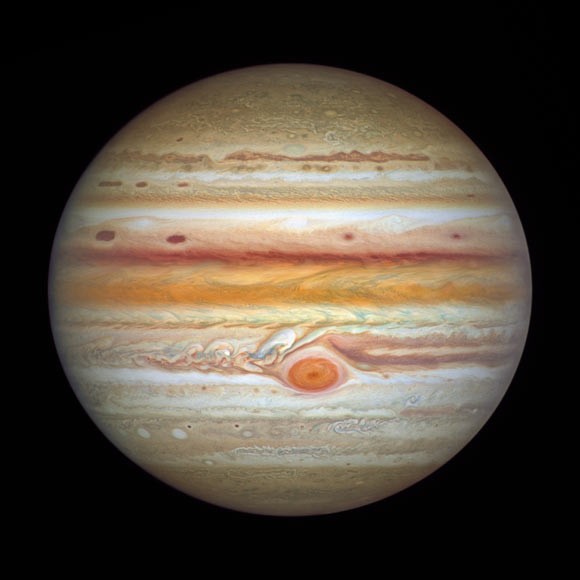
For half a century, our understanding of Jupiter’s size has relied on data from the Voyager and Pioneer missions. But thanks to NASA’s Juno spacecraft, planetary scientists have produced the most precise measurements of the Solar System’s largest planet to date. The results? Jupiter is slimmer and flatter than previously believed.
While the physical planet hasn’t shrunk, our ability to measure it has improved dramatically. This refinement isn’t just a matter of academic precision; it resolves decades-long discrepancies in our models of Jupiter’s interior, offering a clearer window into the depths of this gas giant.
Why the Old Numbers Were Off
Until now, the standard figures for Jupiter’s dimensions were derived from just six radio measurements taken nearly 50 years ago by the Voyager and Pioneer missions. While these early missions laid the groundwork, their data was limited.
The new study leverages 26 high-precision measurements from Juno, providing a much more robust dataset.
“Juno’s passing behind Jupiter provides an opportunity for new science objectives,” said Dr. Scott Bolton, Juno’s principal investigator at Southwest Research Institute. “When the spacecraft passes behind the planet, its radio communication signal is blocked and bent by Jupiter’s atmosphere. This enables an accurate measurement of Jupiter’s size.”
By tracking how these radio signals bend as they traverse Jupiter’s atmosphere, researchers could create detailed maps of the planet’s temperature and density. This method allowed them to translate atmospheric data into a highly accurate picture of Jupiter’s physical shape.
The New Measurements
The team, led by researchers at the Weizmann Institute of Science, found that Jupiter’s dimensions are smaller than textbook estimates across the board:
- Polar Radius: 66,842 km (12 km smaller than previous estimates)
- Equatorial Radius: 71,488 km (4 km smaller than previous estimates)
- Mean Radius: 69,886 km (8 km smaller than previous estimates)
Professor Yohai Kaspi of the Weizmann Institute noted that while knowing the distance to Jupiter and observing its rotation gives a general idea of its size, true accuracy requires sophisticated analysis of atmospheric interference.
Solving the Mystery of Jupiter’s Interior
Why do these few kilometers matter? Because they bridge a critical gap in planetary science.
For years, models of Jupiter’s interior struggled to reconcile gravity data with atmospheric measurements. The discrepancy often stemmed from earlier calculations failing to fully account for Jupiter’s powerful zonal winds and deep atmospheric dynamics.
“These few kilometers matter. Shifting the radius by just a little lets our models of Jupiter’s interior fit both the gravity data and atmospheric measurements much better,” explained Dr. Eli Galanti, a researcher at the Weizmann Institute.
By incorporating the effects of Jupiter’s intense winds into their calculations, the scientists resolved discrepancies that had lingered for decades. The refined shape allows state-of-the-art models of Jupiter’s internal density structure to align perfectly with observational data.
A Clearer View Beneath the Clouds
Jupiter is a world of extreme weather, with winds that can reach supersonic speeds and hurricanes larger than Earth. Understanding its shape helps scientists understand these forces.
“It’s difficult to see what’s happening beneath the clouds of Jupiter, but the radio data give us a window into the depth of Jupiter’s zonal winds and powerful hurricanes,” said Professor Kaspi.
This breakthrough doesn’t just update a number in a textbook; it enhances our fundamental understanding of how gas giants form and evolve. As Dr. Galanti noted, “Textbooks will need to be updated. The size of Jupiter hasn’t changed, of course, but the way we measure it has.”
The findings, published in Nature Astronomy, mark a significant step forward in planetary science, proving that even our most familiar celestial neighbors still hold secrets waiting to be uncovered with the right tools.
Source: E. Galanti et al. 2026. The size and shape of Jupiter. Nat Astron 10, 493-501; doi: 10.1038/s41550-026-02777-x