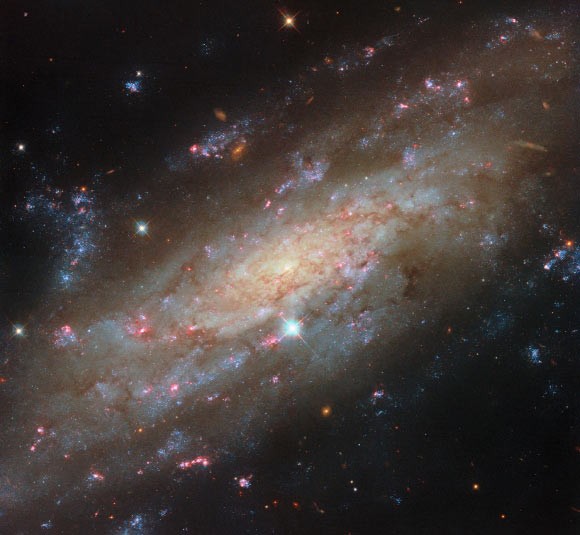
The NASA/ESA Hubble Space Telescope has captured a striking portrait of NGC 3137, a spiral galaxy located approximately 53 million light-years away in the constellation Antlia. While the image showcases the galaxy’s intricate structure and massive central black hole, its primary scientific value lies in its striking resemblance to our own cosmic neighborhood. NGC 3137 serves as a vital analog for understanding the dynamics of the Local Group, the cluster of galaxies that includes the Milky Way.
A Galaxy in High Definition
Discovered by English astronomer John Herschel on February 5, 1837, NGC 3137 (also known as LEDA 29530 or UGCA 203) spans an impressive 140,000 light-years in diameter. From Earth, the galaxy is viewed at a steep angle, offering a unique perspective on its “loose, feathery” spiral arms.
At the heart of NGC 3137 lies a supermassive black hole estimated to be 60 million times more massive than the Sun. This central engine is surrounded by a complex network of fine, dusty clouds. However, it is not the black hole that dominates the visual narrative of this image; rather, it is the galaxy’s prolific star formation activity.
“As stunning as each of these features may be, it’s the galaxy’s brilliant star clusters that steal the show.”
A Cradle for New Stars
The image, captured as part of the PHANGS (Physics at High Angular Resolution in Nearby Galaxies) program, highlights NGC 3137’s intense stellar life cycle. The galaxy is peppered with:
- Dense clusters of bright blue stars, indicating recent and vigorous star formation.
- Glowing red gas clouds, which mark the presence of hot, young stars still embedded within their birth nebulae.
These observations allow astronomers to trace stellar evolution in spiral galaxies, from the ancient stellar populations formed in the galaxy’s infancy to the newborn stars currently emerging from interstellar dust. By analyzing these clusters and their surrounding nebulae, researchers can accurately measure the ages of stars, providing a timeline of the galaxy’s development.
A Mirror to the Milky Way
The true significance of NGC 3137 extends beyond its beauty; it is a key piece in understanding our own galactic context. Astronomers have identified that NGC 3137 belongs to a group of galaxies—often referred to as the NGC 3175 group—that mirrors the structure of the Local Group, which contains our Milky Way and the Andromeda Galaxy.
Both groups share a similar architectural blueprint:
1. Two Dominant Spirals: Just as the Local Group is anchored by the Milky Way and Andromeda, the NGC 3175 group is dominated by two large spiral galaxies: NGC 3137 and its neighbor, NGC 3175.
2. Dwarf Companions: Both groups are surrounded by numerous smaller dwarf galaxies. While the exact count of these tiny companions in the NGC 3175 group remains uncertain, their presence reinforces the structural similarity.
Conclusion
By studying the interactions and evolution of NGC 3137 and its neighbors, astronomers gain critical insights into the gravitational dynamics and history of our own Galactic home. This galaxy acts as a cosmic laboratory, helping us decode the past and future of the Milky Way by observing a distant, yet remarkably similar, sibling.