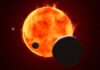
Astronomers have identified thousands of planets orbiting stars beyond our solar system, but billions more are believed to exist. The challenge lies in detecting and studying these exoplanets, which are incredibly distant and emit faint, often obscured, light signals. New research suggests that quantum computers could revolutionize this process, allowing for clearer images and potentially revealing molecular fingerprints of these distant worlds.
The Problem with Conventional Imaging
Current methods struggle to capture the weak light signals from exoplanets. These signals, after traveling vast cosmic distances, become diluted and drowned out by brighter starlight. Johannes Borregaard at Harvard University and his team realized this challenge might be akin to detecting just one photon for every second of telescope operation – an incredibly difficult task for classical computers.
How Quantum Computers Could Help
Quantum computers offer a unique advantage: they can store the quantum states of incoming photons and exploit quantum properties to extract information that would otherwise be lost. This means that blurry, indistinct images – or even single fuzzy dots representing exoplanets – could be transformed into sharper, more detailed depictions.
The proposed system involves two key components. First, light from an exoplanet would hit a quantum computing device constructed from specially engineered diamonds (already proven effective in storing photon states). Second, that quantum information would be relayed to a more powerful quantum computer, possibly built from extremely cold atoms, to run an algorithm designed for image reconstruction.
Significant Efficiency Gains
Calculations show that this quantum setup could achieve comparable image quality using just a fraction of the photons needed by traditional techniques – potentially reducing requirements by a factor of hundreds or even thousands. This makes it especially valuable when dealing with extremely faint light sources.
Challenges and Ongoing Research
While promising, implementing this system is no easy feat. Cosmo Lupo at the Polytechnic University of Bari notes that connecting and controlling the performance of both quantum computers is a complex hurdle. Borregaard acknowledges this, stating that his research group and others are actively working on solutions. The trend of leveraging quantum mechanics for space observation is already underway, with one scheme recently used to observe a star in the Canis Minor constellation.
“Photons obey the rules of quantum mechanics. Therefore, it is natural…to investigate quantum methods to detect and process light coming, for example, from exoplanets.” – Cosmo Lupo, Polytechnic University of Bari.
This research represents an important step toward a future where quantum computing could dramatically enhance our ability to explore and understand the universe beyond our solar system.