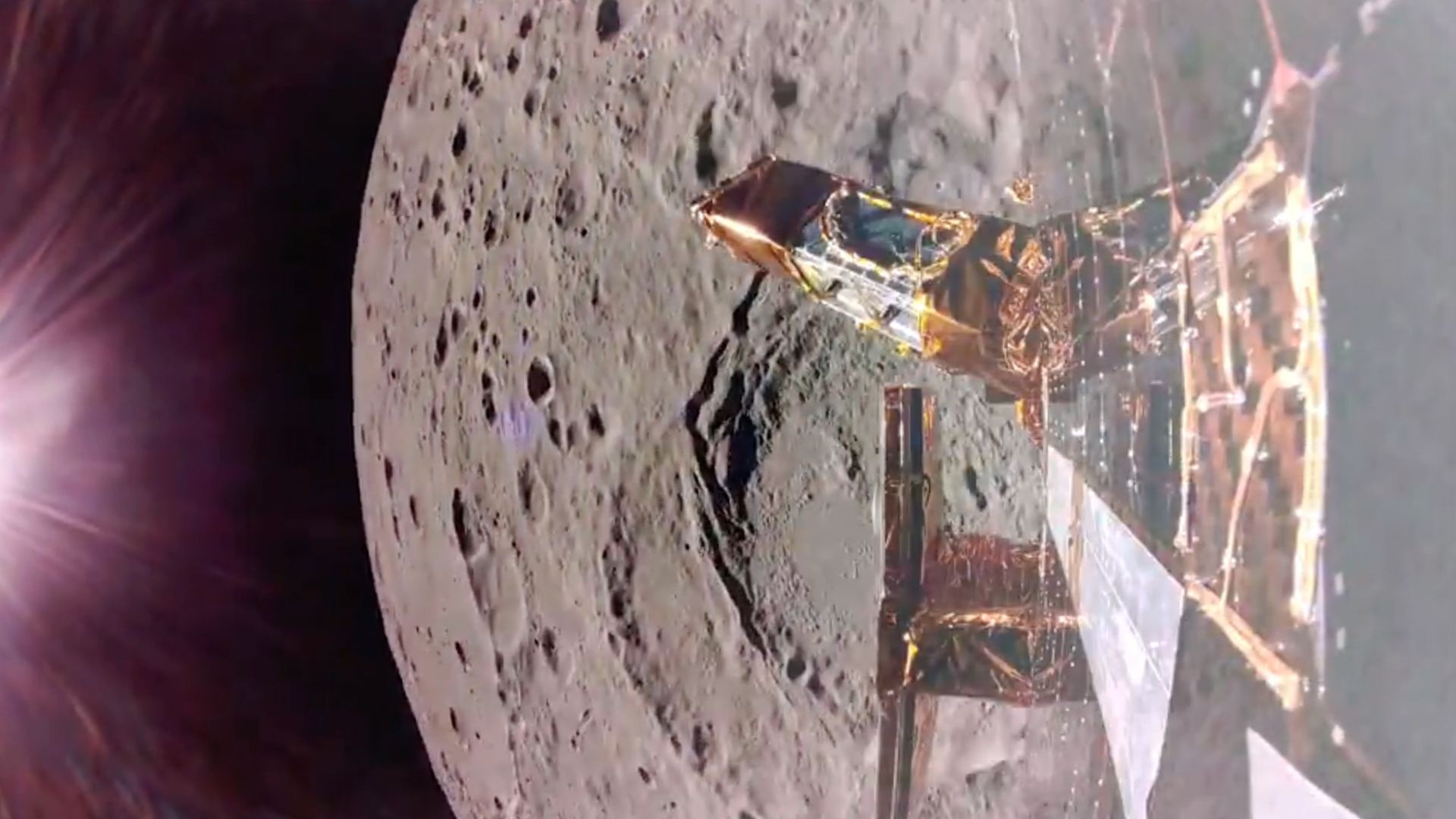
Recent findings from Firefly Aerospace’s Blue Ghost lunar lander are forcing scientists to re-evaluate long-held assumptions about the Moon’s thermal evolution. The private spacecraft, which operated on the lunar surface for two weeks in March 2025, provided the first independent data that questions the traditional model of a sharply divided Moon—one side hot, the other cool.
Challenging the “Hot Side” Narrative
For decades, the prevailing theory suggested that the Moon’s near side, facing Earth, was significantly warmer due to higher concentrations of heat-producing radioactive elements like thorium. These elements likely powered ancient volcanic activity, while the far side remained relatively cooler. However, Blue Ghost’s measurements from Mare Crisium, a volcanic plain outside the traditionally defined hot zone, revealed heat flow comparable to values from NASA’s Apollo missions.
This discovery suggests that heat-producing elements may be more evenly distributed beneath the lunar surface than previously believed. Researchers now propose that volcanic activity in some areas may have been driven not just by high element concentrations, but by thinner crusts allowing magma easier access to the surface.
A Simpler Approach to Data Collection
The Blue Ghost mission deliberately targeted a geologically “simpler” location—the center of Mare Crisium—to avoid the complexities of major impact basins where previous measurements (Apollo 15 and Apollo 17) were taken. The intent was to obtain clearer baseline data, but the mission faced challenges. LISTER, the lander’s heat probe, struggled to penetrate more than 36 inches into the dense lunar soil.
Despite limited depth, the measurements were enough to raise questions. The data does not support the assumption that heat is concentrated in a few regions, suggesting a broader distribution of radioactive materials.
What This Means for Future Lunar Exploration
Robert Grimm, a planetary geophysicist at the Southwest Research Institute, presented additional data from Blue Ghost’s Lunar Magnetotelluric Sounder (LMS). LMS readings support the idea that heat-producing elements are concentrated within the lunar crust, rather than deep underground.
This matters because it changes our understanding of how the Moon formed and evolved. If heat distribution is more uniform, it implies different volcanic processes than currently modeled. The Moon’s internal structure is critical for understanding planetary formation in general.
Scientists agree that more measurements are needed. A growing number of robotic missions are planned to explore the Moon’s interior in greater detail. These future missions will refine the models and provide a clearer picture of the Moon’s thermal history.
The Blue Ghost results are a clear reminder that we still have much to learn about our closest celestial neighbor. More data is crucial for settling the debate and refining our understanding of the Moon’s evolution.