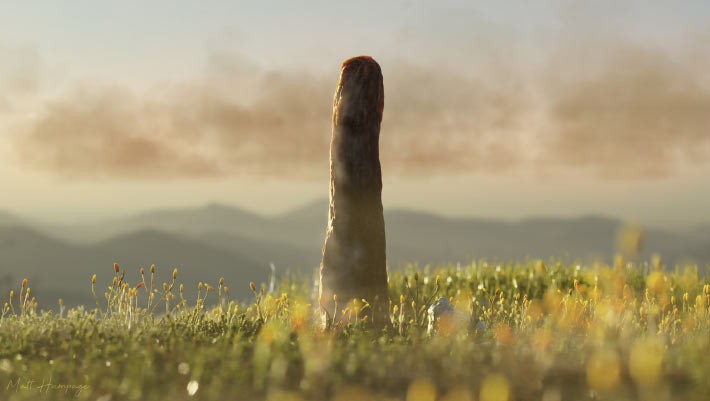
For over 165 years, scientists have debated the identity of Prototaxites, a colossal organism that dominated Earth’s earliest terrestrial landscapes long before the rise of trees. New research suggests this towering structure – reaching up to 8 meters (26 feet) in height – wasn’t a massive fungus, as previously believed, but belonged to a completely extinct and unique lineage of complex life. This discovery redefines our understanding of early terrestrial ecosystems and highlights how little we still know about life’s early experiments.
The Enigma of a Pre-Tree Giant
Prototaxites first appeared around 420 to 370 million years ago, during the Late Silurian and Devonian periods. These organisms were the first giants to colonize land, leaving behind imposing columnar fossils. Their ecological role seems clear – they were a significant part of the early land ecosystem, even being consumed by ancient arthropods. However, determining what they actually were has been a long-standing puzzle in paleontology.
The debate hinged on whether Prototaxites was a bizarre fungus or something entirely different. The sheer size and structure of the organism defied easy classification within known fungal groups. The question matters because it forces us to re-evaluate how life diversified on land. Were early terrestrial giants limited to a few evolutionary pathways, or were there many more experimental forms lost to time?
Breakthrough Analysis in the Rhynie Chert
The latest study, led by Dr. Corentin Loron and colleagues at the University of Edinburgh and National Museums Scotland, focused on Prototaxites taiti, a remarkably well-preserved specimen found in the 407-million-year-old Rhynie chert in Scotland. This site is extraordinary, preserving an ancient ecosystem in exceptional detail. The team employed advanced techniques – including microscopic imaging, infrared spectroscopy, and machine learning – to compare Prototaxites with other fossils from the same period.
Microscopic examination revealed an internal organization unlike anything seen in fungi. Prototaxites contained complex networks of tubes, including large, banded structures and unique spherical regions called medullary spots. These structures didn’t match any known fungal anatomy. Crucially, chemical analysis showed the absence of chitin – a key component of fungal cell walls. The team also failed to detect perylene, a pigment biomarker commonly found in fossil fungi.
Chemical and Structural Evidence Points to Extinction
The combined structural, chemical, and biomarker evidence decisively excludes Prototaxites from the fungal kingdom. The research team used machine learning to compare Prototaxites ‘ molecular fingerprint with that of plants, arthropods, bacteria, and fungi from the Rhynie chert. The results were unambiguous: Prototaxites was distinct from all of these groups.
As Dr. Sandy Hetherington put it, Prototaxites represents “life, but not as we now know it.” It wasn’t a fungus, nor a plant, nor anything else currently recognized in the fossil record. Instead, it appears to have been an independent evolutionary experiment in building large, complex organisms, a lineage lost to extinction.
The study concludes that Prototaxites occupied its own evolutionary branch, separate from any known group. This means early land ecosystems were more diverse and experimental than previously imagined, with life exploring multiple pathways toward gigantism before the familiar patterns of trees and modern organisms emerged.
Ultimately, this discovery underscores how much remains unknown about the early history of life on Earth, and how exceptional preservation is needed to reveal the full extent of past biodiversity.