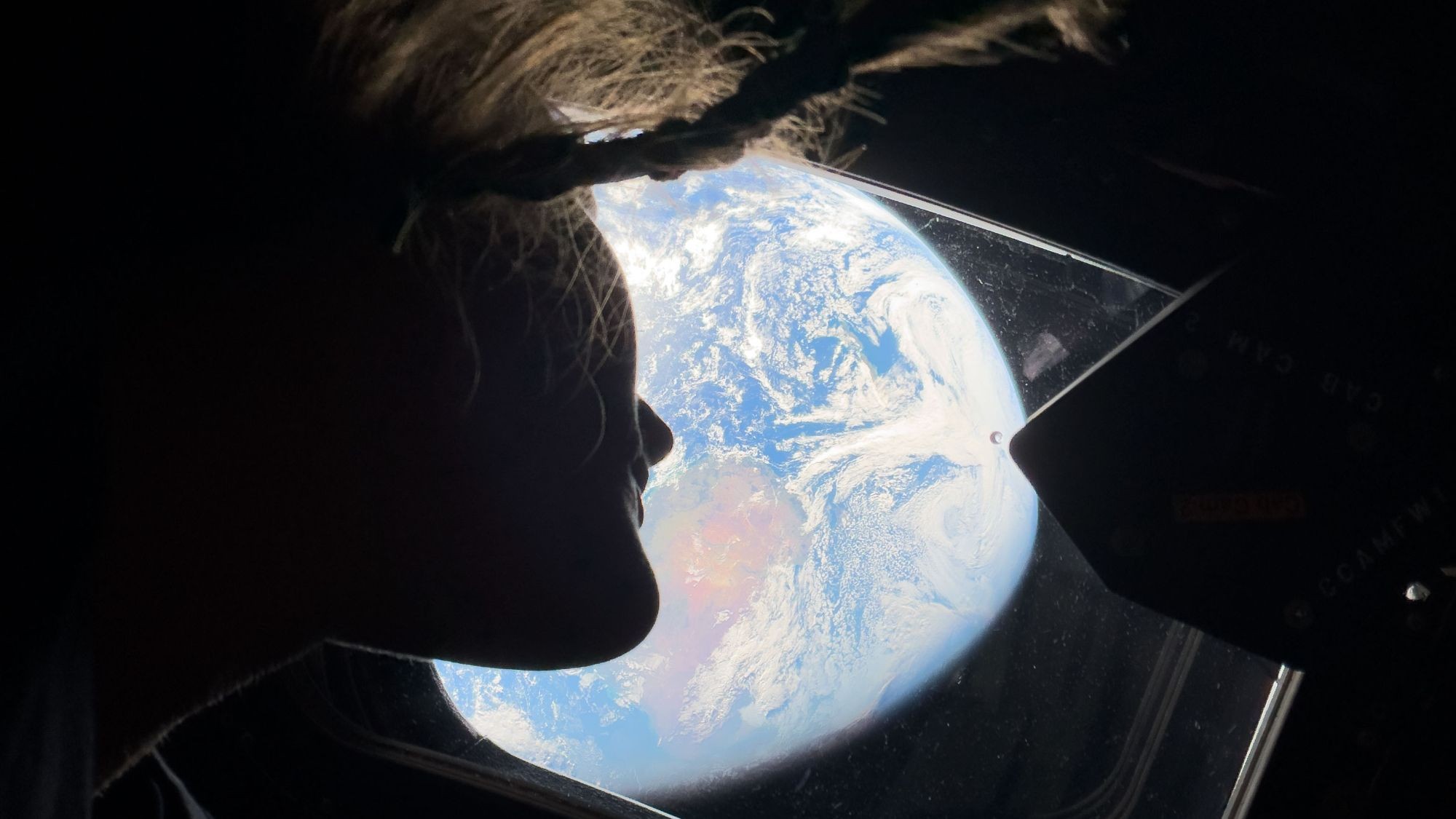
The Artemis 2 mission has just completed a historic milestone: its first crewed flyby of the moon. As the four-person crew prepares for their return to Earth, a recent communication between the Artemis astronauts and those aboard the International Space Station (ISS) revealed a profound shift in how humans perceive our home planet when viewed from the depths of space.
The “Overview Effect” Beyond Earth Orbit
During a 15-minute call on Tuesday, April 7, NASA astronaut Christina Koch shared her reflections on the mission’s recent lunar flyby. The conversation, which included ISS astronauts such as Jessica Meir, centered on a psychological phenomenon known as the “overview effect.”
For many astronauts, seeing Earth from the ISS—a view of specific continents, weather patterns, and human landmarks—is life-changing. However, Koch noted that moving much further away changed her perspective entirely.
“The thing that changed for me looking back at Earth was that I found myself noticing not only the beauty of the Earth, but how much blackness there was around it, and how it just made it even more special,” Koch remarked.
This distinction is vital. While the ISS provides a view of a vibrant, living world, the Artemis 2 mission provides a view of a fragile oasis. By seeing the Earth framed by the overwhelming, vast emptiness of the cosmos, the “preciousness” of the planet becomes more visceral.
A Universal Connection
Koch emphasized that this perspective does more than just highlight environmental beauty; it fosters a sense of human unity. She noted that seeing the planet as a solitary entity in the void underscores two key points:
– Shared Survival: The same biological and atmospheric systems keep every person on the planet alive.
– Universal Humanity: The realization that despite our differences, we share commonalities in how we live and love, all hosted on a single, isolated world.
When asked about the surprises of the mission, astronaut Victor Glover offered a succinct summary of the journey’s intensity: “I can truly say ‘everything’.” From the April 1 liftoff via the Space Launch System (SLS) rocket to the complex maneuvers required for a lunar flyby, the mission represents the first time humans have ventured beyond Earth orbit since the Apollo 17 mission ended in 1972.
Mission Conclusion and Return
The Artemis 2 crew—comprising Christina Koch, Reid Wiseman, Victor Glover, and Jeremy Hansen —is currently in the final stages of their journey.
- Expected Arrival: Friday, April 10.
- Landing Method: Splashdown off the coast of San Diego.
The mission serves as a critical bridge between low-Earth orbit operations and the future of long-duration lunar exploration, proving that as we reach further into the solar system, our appreciation for the world we left behind only grows.
Summary: The Artemis 2 mission has demonstrated that traveling deeper into space provides a unique psychological shift, where the vastness of the void serves to highlight the fragility, beauty, and shared unity of life on Earth.