It’s been fifty years. Fifty years of flying.
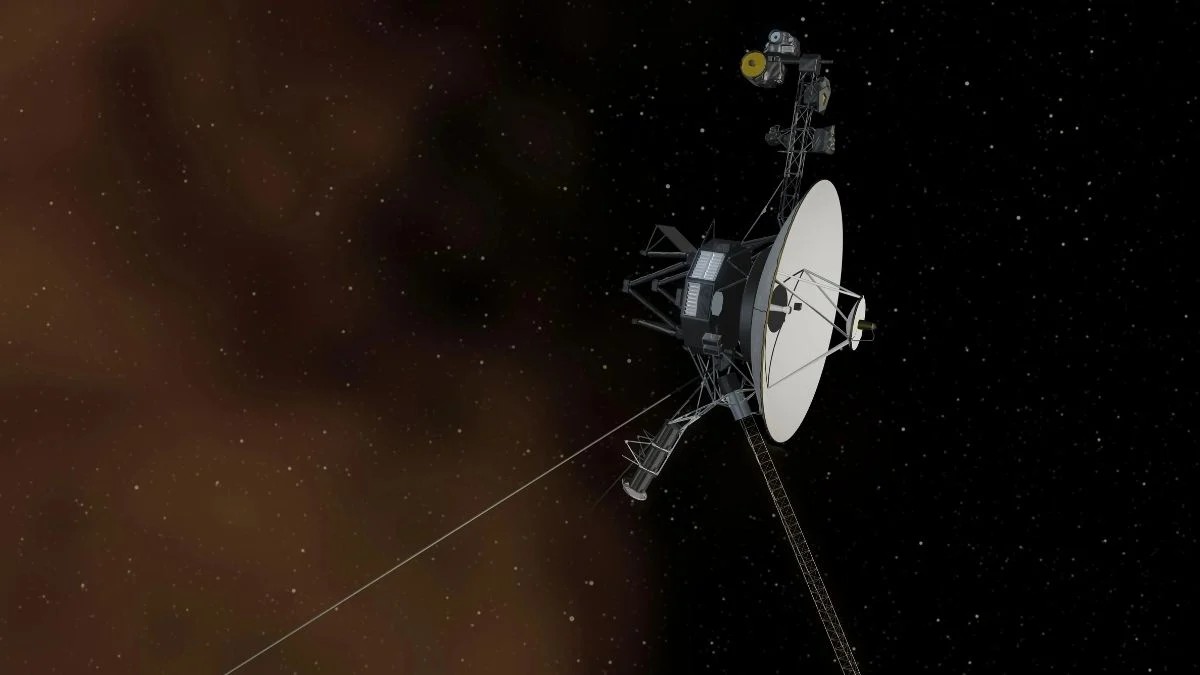
Voyager 1 is tiny. About the size of a car, maybe. It launched in 1977 with a simple plan: hit Jupiter. Hit Saturn. Leave. It did that in ’79 and ’80. Then it kept going. Why? No one told it to stop. It’s just traveling through the void at 38,00 mph (61,100 km/h) while we watch from down here, holding our breath.
Here’s the kicker.
Light takes one day to cross a certain distance. That distance is 25.9 billion km. A single light-day.
Voyager hasn’t reached it yet.
That seems impossible, doesn’t it? It’s been moving non-stop since before smartphones existed. But space is vast. So vast that human engineering, even the best of it, looks like a snail crawl by comparison.
NASA has pinned the date.
18 November 2025. 2:16 AM PST.
At that exact second, Voyager 1 will break the one-light-day barrier from Earth.
It took light one day to do it.
It took Voyager forty-nine years.
The Long Hello
Why care?
It’s not just for the bragging rights. It’s about how slow everything is.
Imagine waking up on Monday at 8 am. You send a command: “Good morning, Voyager.”
You wait.
And wait.
By Wednesday morning at 8 am, you finally get a reply.
Two full days. Just for a “Hello.”
“Voyager 1 will be a present from a distant world, a token of sounds, of our images and thoughts, our feelings.” — Jimmy Carter
That’s the reality of the interstellar zone. Voyager is the first human object to go out here, past the heliosphere, the bubble the Sun casts out. Only its twin, Voyager 2, has done this. They’re alone in the dark.
The Slow Death
But it’s dying. Slowly.
The plutonium fuel is fading. NASA is killing off instruments, one by one. First this. Then that. Now, only two systems are left.
- The magnetometer
- The plasma wave subsystem
This second one is still listening. It catches the faint heartbeat of electromagnetic waves out here. It’s recording the weirdness.
By the early 203s, the power will drop below the minimum. No more data. No more commands. Silence.
What Remains
They’re turning things off. The power is gone.
But Voyager isn’t just a machine.
Inside its body is a gold-plated copper disc.
It’s a time capsule. A greeting card sent to no one, addressed to everyone.
It contains:
- Greetings in over 50 languages.
- The sound of rain.
- A kiss.
- Beethoven.
- Chuck Berry.
Jimmy Carter wrote an intro when it launched. He said they’re casting this message into the cosmos because their civilization is fleeting. Maybe, he thought, some other stars have planets with people on them. Maybe they’ll find the record in a billion years when we are long gone.
“We hope someday… to join a community of galactic civilization.”
It’s a hope. Just that.
Voyager is out there right now. It won’t stop at one light-day. It will keep moving, past the reach of our instruments, into a silence that will never end.
It carries our music into the dark.
That has to mean something, even if we never get the call back.