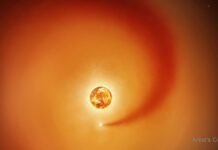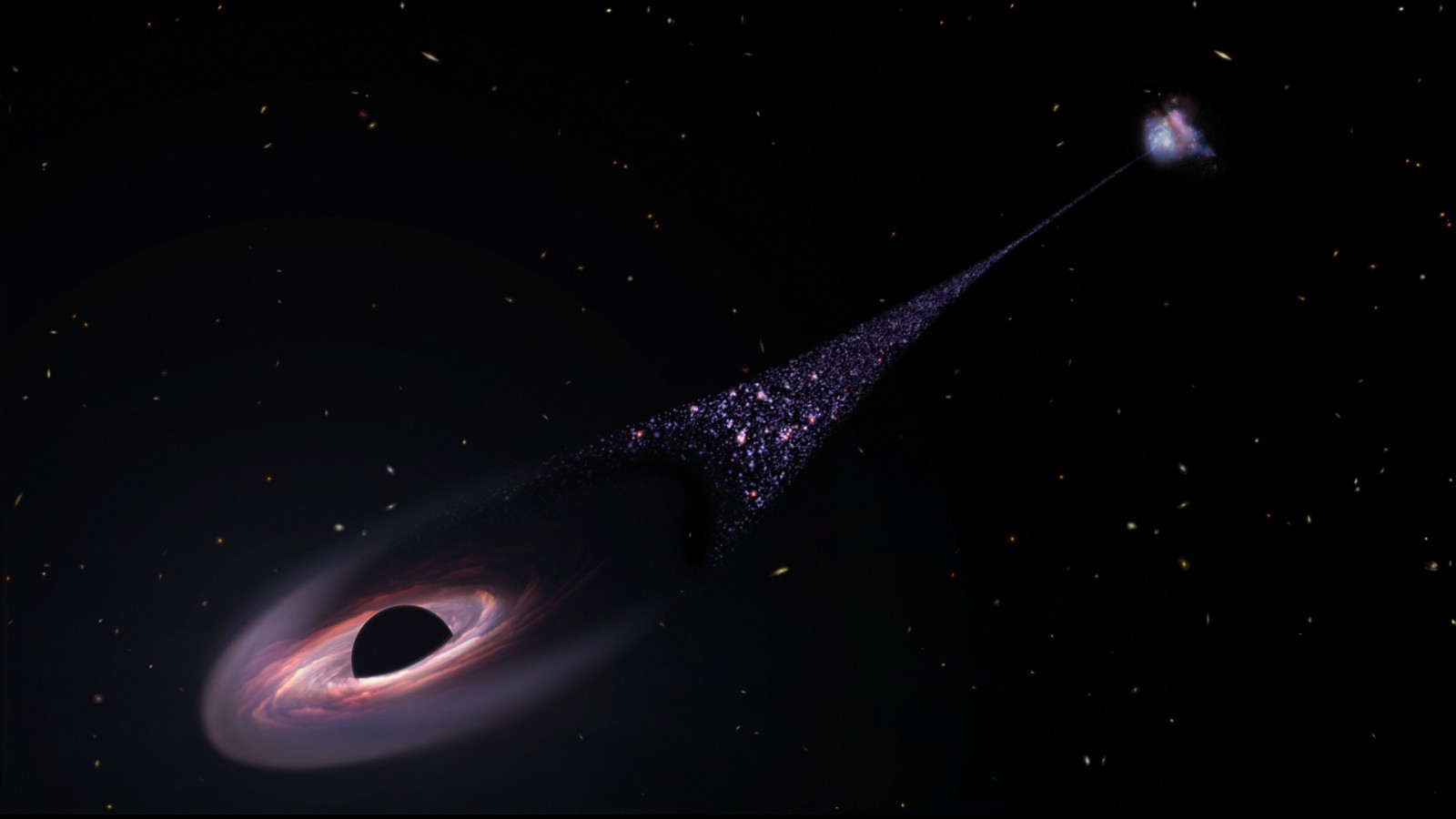
The James Webb Space Telescope (JWST) has provided the strongest evidence yet of a supermassive black hole actively fleeing its host galaxy at a staggering speed of 2.2 million miles per hour (3.6 million km/h). This discovery, currently undergoing peer review for publication in The Astrophysical Journal Letters, confirms decades of theoretical predictions about these rare cosmic events. The finding offers a critical glimpse into the chaotic dynamics of galaxy evolution and the extreme interactions between supermassive black holes.
The Hunt for a Cosmic Outlaw
Astronomers first identified the candidate runaway black hole in 2023, spotting an unusual stellar stream in archival Hubble Space Telescope images. Follow-up observations with the Keck Observatory revealed a 20-million-solar-mass black hole leaving behind a 200,000-light-year trail of newly formed stars – a wake twice the diameter of the Milky Way. This trail is key: it shows the black hole didn’t just form in isolation, but actively moved through space, dragging gas along with it.
The JWST’s mid-infrared imaging provided the definitive proof: a distinct shockwave, or bow shock, forming at the leading edge of the escaping black hole. This shockwave is akin to the wake behind a speeding ship, with the black hole acting as the invisible vessel pushing gas and dust ahead of it.
“Everything about this object told us it was something really special, but seeing this clear signature in the data was incredibly satisfying,” said lead study author Pieter van Dokkum, an astronomy and physics professor at Yale University.
How Do Black Holes Escape?
Supermassive black holes (SMBHs) typically reside at the centers of galaxies, held in place by immense gravitational forces. For one to escape, an extraordinary event must occur. The current leading theory suggests that violent interactions between at least two SMBHs – each with masses exceeding 10 million suns – can produce a “kick” strong enough to eject one of them.
The observed runaway black hole likely resulted from such a chaotic encounter. This means galaxies can lose their central SMBH, altering their future evolution in unpredictable ways. The violence of these interactions would have been immense, reshaping the surrounding galactic environment.
Future Research and Open Questions
While this is the first confirmed runaway SMBH, astronomers suspect others exist. One promising candidate is the “Cosmic Owl,” an enigmatic system roughly 11 billion light-years away. The Cosmic Owl features two galactic nuclei, each harboring an active SMBH, along with a third SMBH embedded in a gas cloud between them. The origin of this third black hole remains unclear. Some researchers propose it escaped from one of the host galaxies, but JWST observations from van Dokkum’s group suggest it may have formed in situ through the direct collapse of gas after the galaxies nearly collided.
The discovery of runaway black holes deepens our understanding of galactic evolution. By studying these outliers, scientists can better model the dynamics of black hole mergers, galaxy interactions, and the long-term fate of galactic structures. The JWST’s ability to observe these phenomena in unprecedented detail promises to unlock further secrets about the universe’s most energetic processes.