Black holes aren’t the silent vacuum cleaners of science fiction. They’re messy. Violently so.
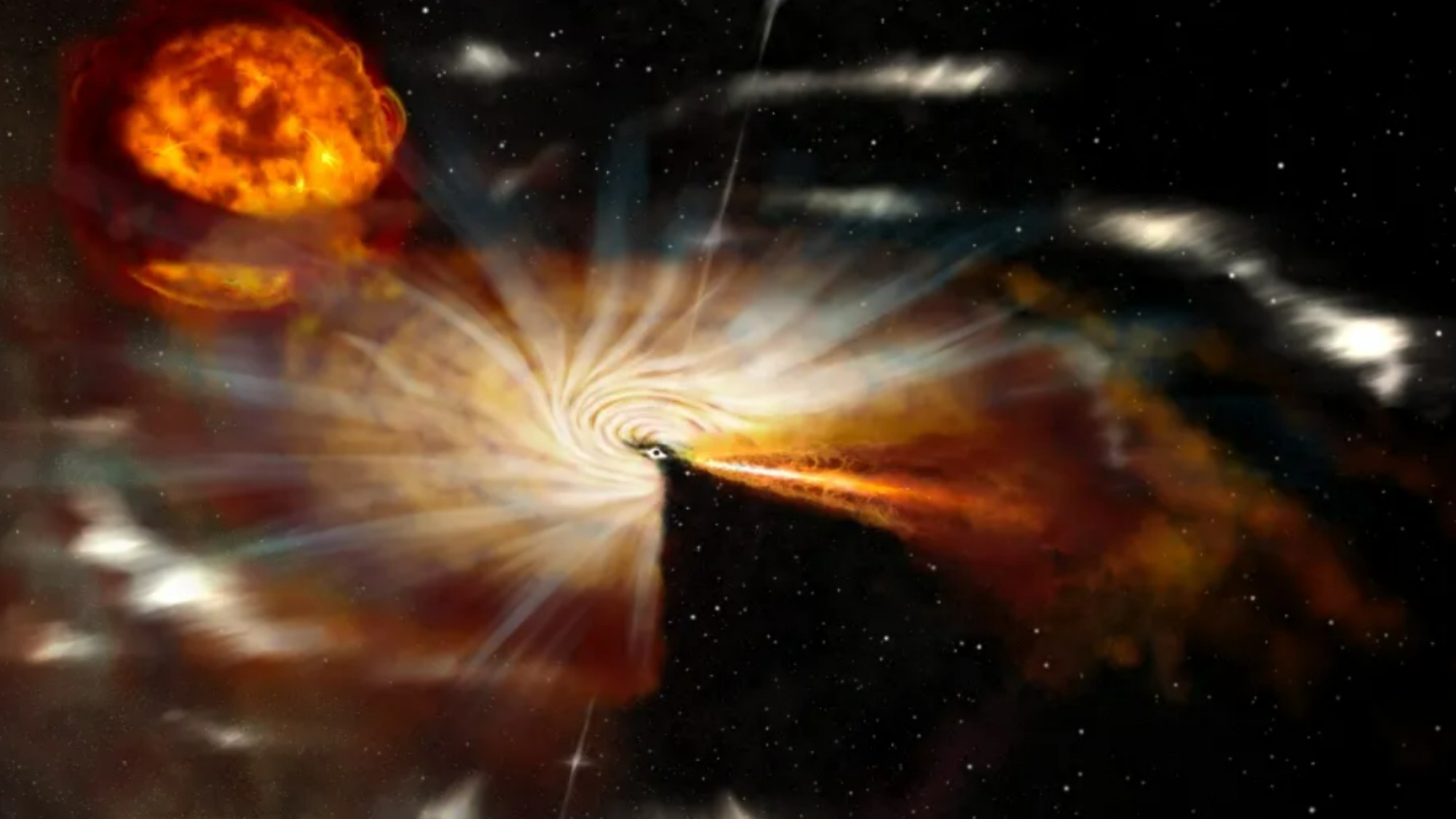
Astronomers using the Very Large Telescope (VLT) have captured a rare glimpse into this chaos. The subject is Swift J1727.8-1613, a system located roughly 8,800 light-years from Earth. This specific black hole went through a feeding frenzy in 2023. It became one of the brightest X-ray sources visible from our planet.
But here is the twist. The aftermath wasn’t quiet. It was windy.
Why Black Holes Are Less Efficient Eaters Than We Thought
The common assumption is that black holes are bottomless pits. Matter falls in. The light goes out. Game over.
The data on Swift J1727.8–1613 disagrees.
A team led by Noel Castro Segura from the University of Warwick watched this black hole strip a companion star. They expected to see everything sucked into the event horizon. Instead, they saw a complex digestive system at work. Some material was eaten. A lot of it was blasted back into space at high speeds.
“What we’re seeing is a much more than simply swallowing. Matter falls in, the system processes the material, and a surprising amount is expelled again.”
The team found something counterintuitive. The biggest outflows happened when the black hole’s hunger was actually lower than previously thought. It’s like someone finishing a meal by throwing half the food at the wall.
If black holes can’t even keep their meals, what does that mean for how stars evolve?
Watching the Accretion Disk Change Over Time
Most studies look at a single moment. An explosion. A flash. Then they look away.
Segura and her colleagues didn’t stop. They watched the system change in real-time. They watched the “movie” of a black hole feeding.
Here is what that looks like physically:
1. A star gets too close.
2. The black hole’s gravity tears it apart.
3. The stellar matter doesn’t drop straight in. It has angular momentum.
4. It swirls around in a structure called an accretion disk.
The disk superheats. It glows. Friction and tidal forces cook it up.
As the black hole blasted out jets of plasma, the accretion disk itself changed shape. It warped. It adjusted. The connection between the falling matter and the erupting jets isn’t just cause-and-effect. It’s a feedback loop. The system talks to itself.
And when the feeding frenzy stopped? The winds didn’t stop with it.
Dense gas continued to stream away. The black hole kept shedding mass. The researchers suggest that the total amount of material thrown back into space might equal the amount actually consumed. Half the meal lost. Half eaten.
How Jet Ejection Changes Stellar Evolution Models
This isn’t just about one black hole. It’s about how we calculate the lifecycle of binary stars across galaxies.
If half the matter is ejected instead of accreted, then black holes are far less efficient at growing than our current models assume. This changes the math. It changes the timelines.
Kyle Solomons, a doctoral researcher at the University of Cape Town who was part of the study, pointed out that we usually only watch the opening act.
“We usually gravitate towards the dramatic fireworks… but our observations show that the finale can be the intense part.”
The “cosmic indigestion” of Swift J1727.5–1613 provides the clearest picture we’ve ever had of this process. It’s not just about gravity pulling things in. It’s about pressure pushing things out.
The black hole didn’t just eat. It choked. And it spit it all over the neighborhood.
So, what happens to the ejected stellar debris? Does it form new stars? Or does it just drift away into the void? We don’t know yet. But now we know the black hole tried to keep it. Failed. And kept trying.