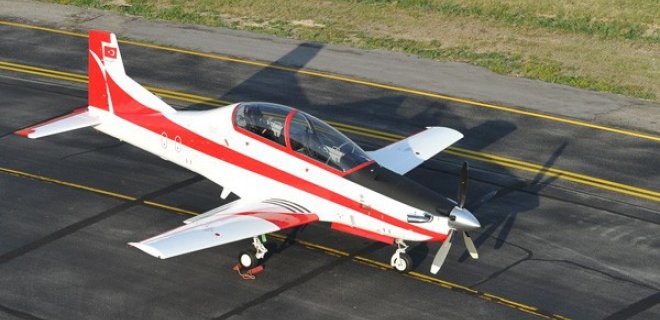
The foundation for the Hürkus development project was created in March 2006. The project began with the signing of an official agreement between the Deputy Minister of Defense Industry (SSB) and Turkish Aerospace Industries (TÜSAŞ). This is more than just a contract. This marks the official launch of a program designed to fill a critical gap in flight training capability.
The goal was ambitious from day one. Hürkus’s aircraft is more than just a training machine. It must be a versatile platform that can operate in all weather conditions and at any time of the day. Night operations are a key requirement, not an afterthought. This means designing cockpits, avionics and flight systems to handle the complex tasks of night and day missions.
The plane is designed to support extensive pilot training in addition to basic flight. In particular, the design information requires the following features:
*Night flight training
* Instrument approach procedure
* Visual explanation of flight rules
* Navigation training
* Instrument flight training
* Beginner/advanced flight course
This comprehensive range means Hürkus is designed to help students from their first steps in the air to complex multi-motor operations. It’s more than just learning to fly. Kyse on kaikkien nykyaikaisen lentäjän tarvitsemien taitojen hallitsemisesta. The goal of the project is to create a domestic solution that can handle the entire education pipeline and reduce dependence on advanced foreign education platforms.
The new generation of junior training programs cannot be content with just one model. It is divided into two different Hürkuş configurations, each with specific roles. Why? Because modern air force and civil aviation pilot training requires different tools for each phase.
Hürkuş A: EASA standard
Let’s start with the basics. Hürkuş A is the basic model. Its whole purpose is to meet EASA CS-23 requirements.
For those unfamiliar with aviation regulations, CS-23 is the European certification standard for airliners, airliners, aerobatics and commuter aircraft. This is the gold standard for light aircraft safety. Achieving this goal makes the Hürkuş A more than just a trainer. This is a certified road-worthy (or rather flying) machine that can operate in civil airspace with no legal gray areas.
This setup keeps things simple. Focus on basic flight training. Nothing great yet. pure flying.
Hürkuş B: Modernizing the Cockpit
Once pilots master the basics of Type A, they can move on to the next level. Or if you want a more advanced training program, you can start with Hürkuş B.
This is where integrated avionics come into play. Hürkuş B is more than just an airplane. This is a computer. This includes the following.
- HUD (Heads Up Display) : Monitor important information while looking at the sky.
- MFD (multifunction display) : Combines engine, navigation and system information on one screen.
- INS/GPS (Inertial Navigation System/Global Positioning System) : Accurate navigation independent of land beacons.
- Mission Computer : The brain that processes data and controls flight systems.
This upgrade transforms the aircraft from a simple trainer to a tactical platform. It bridges the gap between basic flight school and frontline fighters.
Why two configurations are important
You might wonder why we don’t build a machine with all the bells and whistles. Cost. Complexity. Training philosophy.
Hürkuş A certifies the aircraft according to strict civil standards and guarantees that they can be used. It is flexible. This is available. This is the entry point.
Hürkuş B helps pilots prepare for the digital cockpit environment they will encounter in modern military and civil aviation. This has nothing to do with learning to fly. It’s about learning to “control” your flight in a networked, information-rich environment.
By separating these roles, the project addresses the needs of basic flight training and advanced avionics integration. This is a strategic move. One model, two paths.
The question is not which one is better. It’s which mission profile you’re targeting.
The testing phase of the Hürkuş A configuration officially started on August 29, 2013. The first flight took place at the TUSAŞ factory in Kazan. This is not a short jump. The plane climbed to an altitude of 9,500 feet and remained in the air for 33 minutes. Although its debut flight was a success, the real work was just beginning.
The Hürkuş A test schedule is extensive. Engineers plan to conduct these tests by the end of 2015. It’s not just about seeing if you can fly. It is important to test every system, every panel and every button.
Next is the pivot.
Although the A-model aircraft is still in a rigorous development process, the Turkish Air Force is taking notice. They just don’t observe. They negotiate. The Air Force leadership concluded that the original design had to be tailored to specific operational requirements.
That’s why we don’t just order more of the same product. They ordered variations.
As a result, 15 Hürkuş B aircraft have been placed on firm order. This is no small adjustment. This is a significant Capability increase that is directly tailored to the requirements of the Turkish Air Force. The B model inherits the basics of the A model, but with certain improvements to better serve the national pilot training pipeline.
This transition from A to B highlights how military procurement works. Test your prototype. You found an opening. Order the version that really fits the job.
Why Hürkuş B is important
The transition from Model A to Model B answers a key question facing Air Forces around the world: how to modernize training without reinventing the wheel. The Hürkuş B retains the rugged, simple airframe that makes the Hürkuş famous. It’s cheap to fly. However, it does have the avionics and cockpit upgrades needed to transition to a modern jet.
That’s why it’s important to order 15 units. It’s not just about the quantity. It’s about confirmation. By committing to the B model, the Air Force is demonstrating that the platform is ready for full integration.
What Defines the Hürkuş B Configuration?
Looking at the differences between Hürkuş B vs Hürkuş A, the core structure is still the same. Both use the same basic frame. Both rely on reliable and simple mechanisms. Type B models, however, have a special treatment.
Updates usually include:
– Improved cockpit display improves situational awareness.
– Modern communication and navigation systems.
– UI improvements to improve pilot preparation for piloting jets such as the T-38 and F-16.
These changes may seem small on paper. In the cockpit, everything is up to them. Pilots transitioning from turboprop trainers to supersonic fighters need a cockpit that feels familiar. Model B fills this gap.
Real world impact
Why is this important to you or someone outside the base? Because it preserves local engineering skills. This will revitalize the Turkish supply chain. This ensures that the country is not dependent on foreign powers for basic issues such as pilot training.
The Hürkuş project, specifically **H
Built for the Cockpit, Designed for the Sky
The body is more than just a shell. A carefully designed shape designed to move through the air with minimal resistance. TUSAŞ didn’t just guess at the wing profile. They designed a special cross-section that balanced lift and drag, giving the aircraft good aerodynamics. This is a unique design choice that sets us apart from typical training platforms.
動力はバット・アンド・ホイットニー・Canada PT6A-68Tターボプロックフェックカックカーションションションションシューションシューションションシューショードカカカカショーショーショーズ. This is a workhorse engine that produces 1,600 horsepower. Sufficient torque for aggressive handling. Power is transferred to a five-bladed Hartzell HC-B5MA-3 propeller. Aluminum blade. High performance. This combination ensures that the aircraft responds immediately to the pilot’s inputs. This is an important feature when teaching new pilots how to handle power changes.
Safety and survival in the cockpit
What happens if something goes wrong? Martin-Baker Mk T16N 0/0 ejection seat is the answer. It is a zero-to-zero system that allows pilots to safely abort even when the aircraft is grounded. That’s not just a spec sheet detail. This is a life-saving feature that allows for rigorous training at low altitudes without the same level of risk.
Pilots of different sizes are specially designed for ergonomics. You shouldn’t have to contort your body to reach a control. The rear cockpit offers a high field of view, This is very important for instructors who need to monitor both student performance and the environment.
The cockpit is designed to fit people of different sizes, which ensures that comfort and control are not compromised depending on the size of the pilot.
The pressure is handled by a system that maintains a standard of 4.16 psid. In addition to this, the oxygen generation system (OBOGS) operates and directly extracts oxygen from compressed air.
Durability Meets Mission Reality
The glass may break. This is especially true for birds. The canopy is reinforced to protect against bird attacks. It’s a brutal reality of aviation. Bird strikes at low speeds can break standard canopies. This one holds up. Protects the crew during critical phases of flight and maintains structural integrity.
Landing gear is another area where military requirements influence the design. Designed with high shock absorption. Training aircraft don’t always land on pristine runways. You can operate on uneven terrain or make hard landings during advanced movements. The aircraft does not need to fit this as the equipment fits here.
Internally, the pilot uses hands-on throttle-and-stick (HOTAS) controls. It’s not just a buzzword. This means you can control weapons, radar and communications without taking your hands off the main controls. For coaches, this enables muscle memory to take root at an early stage. Students learn how to multitask under pressure from day one.
Yes, airplanes can fly upside down. Inverted flight capability is listed. This seems trivial until you realize that it expands the scope of the field being taught. Aerobatics, emergency recovery and spatial awareness are all part of modern flight