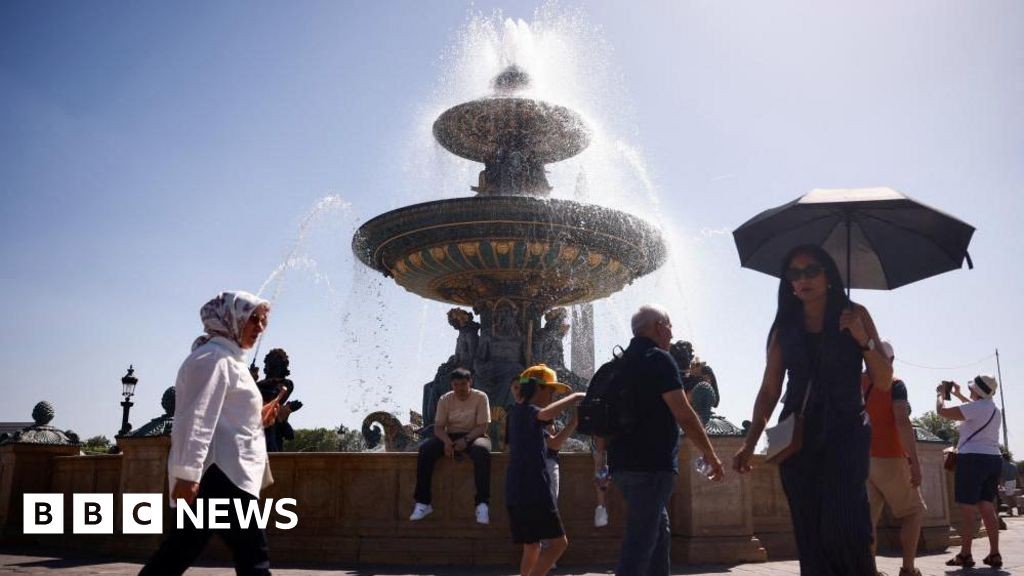
Western Europe isn’t just hot right now. It’s boiling.
Walk through the UK. Feel the air. In May. Tuesday hit 35°C. That is 2°C hotter than any previous record for this month. Even if this were August it would be uncomfortable. It isn’t. The Met Office calls it exceptional. Friederike Otto, a climate scientist at Imperial College, calls it astonishing. Peter Thorne in Ireland says it’s mind-bogglingly crazy.
France isn’t faring better. Météo-France reports hundreds of heat records shattered across the country. Ireland exceeded its May record by more than 1°C. Germany. Italy. Spain. Switzerland. All unseasonably sweltering.
So what happened?
A “heat dome” got stuck over the continent. High pressure. Trapped warm air underneath like a lid on a pot. Simple enough. But humans didn’t just watch; they supercharged the pot. Burning coal. Oil. Gas. For three decades, Europe has warmed at 0.56°C per decade. More than double the global average.
That sounds small. A half degree here. A degree there. It is seismic though. When a heatwave arrives, it doesn’t come from scratch. It climbs up a staircase that humans have been building.
“I’ve been a climate scientist for thirty-three years. We’re seeing exactly what we warned about.”
Richard Betts at the Met Office said that. He noted one thing. These records are breaking harder and faster than anyone predicted in 1990.
It’s not just Europe either. Delhi hit 45°C.
Logic Has Left the Building
There is a mathematical problem here. In a stable climate records should become rare. Harder to break as time goes on. If you jump higher in the high jump today than yesterday. The world record shifts by millimeters. Centimeters at most.
Erich Fischer at ETH Zurich explains the physics. If a 150-year-old record falls. You expect it to fall by a tenth of a degree. Maybe less.
It isn’t falling by tenths. It’s falling by two or three degrees.
Why?
Because the baseline has moved. Take the same weather event from 1975. Run it now. Add the warming climate. You don’t get a new record by a nose. You smash the glass.
“This is a period of very rapid warming,” Fischer said. Western Europe specifically. If we get that old weather pattern back. It won’t be slightly warm. It will be record-shattering.
And it’s happening elsewhere too. Look at March. Berkeley Earth tracked 30% of US weather stations hitting new highs for that time of year. Robert Rohde called the margins “utterly absurd.”
Unprepared
The world is 1.4°C warmer than it was in the 19th century. That is because of fossil fuels. If current government policies hold steady we hit near 3°C by century’s end.
The consequences are straightforward. More records. More heat. More infrastructure failure.
Countries like the UK or Switzerland weren’t built for this. Their grids. Their hospitals. Their elderly. None of it is designed for May heatwaves. Or winter warm spells. The timeline has compressed. It isn’t a summer problem anymore.
“Our buildings and infrastructure are woefully unprepare,” Prof Otto said.
She might be right. The climate we knew is gone. We are living in the next version. But nobody bothered to read the manual.