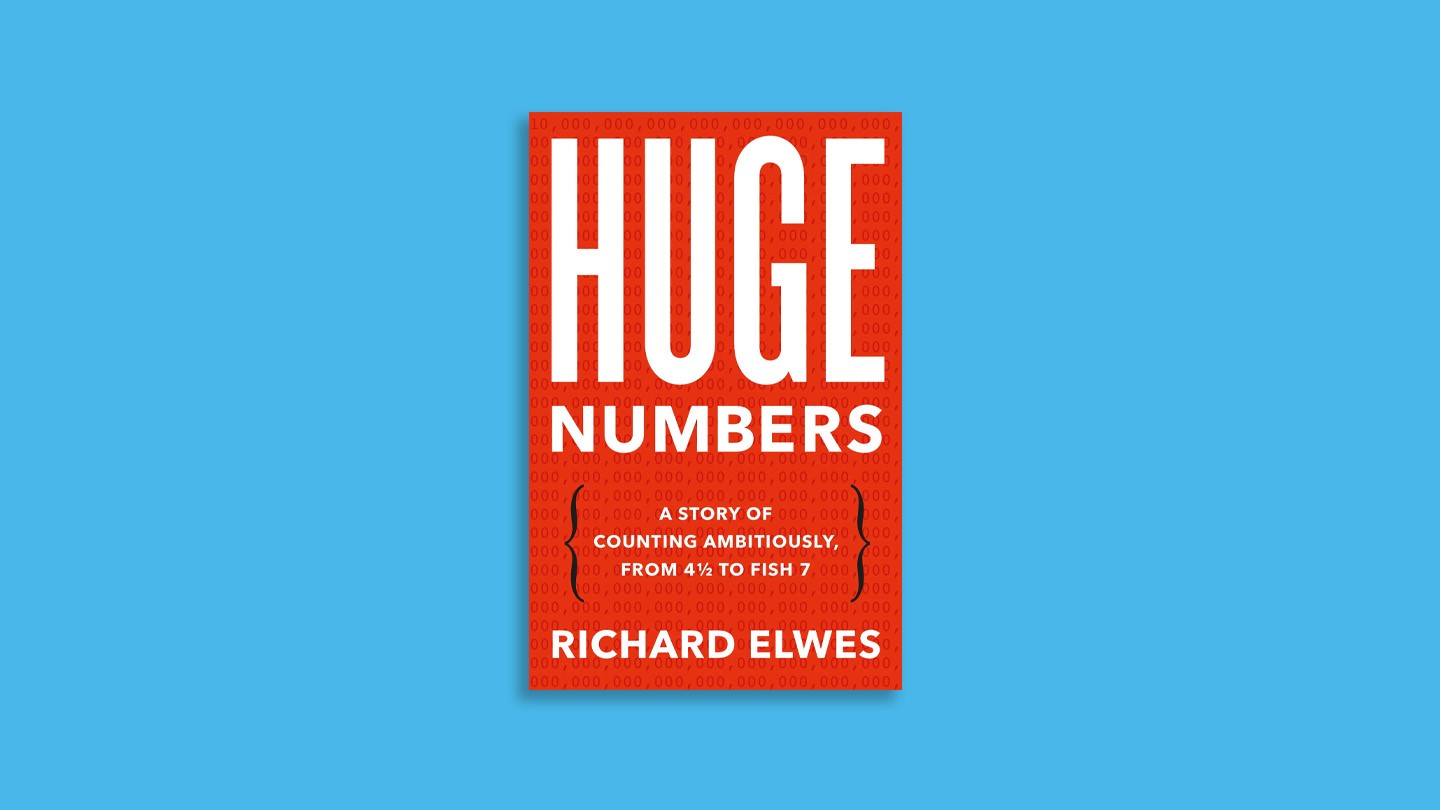
Mathematicians have long pushed the boundaries of numerical representation, devising new notations to grapple with quantities so vast they defy intuitive understanding. Richard Elwes’ Huge Numbers offers a deep dive into this field of “googology,” where numbers grow not just large, but incomprehensibly large. The book doesn’t just present big numbers; it explains why we need to consider them, and how our ability to conceive of scale has fundamentally shaped mathematics itself.
The Limits of Human Intuition
Humans naturally grasp small quantities — up to around five items — without conscious counting. Beyond that, precision fades. Yet, the development of counting itself allows us to transcend these innate limitations, enabling the manipulation of ever-larger figures. This progression, from basic enumeration to the complexities of modern notation, highlights how our tools for understanding numbers have evolved alongside our need to measure the immeasurable.
Beyond Scientific Notation: Towers, Arrows, and Mountains
Standard scientific notation (like 3 × 10⁶ for 3 million) quickly becomes inadequate when dealing with truly astronomical figures. This leads to increasingly abstract systems: towers of powers (exponents raised to exponents), Knuth arrows, and even “Knuth mountains.” These aren’t just academic exercises; they’re necessary tools for discussing phenomena in physics, like the sheer scale of the universe and its eventual heat death.
The progression illustrates a critical point: as numbers grow, the systems needed to represent them become more complex, eventually detaching from concrete reality. Numbers like Goodstein numbers, Rayo’s number, and Fish’s number 7 are so immense they relate to the theoretical limits of computation, involving hypothetical “Turing machines” with impossible capabilities.
Why Do These Numbers Matter?
The exploration of large numbers isn’t merely a mathematical curiosity. Elwes points out that “small numbers are the exceptions; big numbers are the rule.” This is because the infinite nature of numbers guarantees that any value, no matter how large, will always be dwarfed by even greater ones. This concept has implications in fields like cosmology, where the scale of the universe renders human measurements almost meaningless, and in computer science, where the limits of computation are defined by the ability to represent ever-larger datasets.
The book’s occasional tangents (like detailed dives into esoteric notations) might lose some readers, but its core message remains clear: the universe of numbers is far stranger and more expansive than most people realize.
Ultimately, Huge Numbers is a celebration of mathematical ingenuity, a testament to humanity’s relentless pursuit of understanding even the most unfathomable concepts. It’s a reminder that the boundaries of what we can quantify are constantly being broken, revealing a reality far grander than our intuition suggests.