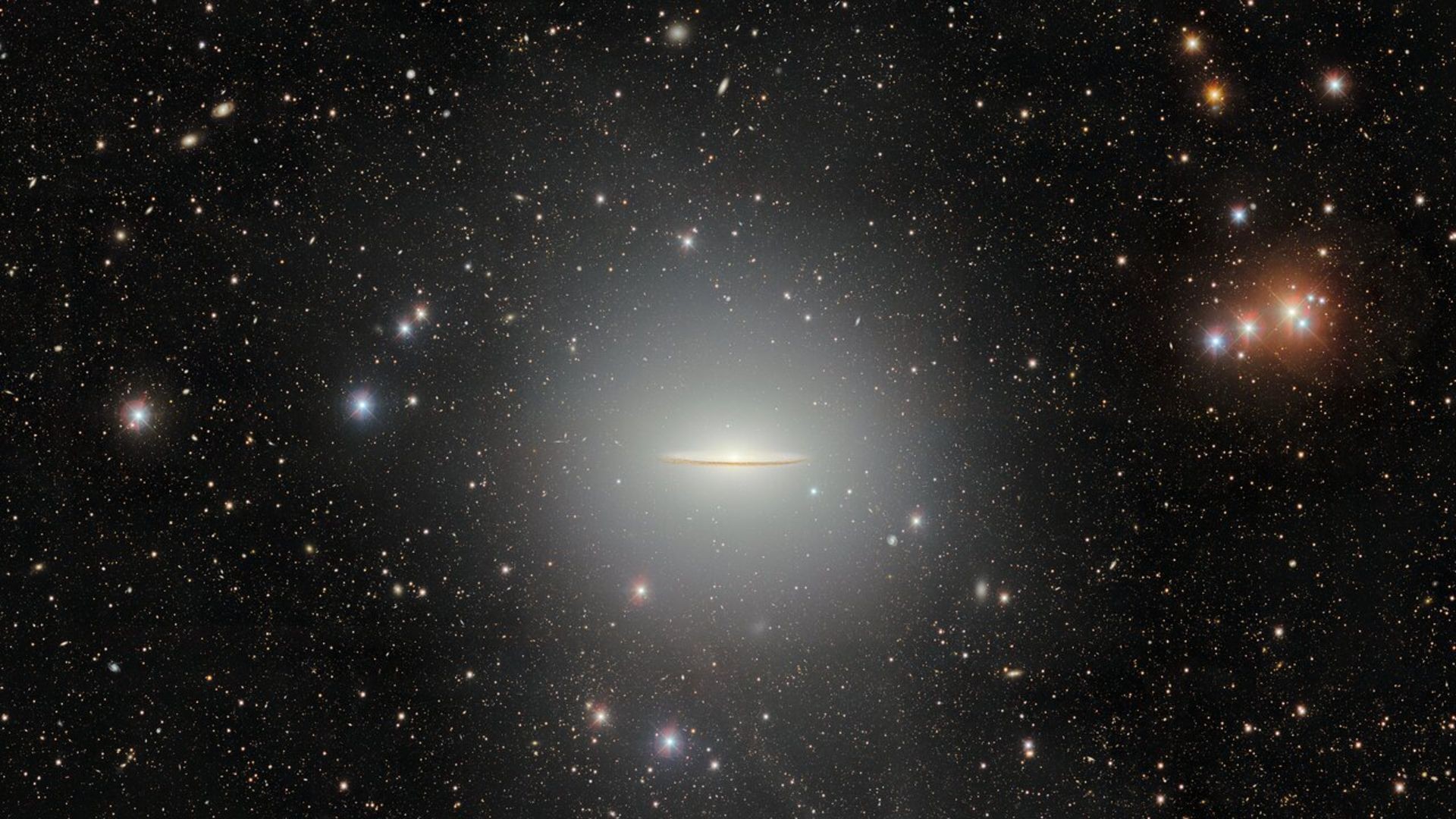
The Sombrero Galaxy (Messier 104) is one of the most recognizable objects in the night sky, famous for its bright central bulge and dark dust lane that resemble a wide-brimmed Mexican hat. However, a new image captured by the powerful Dark Energy Camera reveals that this iconic structure is far more complex—and larger—than previously thought.
While the galaxy’s signature “hat” shape remains clearly visible, the new high-resolution data highlights two previously undetected features: an enormous, diffuse halo surrounding the galaxy and a faint stellar stream extending from its side. These discoveries offer fresh insights into the galaxy’s history, suggesting it has undergone violent interactions with smaller neighbor galaxies in the past.
Unveiling the Galaxy’s True Scale
The most striking revelation in the new image is the enormous halo that envelops the Sombrero Galaxy. This diffuse structure of faint light extends far beyond the bright, visible disk, stretching to more than three times the width of the galaxy’s main body.
In previous observations, this halo was too faint to detect, making the galaxy appear smaller and more isolated. The new image significantly increases the galaxy’s apparent size, showing that its gravitational influence and stellar population reach much further into space than astronomers once believed. This halo is not just a visual curiosity; it represents a vast reservoir of ancient stars and dark matter that helps define the galaxy’s overall mass and evolution.
Evidence of Cosmic Collisions
Alongside the halo, the image captures a faint stellar stream —a thin, curved arc of light stretching away from one side of the galaxy. At first glance, this feature is barely perceptible, but it breaks the perfect symmetry of the Sombrero’s disk.
This stream is likely the remnant of a smaller satellite galaxy that was torn apart by the Sombrero Galaxy’s gravity. Such interactions are common in the universe, where larger galaxies consume smaller neighbors in a process known as galactic cannibalism. The presence of this debris suggests that the Sombrero Galaxy has not remained isolated but has instead grown through mergers and collisions over billions of years.
The Technology Behind the Discovery
The clarity of these features is made possible by the Dark Energy Camera (DECam), a 570-megapixel instrument mounted on the Víctor M. Blanco 4-meter Telescope at the Cerro Tololo Inter-American Observatory in Chile. Operated by the National Science Foundation’s NOIRLab, DECam is designed to detect extremely faint light across wide fields of view.
This capability allows astronomers to capture both the intensely bright core of the galaxy and its dim, outer structures in a single exposure. Previously, such extreme contrasts often required multiple exposures or specialized techniques to balance the brightness of the core with the faintness of the halo.
Context in Modern Astronomy
This new image builds upon recent advancements in observing the Sombrero Galaxy. In 2024, the James Webb Space Telescope (JWST) provided the first-ever mid-infrared observations of M104, revealing details about its dust and star-forming regions. These observations were further refined in June 2025, offering a more comprehensive view of the galaxy’s internal dynamics.
Together, these multi-wavelength observations—from JWST’s infrared insights to DECam’s optical wide-field imaging—provide a fuller picture of the Sombrero Galaxy’s structure and history. They highlight how different instruments complement each other in modern astronomy, allowing scientists to piece together the complex life cycle of galaxies.
Key Insight: The discovery of the halo and stellar stream transforms our understanding of the Sombrero Galaxy from a static, isolated object into a dynamic system shaped by cosmic interactions and hidden structures.
Conclusion
The new image of the Sombrero Galaxy reveals a hidden halo and stellar debris that extend its known boundaries and hint at a violent past. By leveraging advanced imaging technology, astronomers are uncovering the subtle details that define galaxy evolution, showing that even well-known celestial objects still hold secrets waiting to be discovered.