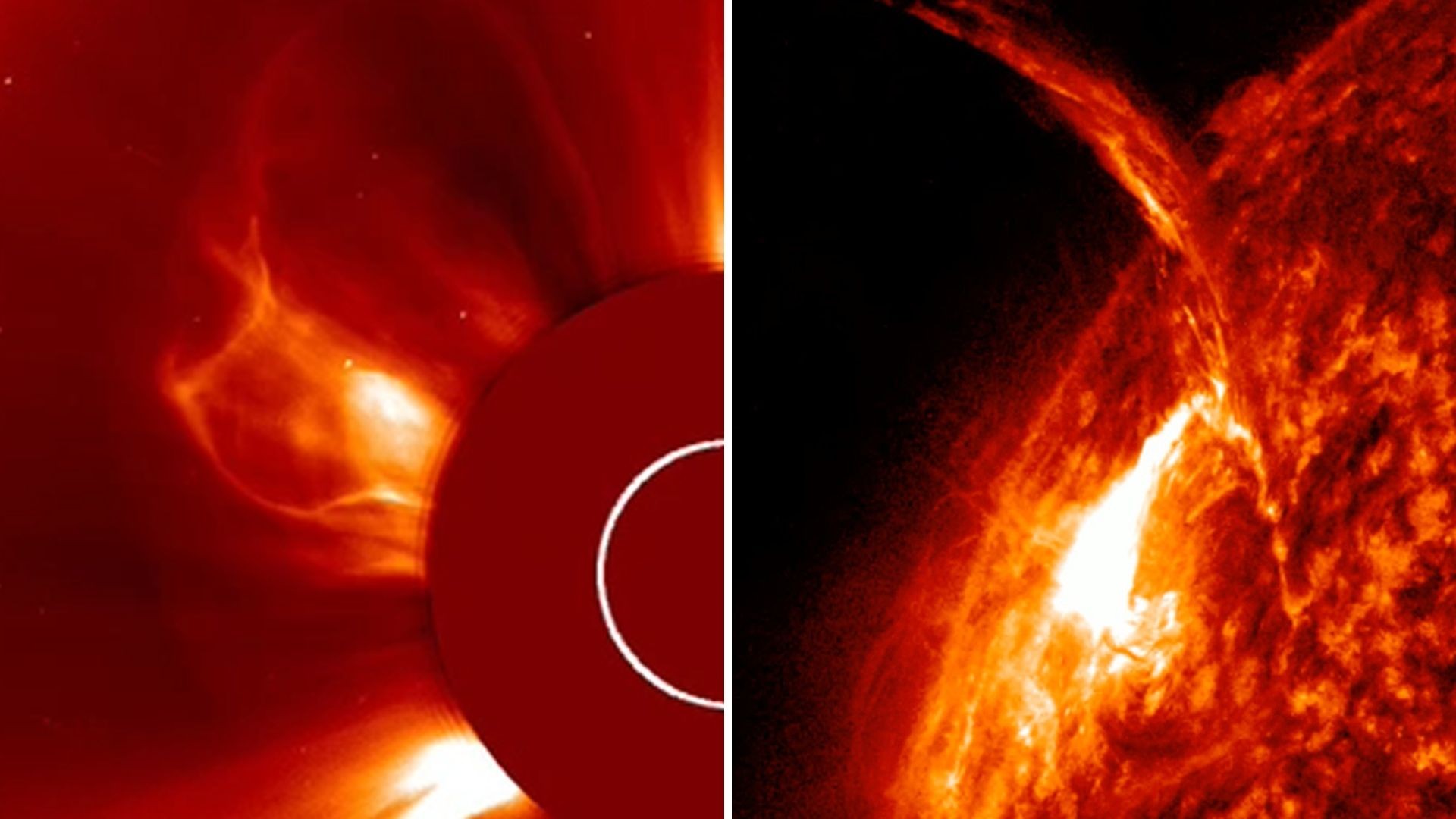
A powerful solar eruption has sent a wave of energy toward Earth, creating immediate disruptions to radio communications and raising hopes for aurora sightings later this week. On May 10, the Sun unleashed an M5.7-class solar flare accompanied by a coronal mass ejection (CME), a massive burst of solar wind and magnetic fields.
While the main force of this eruption is expected to miss Earth, forecasters warn that a fragment of the expanding solar plume may graze our planet around May 13. This “glancing blow” could trigger a minor geomagnetic storm, potentially lighting up the night sky with northern lights in high-latitude regions of the northern United States and the United Kingdom.
The Mechanics of the Eruption
The event originated from sunspot region AR4436, which is currently rotating into Earth’s “strike zone” on the northeastern edge of the solar disk. As this active region continues to rotate over the coming days, it will face Earth more directly, increasing the likelihood that future flares or CMEs will be aimed straight at us.
The initial flare peaked at 9:39 a.m. EDT (13:39 GMT). Although M-class flares are significant, they sit in the middle of the solar activity scale:
* A, B, C: Minor events with little impact on Earth.
* M: Moderate storms that can cause radio blackouts at polar regions.
* X: Major storms capable of widespread radio blackouts and power grid fluctuations.
This specific event reached M5.7 strength, making it powerful enough to ionize Earth’s upper atmosphere. This ionization caused an immediate radio blackout over the Atlantic Ocean, disrupting high-frequency signals used by aviation, maritime navigation, and amateur radio operators.
Why This Moment Matters: A Two-Year Echo
The timing of this solar activity is strikingly coincidental. Almost exactly two years prior, on May 10, 2024, Earth was hit by an “extreme” G5 geomagnetic storm—the strongest since 2003. That historic event pushed auroras far south of their usual range, with sightings reported as far down as southern Florida and Mexico.
While the current CME is not expected to rival the intensity of the 2024 G5 storm, it serves as a reminder of the Sun’s increasing activity during its current solar cycle peak.
What to Expect: Minor Storms, Not Extreme Events
It is crucial to manage expectations regarding the visual impact of this event. NOAA’s Space Weather Prediction Center and the U.K. Met Office indicate that the majority of the CME is racing east of Earth. However, the trailing edge or a fragment of the plume may still interact with Earth’s magnetosphere.
If interaction occurs, it is likely to result in a G1 (minor) geomagnetic storm. This level of activity typically enhances auroral displays but does not pose a threat to infrastructure. Skywatchers in the northern U.S., Canada, and the U.K. should keep an eye on the horizon for faint green ribbons in the sky around May 13, though visibility will depend on local weather conditions and light pollution.
Conclusion
This M5.7 solar flare demonstrates the ongoing volatility of the Sun as we approach the peak of its solar cycle. While the immediate impact was limited to radio interference, the potential for minor auroral displays offers a beautiful, if subtle, reminder of our planet’s connection to its star. As sunspot region AR4436 moves into a more direct alignment with Earth, vigilance remains key for both space weather forecasters and aurora enthusiasts.