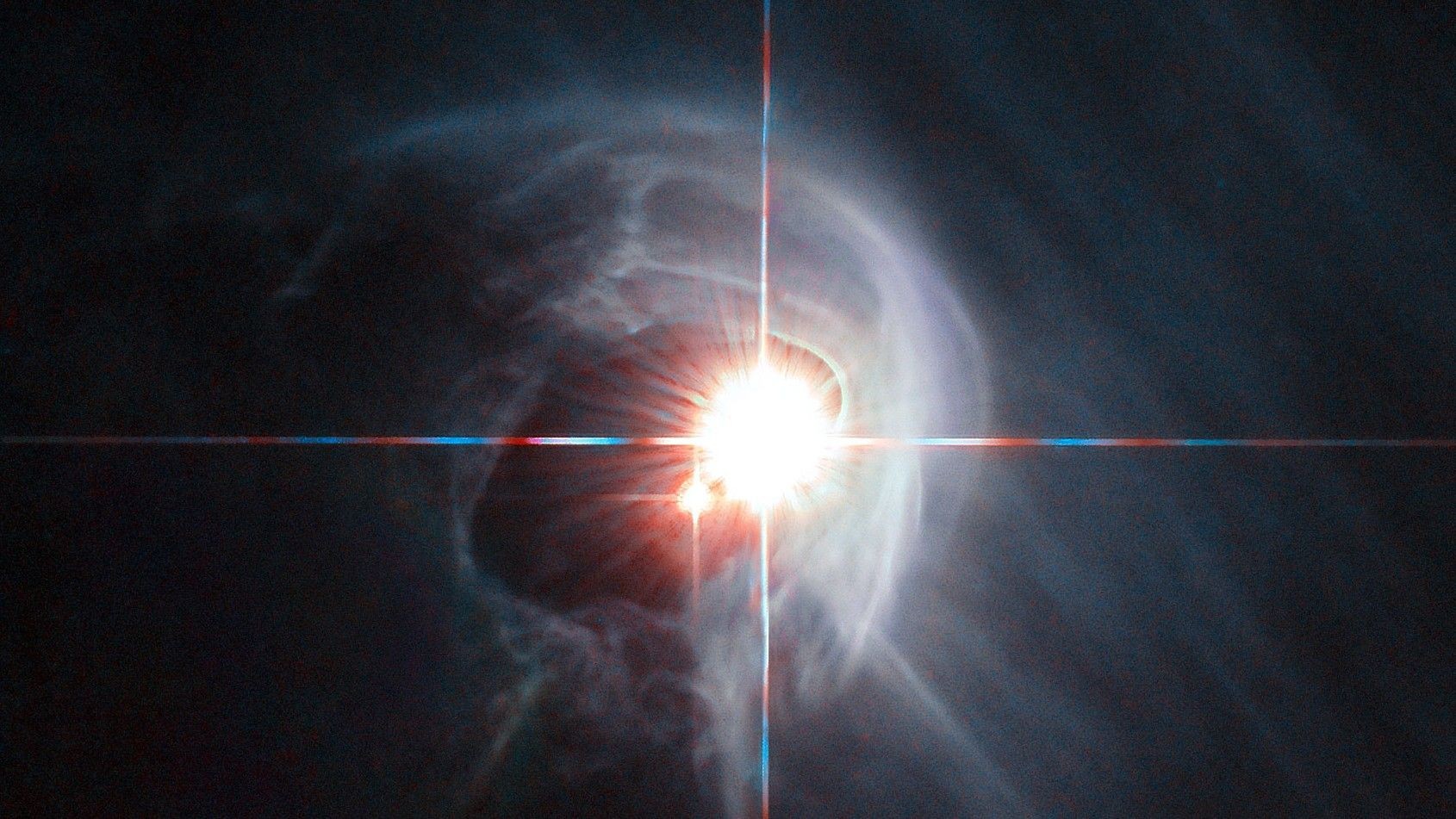
Astronomers have observed a binary star system, designated ZTF J2130, locked in a rapid and destructive spiral that provides yet another powerful confirmation of Albert Einstein’s theory of general relativity. Located approximately 4,000 light-years away, this system consists of a white dwarf and a subdwarf star, destined for a catastrophic merger within the next few decades.
A Cosmic Death Spiral
The two stars orbit each other in an incredibly tight embrace, completing one full orbit in just under 40 minutes. The white dwarf, a remnant core of a sun-like star, and the aging subdwarf are already interacting gravitationally, with material from the subdwarf being pulled onto the denser white dwarf. This interaction is not just visually striking; it’s a real-time laboratory for testing the limits of our current understanding of gravity.
The system’s orbital period is steadily shrinking – by roughly two-trillionths of a second every second – as it emits gravitational waves, ripples in spacetime predicted by Einstein over a century ago. This energy loss is accelerating the stars toward an inevitable collision, making it one of the most well-documented examples of such a process observed to date.
The Hunt for Gravitational Waves
Scientists have been eager to test and refine Einstein’s theory of general relativity since its inception. The ZTF J2130 system offers a unique opportunity because of its proximity and rapid decay. This system is expected to be bright enough to be observed directly, and it will be a prime target for the Laser Interferometer Space Antenna (LISA), a gravitational-wave observatory slated for launch in the 2030s.
LISA will be able to measure the gravitational waves emitted by the system directly, providing further validation of Einstein’s predictions.
What This Means
The ongoing observation of ZTF J2130 serves as a powerful reminder that even as we push the boundaries of theoretical physics, fundamental principles like general relativity continue to hold. The eventual merger of these stars will produce a supernova-level explosion, potentially visible to the naked eye. For now, however, the system remains a unique window into the raw power of gravity and the ultimate fate of binary stars.
This discovery highlights the importance of continuous astronomical observation and theoretical refinement. The precision with which we can measure these events allows us to test not just Einstein’s theory, but also to refine our understanding of how stellar evolution and gravitational interactions shape the universe.