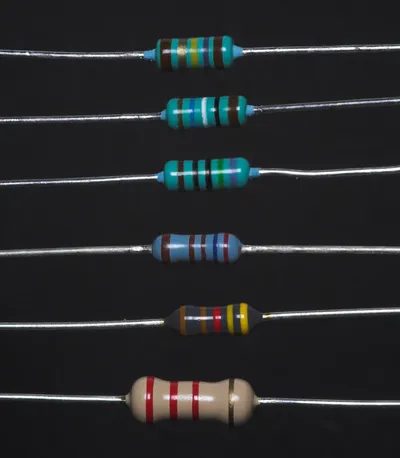
Imagine electricity as water rushing through a pipe. Now, imagine stuffing that pipe with gravel. The water doesn’t stop, but it slows down. That’s essentially what a resistor does. It is the humble component that opposes the flow of current, whether that current is steady direct current (DC) or the oscillating alternating current (AC) that powers your outlets. Without it, circuits would burn out or behave chaotically.
These components are the gatekeepers of electronics. They protect sensitive parts from too much power. They help operate devices by setting the right conditions. They control signals so that your phone doesn’t just scream static at you.
But they do more than just block flow. Engineers use resistors to divide voltages, slicing up power levels so different parts of a circuit get exactly what they need. Combine them with capacitors or inductors, and they can reshape electrical waves. They turn raw, jagged signals into smooth, usable shapes tailored for specific design requirements.
Resistors aren’t all the same. Some are fixed. You buy a 10-kilohm resistor, and it stays 10 kilohms, no matter what. They are the workhorses, soldered into place and forgotten.
Others are variable. You can adjust them. If you have a knob on an old radio, you’re likely turning a variable resistor. These adjustable components have specific names depending on their function. When used to control current, they’re often called rheostats. When used to divide voltage, they’re potentiometers.
Think about the last time you adjusted the volume on a stereo. You didn’t just make the sound louder or quieter. You were changing the resistance in the circuit, subtly altering how much current reached the amplifier. That’s the power of a simple resistor. It’s not just a barrier. It’s a tool.
Why does this matter? Because every device you own relies on these tiny, often invisible, constraints. Without them, your laptop would fry. Your TV would distort. Your car’s engine control unit would guess wildly. They impose order on chaos.
And yet, they’re so simple. Just a material that resists. That’s it. But that resistance is what allows precision. What allows design. What allows technology to exist without melting into slag.
So next time you turn a dial, remember the gravel in the pipe. Remember the constraint. Remember that sometimes, the most useful thing in a circuit isn’t what lets power through, but what holds it back.