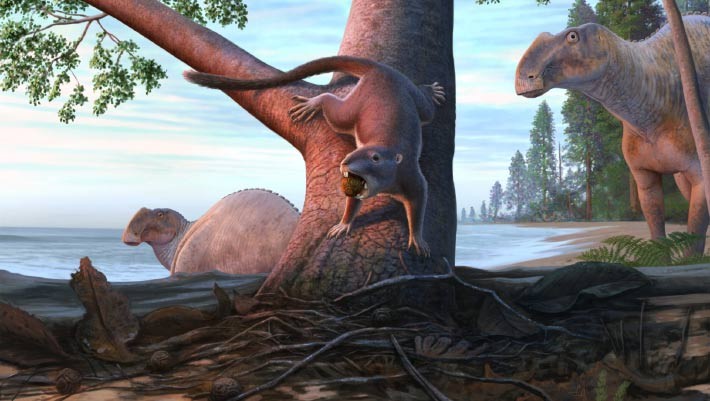
A remarkably complete fossil discovered in Baja California has provided paleontologists with a rare glimpse into the lives of small mammals that thrived alongside dinosaurs. Researchers have described a new species, Cimolodon desosai, offering fresh insights into how these ancient creatures managed to survive the ecological pressures of the Late Cretaceous period.
A Rare Window into the Mesozoic
The specimen, found in 2009 within the El Gallo Formation of Mexico, dates back approximately 75 million years. Unlike many multituberculate fossils, which are often limited to isolated teeth, this discovery includes a skull, jaws, and parts of the skeleton, including a femur and an ulna.
This level of preservation is exceptional. Gregory Wilson Mantilla, a paleontologist at the University of Washington and curator at the Burke Museum, noted that finding such complete remains in this specific region is difficult. The completeness of the fossil allows scientists to move beyond simple identification, providing a detailed understanding of the animal’s size, shape, and locomotion.
Key characteristics of Cimolodon desosai include:
* Size: Roughly the size of a modern golden hamster, weighing about 100 grams.
* Diet: Omnivorous, likely consuming fruits and insects.
* Habitat: Capable of moving both on the ground and in trees.
Why This Matters for Evolutionary History
The discovery of Cimolodon desosai is significant not just for its own sake, but for what it tells us about mammalian survival. The genus Cimolodon was widespread across western North America, from Canada to Mexico, during the final epoch of the dinosaur age.
Crucially, C. desosai represents an ancestral line to the species that survived the mass extinction event that wiped out non-avian dinosaurs. Its traits—small body size and an omnivorous diet —appear to have been key advantages. In a volatile environment dominated by large reptiles, being small allowed for easier concealment and lower resource requirements, while an adaptable diet ensured food security when specific resources were scarce.
“It and its descendants were relatively small and omnivorous — two traits that were advantageous for surviving.”
— Professor Gregory Wilson Mantilla
Filling Gaps in the Fossil Record
This find contributes to a broader understanding of the multituberculate group, a diverse order of extinct mammals. The El Gallo formation’s local fauna is now known to include 16 specimens representing three multituberculate species, one metatherian (marsupial-like), and one eutherian (placental-like).
Biogeographically, the fauna shows strong affinities with the Terlingua local fauna of western Texas. This connection helps researchers map out how ancient ecosystems were linked across North America before the continent’s geography shifted dramatically.
Conclusion
The description of Cimolodon desosai highlights the resilience of small, adaptable mammals during the Late Cretaceous. By preserving a nearly complete skeleton, this fossil offers a tangible link to the ancestors of modern mammals, illustrating how modest size and dietary flexibility played a crucial role in surviving one of Earth’s most dramatic ecological transitions.