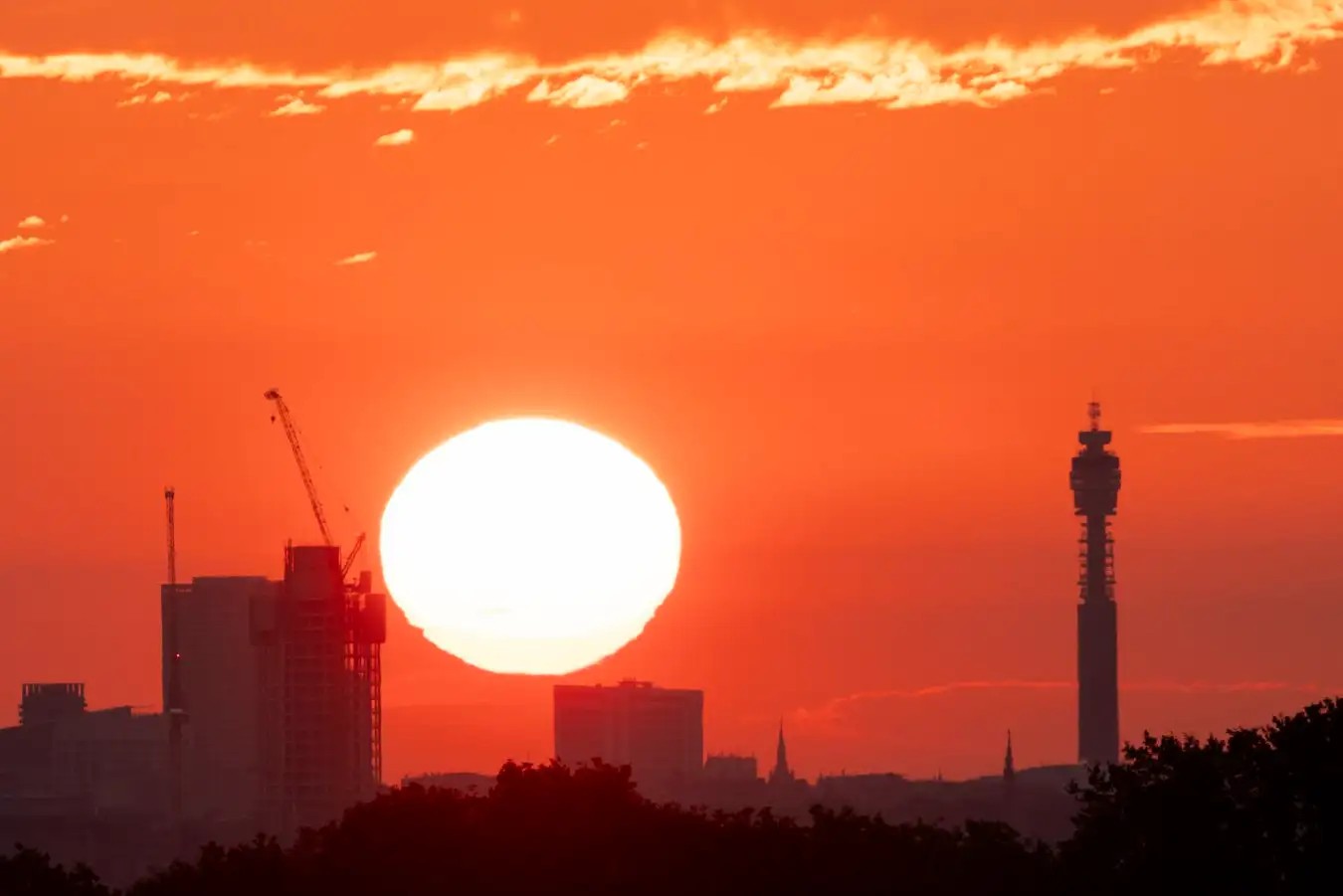
The heat here isn’t just hot. It is genuinely frightening.
Europe is baking. Records are shattering left, right, and center. The real kicker isn’t even the daytime sun though. It is the nights. Higher minimum temperatures mean zero recovery time. You can’t sleep. You can’t cool down.
One question loops in my head.
If it’s this bad now, what happens in thirty years?
The math is ugly.
By 2056 — just three decades from now — the UK’s Met Office predicts we could see nine consecutive days above 40°C. Some spots might hit 45°C. Is this the “new normal”? Forget normal. There won’t be one. There is only escalating extremes.
Surviving worse heat is technically possible. But only if your infrastructure actually works. The UK’s does not.
As I type this, the air conditioning at New Scientist is failing. It is wheezing. Giving up. Thousands of people have no AC at all. They are just sitting in the oven. Irony? A major conference on adapting to heat, part of London Climate Action Week, got canceled because of the heat.
Climate scientists have been screaming into the void.
“Prepare for hotter heat, worse drought, flooding, rising seas.”
They get a sliver of media airtime when the asphalt melts. Then the weather cools. The news cycle pivots to something softer. Nothing happens.
It is not just my pessimism. The UK Climate Change Committee — the government’s official advisory body — dropped a bombshell report last year.
“Adaptation progress is too slow. Stalled. Or moving in the wrong direction.”
Everyone assumes this “green and pleasant land” stays green and pleasant. It won’t. We are barreling toward catastrophe with our eyes glued to the ground.
The numbers don’t tell the whole story
Here is why this terrifies me even more.
Emissions are still climbing. The root cause is worsening. It might be slowing its rate of acceleration, but we are on track for global temperatures to jump 2.1°C to 3.3°C (or more) by 2100.
Those averages? Deceptive.
Water has thermal mass. Land heats up fast. The average land temperature will rise much sharper than those ocean-diluted statistics suggest.
We care about extremes anyway. Not averages.
Projections for extreme weather are already grim. Reality might outpace the models. We are seeing heatwaves more brutal than predicted. Why?
Climate models might be missing how jet streams behave in a warmed world. Also, they often ignore the drop in sunlight-blocking air pollution — which used to shade us, however unintentionally.
Then there are the domino effects. Complex systems failing together. Hard to predict? Yes. Are we underestimating it? Probably.
Imagine mass mortality events affecting young, healthy people. That is on the table.
Then feed the planet. Civilization depends on food. Global warming is already wrecking crops. Prices spike. Deforestation worsens as farmers panic-plant more land.
Combine these weather disasters, and the economy buckles. A 2024 study suggested this could trigger the worst financial crash in history.
And I haven’t mentioned the wild cards.
The Amazon drying out. The Atlantic Meridional Overturning circulation shutting down. Talked to a researcher recently about the last time that current slowed, 12,00 years ago. Result? Sweltering summers followed by winter cold snaps plunging tens of degrees. Extreme seasonality. A nightmare.
The world is changing speedily. We need to retrofit everything. Houses. Offices. Schools. Trains. Farms. Gardens.
We are doing none of this.
If the current heat hasn’t scared you witless, maybe it should.