A catastrophic break in the Atlantic currents.
It might be happening already. Or at least, we’ve likely crossed the point of no return. Researchers at the UK Open University say there is a 10 to 23 percent chance that a collapse of the Atlantic Meridional Overturning CircULATION (AMOC) is now locked in. We can’t undo it.
Phil Holden puts it bluntly: “There is a significant probability that we’re just committed.”
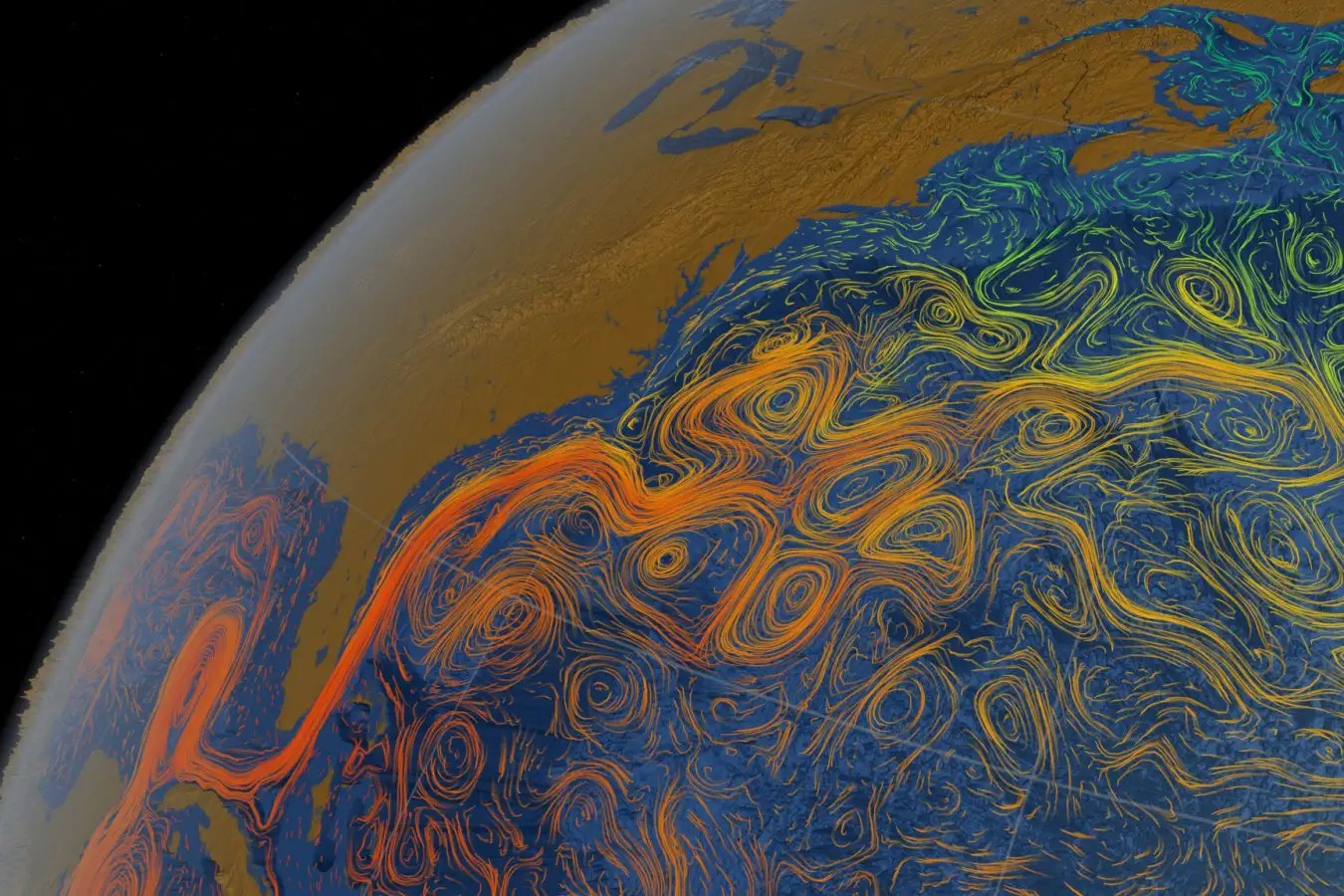
The AMOC matters. It carries warm water north, cools it, lets it sink, and sends it back south. Europe’s climate, African monsoons, even American weather patterns rely on this loop. Lately though? The loop is dragging its feet. Slowing down.
Why? Climate change is melting the Greenland Ice Sheet. Fresh water mixes with salty Atlantic water. Less dense water sinks slower. The engine sputters.
Some scientists think a total collapse is possible. Europe could freeze into near-Arctic misery. Monsoons fail globally. But until now, it felt like guesswork.
“The AMOC collapse has just been so tangible… So far there’s been no firm quantity.” — Phil Holden
It was vague. Abstract. Scary, sure, but vague.
So Holden, Tim Lenton at Exeter, and their team stopped guessing. They ran 21 simulations.
Here’s how it worked.
They modeled varying ice melt rates and emission peaks every 10 years from 2005 to 2135. Then they let the models run for 300 years total. After the peak, they assumed emissions drop to net zero over 35 years. Ice melt stayed constant.
The results were chilling.
Under a “best-case” conservative scenario—emissions peak in 2025, Greenland ice adds just 54mm to sea levels by 2100—the odds of being committed to collapse sit at 10 percent.
Let the emissions peak drag out until 2100?
The odds jump to 80 percent.
That is a massive difference for doing nothing.
Even if the “real” projected melt (274mm rise by 2100) is more likely, we’re looking at a 23 percent chance we’re already doomed to a breakdown.
But don’t panic just yet.
“Locked in” doesn’t mean “happening now.”
In the models, there is a long lag. An average of 84 years passes between the moment of commitment and the actual collapse. The earliest possible collapse? Around 2060.
This gap changes how we talk about risk. It’s not just “when will it happen.” It’s “when did we lock it in?”
Till Wagner from the University of Wisconsin-Madison likes this framing for risk management, though he warns the real world is messy. “I think there’s fairly good proof of weakening… but the larger-scale outcome is still up in the air.”
There are caveats, of course. Always are.
The study used 5-degree grids for its model. That is low resolution. Most modern climate models use 1-degree grids, which crunches much more detail but costs more computing power. Tim Lenton says they didn’t have the resources for high-res runs across that many scenarios.
Jonathan Baker at the Met Office points this out. The lower resolution might skew risk estimates. He says more work with different models is needed.
However—and here is the kicker—recent high-resolution research suggests that if you did use finer grids, the risk probabilities might go up, not down.
So what’s the takeaway?
It’s a simple message, wrapped in complex data.
Cut emissions.
If we delay net-zero targets by just 10 more years past the commitment point, the collapse comes faster. Average time to break drops from 84 years to 57.
“Do everything in our power,” Lenton says. “Get to net zero quickly to keep the probability down at that 10 percent level.”
There is a glimmer of hope. Last month’s research hints that if CO2 drops enough, the slowdown might actually be reversible. Maybe we haven’t lost it entirely. Maybe.
Or maybe we’re just watching the clock tick while the current stalls.
Reference: EarthArXiv, DOI: 10.3123/X5N44Q