A meteorite is essentially a survivor. It starts as a meteoroid, a chunk of rock or metal drifting through the void between planets. Most of these things burn up completely when they hit our atmosphere. But some are tough enough to survive the fiery plunge. They punch through the sky and land on the ground. That surviving fragment is what we call a meteorite.
The definition has expanded over time. We don’t just use it for things that hit Earth. If a rock lands on another large celestial body, we still call it a meteorite. Scientists have found fragments like this in samples brought back from the Moon. Even on Mars, the robotic rover Opportunity spotted at least one meteorite resting on the red planet’s surface.
Giants and Dust Motes
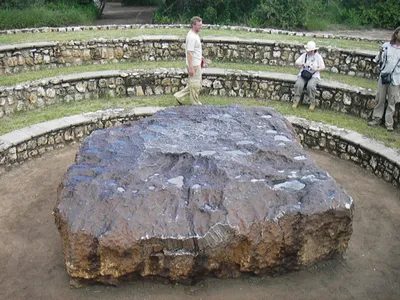
Size varies wildly. The largest known meteorite on Earth is a monster named Hoba. It was discovered in Namibia in 1920. It hasn’t been moved since. The rock measures 2.7 meters across. That is nine feet of solid space rock. It weighs nearly 60 tons. The material is an alloy of iron and nickel. It is massive.
The largest meteorite that has been identified on Earth was found in 1920 in Namibia and was named the Hoba meteorite.
On the other end of the spectrum, we have micrometeorites. These are tiny. They range from a few hundred micrometers down to about 10 micrometers. They come from the constant cloud of dust that fills interplanetary space. You probably breathe some of them in every day. They are the microscopic remnants of cosmic collisions.
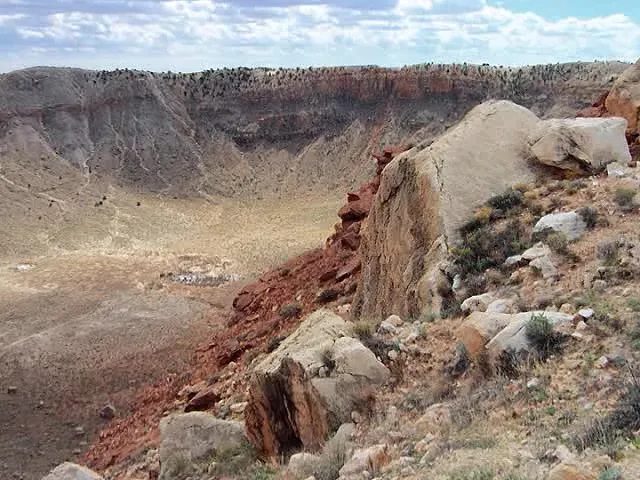
Where do meteorites actually come from?
Most of the rocks you find lying on the ground aren’t from space in the way you might think. They are fragments of asteroids. Specifically, they come from the inner main belt. This is the zone between 2.1 and 3.3 astronomical units (AU) from the Sun. One AU is the distance from Earth to the Sun. That’s roughly 150 million kilometers.
Jupiter plays a dirty trick here. Its gravity tugs at these asteroids. It perturbs their orbits. It kicks them onto paths that cross Earth’s orbit. This is how they get here.
But not everything formed in that specific zone. Orbits migrate. Processes shift material over millions of years. Still, the majority of discrete meteorites we collect trace back to that inner belt.
The Moon and Mars are rare visitors. Less than one percent of all meteorites are from them. You can trace their origin to specific impacts that launched debris into space.
Comets are different. They drop micrometeorites. These are tiny grains drifting through the upper atmosphere. Studies of meteors show some cometary chunks are tough. They survive the heat. They reach the surface. But scientists generally agree that nothing from comets makes it into formal meteorite collections. The material is too fragile. It turns to dust. It doesn’t land as a rock.
Why study these space rocks?
The main reason for studying meteorites is time. Asteroids and comets are time capsules. They hold evidence from the solar system’s infancy.
There are two solid reasons for this.
First, look at the ingredients. The early solar system was gas and fine dust. Planets grew by smashing smaller things together. It started with dust balls. It ended with rocky planets like Mercury and Venus. The giants like Jupiter involved more complex physics. But their moons? They likely formed by simple aggregation. So did comets.
Asteroids and comets are leftovers. They are the debris from intermediate steps. They represent bodies that formed early. They didn’t change much since then.
Second, look at the heat. Early in the solar system, things got hot. Radioactive isotopes decayed. Collisions generated friction. Large bodies melted. Their insides changed chemically and physically. They reset their clocks.
Small bodies didn’t melt. They radiated heat away efficiently. Their interiors stayed cool. They kept the original dust. They kept the primordial material.
Some meteorites contain material older than the solar system itself. They are ancient relics. They survived because they were small. They stayed cold.
Recovery of meteorites
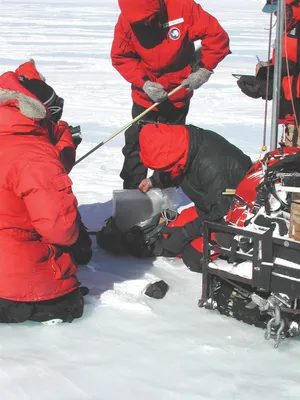
Traditionally, meteorites bear the name of the nearest geographic feature. It is a naming convention born of scarcity. For centuries, there was no systematic effort to recover them. The problem was simple: meteorites fall more or less uniformly across the Earth’s surface. There was no obvious way to predict where they would land or where they might be found. If you saw one fall, or if you stumbled upon a strange rock, you handed it to a museum or a private collector. That was the end of the story.
Then came the 1930s and 40s. Enterprising collectors began crisscrossing the prairie regions of North America. They asked farmers to bring in unusual rocks pulled from the earth during plowing. It was a strategy based on geology. Prairie soil is largely derived from fine glacial loess. It contains few large rocks. Collectors reasoned that any rock unearthed in this barren landscape had a reasonable chance of being a meteorite. It was a low-probability game, but played on a massive scale.
Searching for Accumulation Zones
A better approach to finding meteorites than searching places with few rocks is to search places where they accumulate over time. You want areas where the surface is quite old and rates of weathering are low. Meteorites contain minerals, such as iron metal, that are easily weathered. They do not normally last long on Earth’s surface. Liquid water is one of the principal agents of decay.
In desert environments, where water is scarce, meteorites survive much longer. Indeed, they tend to accumulate on the surface in arid regions if weathering rates are slower than the rates at which meteorites fall to Earth. This only works provided that little windblown sand accumulates to bury them. Areas of the Sahara in North Africa and the Nullarbor Plain region in Australia have proved to be good places to look for meteorites. But the most successful collection efforts have been in Antarctica.
The Blue Ice Trap
The Antarctic can be viewed as a cold desert. Annual snowfall is quite low over most of the interior. The intense cold slows weathering rates considerably. Most meteorites that fall on the ice sheet become buried and are stored for 20,000–30,000 years. Some appear to have been in Antarctica for a million years or more. The ice of the Antarctic sheet gradually flows radially from the South Pole northward toward the coast.
In places, the ice encounters an obstruction. A buried hill forces it to flow upward. Strong katabatic winds, which sweep down the gently sloping ice sheets from the centre of the continent, sandblast the upwelling ice with snow and ice particles. They erode it at rates as high as 5–10 cm (2–4 inches) per year. This leaves the meteorites stranded on the surface.
Areas of upwelling ice, called blue ice for its colour, can be recognized from aerial or satellite photographs. On foot, the dark meteorites are relatively easy to spot against the ice and snow. The drawback of collecting in Antarctica is the harsh conditions. The collection teams must endure them for weeks to months while camping out on the ice. Since the 1970s several countries, notably the United States and Japan, have operated scientific collection programs.
Some tens of thousands of meteorites have been retrieved from Antarctica by these programs. This increased the number of meteorites available to researchers manyfold. These include one-third of all known Martian meteorites. They include one-third of known lunar meteorites. And numerous other rare or unique samples.
Because large numbers of Antarctic meteorites are found within small areas, the traditional geographic naming system is not used for them. Instead, an identifier is made up of an abbreviated name of some local landmark plus a number that identifies the year of recovery and the specific sample.
Types of meteorites
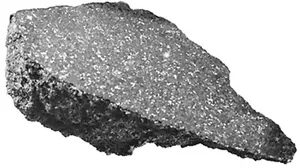
Meteorites have always been sorted into three buckets: stones, irons, and stony irons. It’s a simple split based on what’s in them—rock-forming minerals versus nickel-iron metal alloys. Stony meteorites dominate the list, accounting for roughly 94% of all known specimens. Irons make up about 5%, and stony irons a mere 1%.
But don’t let that simplicity fool you. Inside each bucket, there is chaotic diversity. Subdivisions exist based on chemistry, mineralogy, and structure. And here is the catch: classification is mostly cosmetic. It relies on what you can see, not where the rock came from. Two rocks in the same category might have totally different parent bodies. Sometimes, rocks from different categories actually share a common origin.
“Indeed, more often than not, they are unrelated.”
Consider a large asteroid. If it melts, heavy metals sink to the core while lighter rock forms a mantle. This is geochemical differentiation. When that asteroid eventually shatters, the debris field could contain samples from the core, the mantle, and the messy boundary between them. One sample looks like an iron. Another looks like a stony meteorite. They are siblings, separated by physics and violence. The real challenge for scientists isn’t just naming these rocks. It’s figuring out which ones are related and which processes created such wild variety.
The Stony Divide: Molten vs. Unmelted
Within the vast stony category, the first real split is between achondrites and chondrites. The difference? Heat. Achondrites were once molten. Chondrites were not.
Chondrites are the most abundant type of stony meteorite, making up about 87% of collections. They are arguably the most important too. Think of them as the solar system’s sedimentary conglomerates. They aren’t single, solid rocks. They are mechanical mixtures of components that formed in the solar nebula, or even earlier.
Their composition is a mirror of the Sun. Almost. They lack the very volatile elements like hydrogen and helium, but everything else lines up. The Sun holds more than 99% of the solar system’s mass. So, its composition is the closest thing we have to a baseline for the solar system’s average makeup at birth.
This matters because it gives us a reference point. If a meteorite’s composition deviates from the Sun’s baseline, that deviation is a clue. It tells us about the specific processes that shaped its parent body and the materials inside it.
Chondrules: The Frozen Rain of Creation
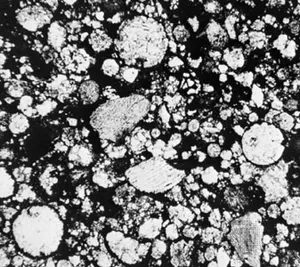
Chondrites are defined by something visible to the naked eye (or at least under a strong lens). They contain chondrules. These are tiny, spherical grains of silicate minerals that solidified from molten droplets in the early solar nebula. They look like bits of frozen rain.
Finding chondrules means the rock never experienced enough heat to melt them down and erase their history. That preservation is key. While achondrites tell stories of planetary differentiation and volcanic activity, chondrites tell the story of the raw ingredients. They are the pristine building blocks.
Scientists look at the size, shape, and mineralogy of these chondrules to reconstruct the thermal environment of the early solar system. How hot did it get? For how long? Was there mixing between different regions of the nebula? The chondrules hold the data.
This leads to a more granular classification of chondrites themselves. They are split into three main classes: ordinary, carbonaceous, and enstatite. Each class has further subdivisions into groups based on subtle chemical tweaks.
Ordinary chondrites are the most common. They are relatively unaltered by water. Carbonaceous chondrites are different. They contain carbon and often water-bearing minerals. They are the wettest and most chemically complex, sometimes carrying organic compounds that predate life on Earth. Enstatite chondrites are rare and formed in a very reducing environment, with a distinct lack of oxygen compared to the others.
“Deviations in a meteorite’s composition from this reference composition provide clues to the processes that influenced the formation of its parent body and the components in it.”
The diversity within these groups is staggering. A single meteorite fall can yield specimens that look identical but have vastly different isotopic signatures. Isotopes are the fingerprint of origin. They can tell us if a rock came from the inner solar system or the outer belts. They can reveal if it was heated by a short-lived radioactive isotope like Aluminum-26.
This is why the study of chondritic meteorites is not just about cataloging rocks. It is about reconstructing a timeline that no one saw. It is about understanding why the Earth became a rocky planet while Jupiter remained a gas giant. The answers are buried in the chondrules, frozen in time, waiting to be read.
The Puzzle of Chondrules
Meteorites get their “chondrite” label because they contain chondrules. These are tiny, spherical bodies. Usually about a millimeter wide. They look like frozen droplets.
Scientists believe these were once molten. They floated in the solar nebula. Then they cooled rapidly. Experiments confirm this. Flash heating hit peak temperatures of 1,800 °C. Then cooling was swift. Up to 1,000 degrees per hour.
But where did that heat come from? That’s the million-dollar question. Chondrules vary by size and composition. This suggests formation was localized. It also happened many times. It was likely the most energetic process in the asteroid belt region. Yet, despite over a century of study, we still don’t know the exact mechanism.
Refractory Inclusions: The Heat Resisters
Chondrites also hold refractory inclusions. Minor, sure. But important. They’re rich in refractory elements. These are elements that don’t vaporize easily. Think calcium and aluminum. Hence, CAIs.
They range from irregular shards to perfect spheres. Tens of micrometers to centimeters. They formed at high temperatures too. But differently than chondrules. The heating was more prolonged. Some melted. Others condensed directly from hot gas into solid crystals.
No consensus exists on how they formed either. Just like chondrules, the origin story of CAIs remains incomplete.
The Matrix: A Fossilized Record
Between the chondrules and inclusions lies the matrix. It’s a fine-grained cement. It holds the larger pieces together. The matrix is richer in volatile elements. This implies some of it formed at lower temperatures.
It’s also rich in organic matter. Up to 2% by weight. The hydrogen and nitrogen isotopes here are weird. Unusual. This points to an interstellar origin. The organic matter likely came from the molecular cloud that birthed the solar system.
But the matrix holds older secrets. Tiny grains. Nanometers to 10 micrometers. They predate the sun. These grains formed in dying stars millions of years before we existed. How do we know? Isotopes.
Solar system carbon-12 to carbon-13 ratios hover around 89 to 1. Some grains from chondrites show ratios of 7,000 to 1. Or 2 to 1. That’s impossible to produce in our sun’s environment. These grains are circumstellar. Minerals like diamond, graphite, and silicon carbide. They are stardust.
Scars of History
Few chondrites are pristine. Most have been altered. Four processes changed them. Aqueous alteration. Thermal metamorphism. Shock. Brecciation.
It started soon after formation. Parent bodies heated up. Some stayed modest. Liquid water existed. Minerals reacted with water. Aqueous alteration created complex new mineral mixes.
Others got hotter. Water boiled off. Thermal metamorphism followed. Mineralogy changed. Physical structure shifted. No widespread melting. Just enough to recrystallize the matrix. Organic matter and circumstellar grains were destroyed. In the most heated chondrites, chondrules themselves recrystallized. At 1,000 °C, they’re hard to see.
Then there’s shock. Asteroid collisions. Every major meteorite type shows this. From minor fracturing to localized melting. This continues today.
Brecciation is the final twist. Bodies broke apart. Then reassembled. The solar system isn’t just a place. It’s a construction site. And these rocks are the debris.
Look at a chondrite and you are looking at a collision of histories. These rocks hold evidence of two separate eras. One era built the parent body. The other changed what happened inside it later. That dual history is why scientists use two overlapping ways to label these meteorites.
The first method looks at the big picture. It relies on major elements. Iron. Magnesium. Silicon. Calcium. Aluminum. Scientists also check oxidation states. They look at oxygen isotopic compositions. They study the petrology. This includes chondrule abundance. It covers matrix presence. It notes chondrule size. It analyzes mineralogy.
When you plot these variables, chondrites don’t scatter randomly. They cluster. Distinct groups emerge. The consensus is that these defining traits formed before or during the creation of the parent bodies. Each group likely comes from a different asteroid or a specific set of asteroids. The chemistry tells us where they started.
But that is only half the story.
Inside those groups, meteorites are not identical. They differ in how much they were heated or soaked in water. This leads to the second classification system. It is called the petrologic type. These types measure the degree of thermal metamorphism. They also track aqueous alteration.
“These differences are referred to as petrologic types; they are broken down in the Click Here to see full-size table”
This system adds a layer of detail to the elemental groups. It explains why rocks from the same parent can look and behave differently. One might be pristine. Another might be baked or altered. The petrologic type captures that post-formation journey.
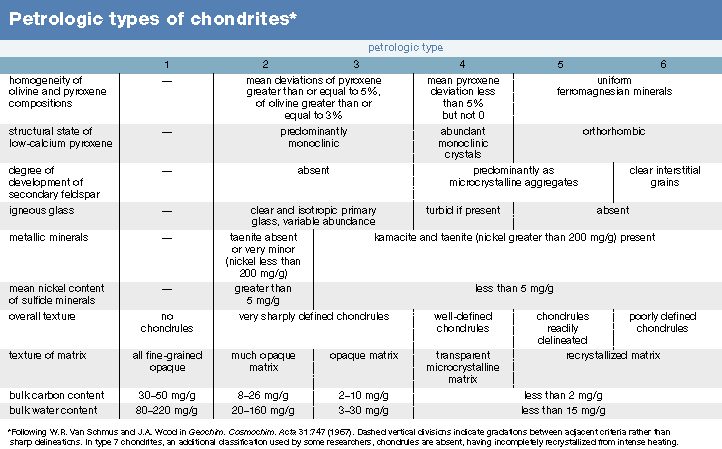
Decoding the Petrologic Type Scale
If you crack open a chondrite meteorite, the first thing scientists look for isn’t gold or diamonds. It’s a code. A single digit that tells the story of the rock’s life. This is the petrologic type system, a classification method that maps exactly how much a meteorite has been beaten up, heated up, or drowned in water since the solar system began.
The scale runs from 1 to 6, though some researchers push it to 7. It’s not random. It’s a timeline of destruction and preservation.
The Water Factor: Types 1 and 2
Start at the beginning. Type 1. This is where water wins.
These meteorites have been soaked. For millions of years, the parent body was warm enough for ice to melt. Liquid water seeped into the cracks, reacting with minerals, creating clays and sulfides. The original chondrules—the tiny melted droplets that define chondrites—are erased. Or at least, they’re heavily altered. If you’re looking for a rock that tells you how much water played a role in early planetary formation, you look here.
Type 2 is the middle ground. There was water, but not enough to completely rewrite the rock’s chemistry. You can still see the original textures. The alteration is there, but it’s mild. It’s the difference between a sponge left in a bucket for an hour versus one left for a week.
The Heat Factor: Types 3 through 6
Then there’s heat.
Type 3 is the baseline. The boundary between unaltered and altered. A type 3 meteorite has seen almost no water. It has also seen almost no heat. It’s pristine. It’s the closest thing we have to the raw material of the solar nebula. You look at it and you’re looking at 4.6 billion-year-old dust and melt.
But as you move up the scale, things get cooked.
Type 4 and 5 represent increasing degrees of thermal metamorphism. The parent body was heated, probably by radioactive decay or impacts. The heat baked the rock. Chondrules become harder to distinguish. Matrix minerals recrystallize. The texture changes. The rock becomes more homogeneous.
Type 6 is the end of the line for most classifications. This is high heat. The rock is nearly melted, but not quite. The boundaries between different mineral grains blur. The chemical signatures of the original components start to blend. It’s a rock that has been through the wringer and come out looking like a different element.
“A meteorite that experienced temperatures just short of melting would be type 6. One that saw extensive aqueous alteration? Type 1.”
The Edge Cases: Type 7 and the Boundary
Some researchers argue that the scale doesn’t stop at 6. Type 7? That’s for rocks that have been heated to the point of partial melting. The chondrules don’t just blur; they melt into the surrounding matrix. The rock is on the verge of becoming an igneous rock, losing its chondritic identity entirely.
So where does your sample land?
If it’s wet and altered, it’s 1 or 2. If it’s dry and pristine, it’s 3. If it’s been baked,
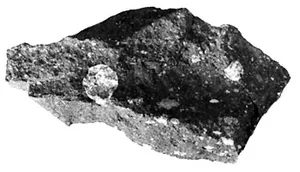
Meteorite scientists have two main ways to classify space rocks. They group them by chemical family or by their thermal history. Most of the time, these methods match up nicely. Sometimes, they don’t.
Take the Allende meteorite. It fell in 1969 in Mexico. The fall was witnessed. That helps. You can track its path. You can find pieces quickly. Scientists studied it for years.
They placed it in the CV3 category. What does that mean?
The “CV” part refers to the chemical group. It belongs to the CV carbonaceous chondrites. These are rare. They contain organic compounds and water-bearing minerals. They are like time capsules from the early solar system.
The “3” is the petrologic type. This number ranges from 1 to 6. It measures how much heat the rock has seen.
- Type 1 and 2 are unaltered. They are cold.
- Type 3 is the least processed. It is still primitive.
- Types 4 through 6 are heated and altered.
Allende is a type 3. It has not been cooked. It retains its original structure. The minerals inside it are pristine. This makes it valuable for studying how the solar system formed.
The classification system helps researchers compare stones from different falls. It tells them the story of the rock. It explains its journey.
“The number 3 indicates a primitive state, preserving clues that heated rocks lose.”
Not every meteorite fits neatly. Some stones show signs of both chemical groups. Some have mixed thermal histories. Scientists have to look closer. They check the minerals. They measure the isotopes.
The Allende meteorite remains a key example. It shows how the two classification methods work together. It provides a baseline. It helps us understand other carbonaceous chondrites.
Why does this matter to us? These rocks hold secrets. Secrets about water. Secrets about life’s building blocks. By classifying them, we organize our search for answers. We know what to look for. We know what to avoid.
The system is not perfect. It is a tool. A useful one. But tools can be misused. Or misunderstood.
Does the classification tell the whole story? No. It tells part of it. The rest requires context. It requires more data. It requires time.
We keep finding new stones. We keep refining the categories. The solar system is not static. Neither is our understanding of it.
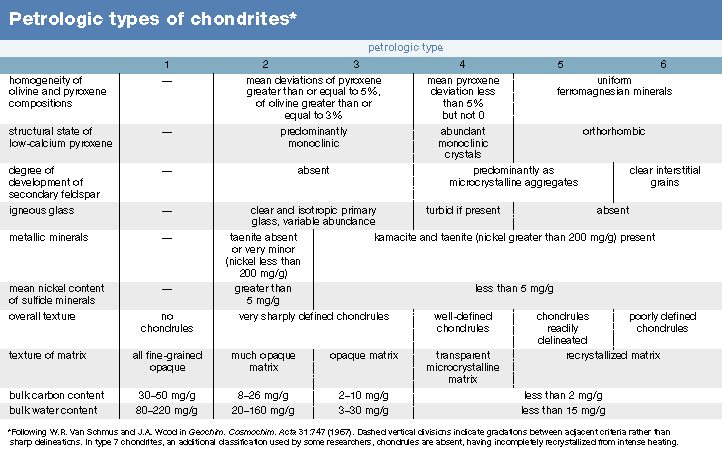
CI carbonaceous chondrites
Some meteorites are labeled by how much they’ve been shocked or weathered on Earth. Those schemes exist but rarely see use. The more common split is simple: did anyone see it fall, or was it just found lying around? That distinction creates the categories of “falls” and “finds.”
The CI group of carbonaceous chondrites stands out in that mix. They are fascinating precisely because they break the rules. Technically, calling them chondrites is questionable. They lack chondrules entirely. If they ever had them, intense aqueous alteration erased all trace. Water processed them so thoroughly that the original structure vanished. Yet their elemental makeup tells a different story. Compare their composition to that of the Sun and the match is striking.
Among all meteorite types, CI chondrites mirror the Sun’s composition most closely. This similarity is why classification systems keep them grouped with chondrites despite the missing structural features. It is a pragmatic choice. These rocks represent the average chemical makeup of the early solar system. Some researchers have pushed this logic further. They suggest CI chondrites might come from comets rather than asteroids. Comets are thought to hold the most pristine, unaltered material in the solar system. The idea has flaws. Science still lacks a complete understanding of cometary nature and origins. That gap in knowledge means dismissing the possibility entirely is unwise. It remains a compelling hypothesis.
Achondrites
Achondrites tell a different story entirely. Unlike chondrites, they do not contain chondrules. They are igneous rocks. Their parent bodies underwent enough heating to melt and differentiate. The material separated into core, mantle, and crust layers. When these bodies broke apart, fragments escaped into space. Some eventually rained down on Earth.
These rocks often look like terrestrial igneous rocks. Basalts and gabbros from Earth share similarities with certain achondrites. The key difference lies in their origin. They come from differentiated parent bodies. That could be a large asteroid like Vesta or even a planet. Mars provides a specific example. Some achondrites are confirmed to be Martian meteorites. Lunar meteorites also fall into this category. They represent crustal material from the Moon or Mars.
The classification of achondrites relies on their petrology and geochemistry. Scientists analyze mineral compositions and isotopic ratios. These data points link the rocks to specific parent bodies. For instance, unique oxygen isotope signatures help identify Martian origin. The process is meticulous. It requires advanced analytical techniques to distinguish between Earth rocks and extraterrestrial ones. Despite the challenges, achondrites provide crucial insights into planetary formation. They reveal how heat and pressure shaped the early solar system.
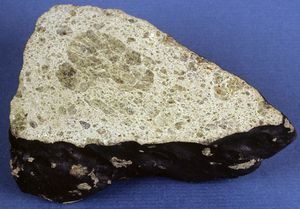
Achondrites. The name is a mouthful, but the definition is simple enough: these are meteorites “without chondrites.” They aren’t just random space rocks. They tell a story of chaos, heat, and planetary evolution. While they make up a relatively small slice of the meteorite pie, they are wildly diverse.
Their parent bodies didn’t stay cold and primitive. They melted.
Think about that for a second. Widespread melting. That’s not just a warm day in space. That’s enough energy to drive geological processes we usually associate with Earth. These stones show us igneous features—look closely and you’ll see textures identical to terrestrial volcanic rocks. You’ll see segregation. Molten metal separating from molten silicate rock, potentially forming a core. Silicate crystals sorting themselves out of the magma. Most of the achondrites we dig up on Earth come from asteroids. But a tiny fraction? They’re from Mars. And another small group? From the Moon.
The Aubrites and Chemical Oddities
Let’s look at the three most numerous asteroidal groups. First up: the aubrites. Also known as enstatite achondrites.
They come from parent bodies that formed under highly chemically reducing conditions. That’s a fancy way of saying the chemistry was weird. Unlike Earth, where you expect oxygen to bind with everything, these bodies hoarded electrons. The result? Elements exist in less-common compounds. Take calcium. On Earth, you’ll find it in silicates and carbonates. In aubrites? It shows up as oldhamite (CaS), a sulfide. It’s a reminder that the solar system wasn’t a monolith. Different regions had different chemical personalities.
Vesta’s Violent History
Then there’s the howardite-eucrite-diogenite (HED) association. These three aren’t just related. They’re siblings from the same family. The asteroid Vesta. The second-largest member of the asteroid belt.
Linking them to mesosiderites (a group of stony iron meteorites) makes sense. When you examine HED meteorites, you don’t just see a rock. You see a timeline. Vesta has a complex history. It melted. It segregated metal into a core. It crystallized. It underwent metamorphism. It got slammed by impacts that turned solid rock into breccia—a process where impact shatters the rock and cements it back together.
It’s a violent history. And we have the receipts.
Depth vs. Surface: The Eucrite Split
The eucrites are subdivided, and the difference is all about where and how fast they cooled.
Cumulate eucrites are the deep divers. They’re like terrestrial gabbros. They formed at depth in Vesta and crystallized quite slowly. You have time. The minerals have time to grow. To settle.
Basaltic eucrites? They’re the surface dwellers. Similar to terrestrial basalts. They formed at or near Vesta’s surface. Cooled fast. No time for deep crystallization. Just rapid solidification.
And then there are the diogenites. Composed predominantly of the mineral pyroxene. Also formed at depth. But distinct from the cumulate eucrites. The howardites tie it all together. They’re impact breccias. Cemented fragments of diogenite and eucrite materials. They’re the debris field of Vesta’s violent past.
The Carbon Veins of Ureilites
The third main class of asteroid-derived achondrites brings us to the ureilites. These are carbon-bearing.
Picture a silicate rock. Primarily olivine and pyroxene. But running through it are dark veins. These veins can make up as much as 10 percent of the meteorite. What’s inside them? Carbon. Graphite. Some diamond. Nickel-iron metal. Sulfides.
The silicates clearly crystallized from magma. That part is settled. But how they formed? There’s debate.
The carbon-rich veins seem to have formed by shock-induced redistribution. Graphite originally crystallized along with the silicates. Then, shock waves moved it around. Pulled it into veins. It’s not just a static rock. It’s a dynamic system that got shaken apart and put back together.
Beyond the Big Three
You have your aubrites. Your HEDs. Your ureilites.
But that’s not the whole story. There are minor classes. A collection of unique achondrite specimens. Each one reflects the variability of melting processes in the asteroids. No two parent bodies behaved exactly the same. No two melting histories were identical.
We are looking at the geological fingerprints of worlds that are no longer there, or are heavily modified. The science of achondrites isn’t just about classification. It’s about
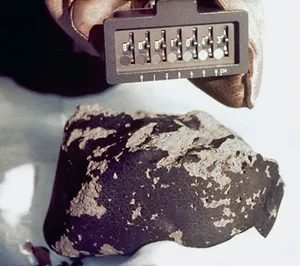
Three dozen meteorites have been identified as having come from Mars. They are all volcanic rocks. All but one belong to three specific classes—shergettites, nakhlites, and chassignites. These were named long before anyone suspected they were from another planet. Collectively, scientists call them SNCs.
One piece of evidence for a planetary origin of the SNCs is their young age, between 150 million and 1.3 billion years. Retaining enough heat so that volcanic activity could continue until just 1.3 billion years ago, let alone more recently, required a planet-sized parent body. Because there is considerable geochemical evidence that the rocks did not originate on Earth, the only likely candidates that remain are Venus and Mars, both of which appear to have experienced recent volcanic activity.
The most convincing evidence for a Martian origin comes from an Antarctic meteorite, an SNC named EETA79001. This meteorite contains trapped gases (noble gases, nitrogen, and carbon dioxide) whose relative abundances and isotopic compositions are almost identical to those of the Martian atmosphere as measured by the two Viking landers. Scientists believe that the Martian meteorites are fragments of the planet’s near surface that were launched into space by large impacts and that eventually found their way to Earth. In the case of EETA79001, atmospheric gases apparently became trapped in glasses produced during the violent shock event that excavated the rock from Mars. As the only samples of Mars available to scientists on Earth, Martian meteorites provide a unique window into the evolution of this enigmatic planet.
Searching for Ancient Life in ALH84001
Several Martian meteorites have been aqueously altered to some degree, which is in line with other evidence that liquid water was present at least periodically on Mars at some time in the past. The most unique Martian meteorite is another Antarctic specimen, ALH84001. This rock, an orthopyroxenite, has a crystallization age of about 4.5 billion years, which is roughly the same age as asteroidal meteorites (see below The ages of meteorites and their components), but several of its properties clearly tie it to the other Martian meteorites.
About 3.9 billion years ago, aqueous fluids passed through it, precipitating carbonate-magnetite-sulfide mineral assemblages. Some researchers interpreted these rather unusual assemblages as evidence for life on Mars. They also reported features in the meteorite that they interpreted as fossilized bacteria. These claims created considerable controversy, but they also generated important debate on how life might originate and how it might be recognized even if it is unlike the life known on Earth.
The Lunar Connection
A number of lunar meteorites have been found in Antarctica and hot deserts on Earth. They probably would not have been recognized as having come from the Moon were it not for the lunar samples brought back by the crewed Apollo and robotic Luna missions. The meteorites, which likely are fragments blasted off the Moon by large impacts, resemble the various rock types represented in the lunar samples (e.g., mare basalts, highland regolith breccias, and highland impact-melt breccias), but they almost certainly came from areas that were not sampled by the various missions. Therefore, like the Martian meteorites, they are an important source of new information on the formation and evolution of their parent body.
Iron meteorites
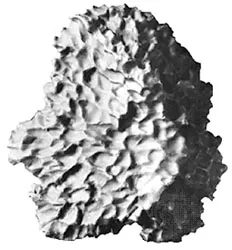
Iron meteorites aren’t just random chunks of space junk. They are the heavy, metallic remnants of a violent cosmic history. Specifically, they are pieces of denser metal that segregated from less-dense silicates when their parent bodies were at least partially melted.
For a long time, the standard explanation was simple. These rocks came from the cores of their parent asteroids. Think of a planetesimal that heated up enough to turn into a soup of rock and metal. The heavy iron sank to the center. The lighter silicates floated to the crust. When those bodies were later shattered by collisions, the core fragments ended up raining down on Earth as iron meteorites.
But the picture might be more complicated.
Some researchers suggest that metal didn’t always form a single, massive repository at the center. Instead, it may have pooled locally. Imagine a structure resembling raisin bread. The silicate rock is the dough. The metal chunks are the raisins.
“Metal, rather than forming a single repository, may have pooled more locally, producing a structure resembling raisin bread, with metal chunks as the ‘raisins.'”
How did we get raisin bread instead of a layered core? The difference lies in how the heat was applied.
If an asteroid underwent global melting, the density differences would force a complete separation. Heavy iron sinks. Light rock rises. The result is distinct layers. A core. A mantle. A crust.
If an asteroid underwent localized shock melting, the story changes. A massive impact might heat only a small region. Enough to melt some metal. Not enough to melt the whole body. The metal forms pockets. It doesn’t sink to the center because the surrounding rock is still solid. It stays put.
This theory explains why some iron meteorites have chemical signatures that don’t quite match a deep-core origin. They look like they formed in a hurry. In pockets. In the middle of nowhere.
It also raises questions about which asteroids actually produced these samples. Not every parent body had the right conditions. Some stayed cold. Some melted completely. The ones that produced “raisin bread” asteroids were caught in a specific window of thermal energy. Enough to mobilize the metal. Not enough to erase the chaos.
So when you hold an iron meteorite, you’re holding a piece of a core. Or maybe just a raisin from the middle of a broken loaf. The distinction matters for understanding how early solar system bodies processed their materials. Did they reach equilibrium? Or did they get interrupted?
We’re still sorting out the details. The metal tells a story. It’s just not always a linear one.
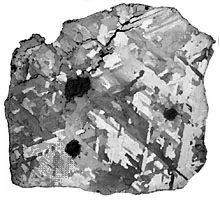
Iron meteorites are basically frozen chunks of planetary cores. They are mostly made of two nickel-iron minerals: nickel-poor kamacite and nickel-rich taenite. The ratio of these two minerals dictates the meteorite’s internal structure.
Take hexahedrites. They are almost entirely kamacite. Because they are so uniform, they lack internal structure beyond shock features. At the other end of the spectrum are ataxites. These are rare and rich in taenite, containing up to 60 percent nickel by weight. Like hexahedrites, they are nearly monomineralic and thus structurally featureless.
Between them lie the octahedrites. Here, kamacite crystals form interlocking plates in an octahedral arrangement. Taenite fills the gaps. When you cut, polish, and etch an octahedrite with dilute acid, you see the Widmanstätten pattern. This geometric lattice proves the meteorite formed at low pressure. It matches conditions expected inside asteroid-sized bodies.
Chemical Classification Over Structure
We used to classify iron meteorites by nickel content and Widmanstätten patterns. That method is largely obsolete. Now, scientists use a chemical classification based on gallium, germanium, and nickel levels.
The most common groups have boring names: IAB, IIAB, IIIAB, IVA, and IVB. There are many smaller classes and unique specimens too. The working assumption is that most irons came from asteroid cores. Variations within a class reflect changing conditions during core solidification.
Gallium and germanium abundances in molten metal don’t change much during crystallization. They are sensitive to the environment where the parent asteroid formed. Similar gallium and germanium levels suggest a shared origin. Maybe they came from the same rock. Or maybe their parent bodies formed at the same time and place.
Nickel tells a different story. It concentrates in the parts of the metal that stay molten longer. This makes nickel levels a useful tool for determining the crystallization sequence within a class.
Similar gallium and germanium levels suggest a shared origin. Maybe they came from the same rock. Or maybe their parent bodies formed at the same time and place.
Anomalous Origins
Not everything fits neatly into the core-formation model. The IAB, IIICD, and IIE iron meteorites show geochemical traits distinct from other classes. Their origin is unclear. Some researchers believe impact processes created them.
Stony iron meteorites
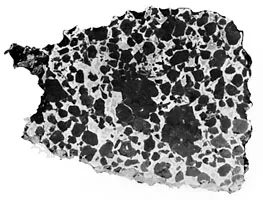
Pallasites: Windows into Asteroid Cores
Stony irons are the oddballs of the meteorite world. Roughly half silicate, half nickel-iron metal. They split into two camps: pallasites and mesosiderites.
Pallasites are where it gets pretty. You get a network of shiny metal with green olivine crystals embedded inside. Think of it as a cosmic jewelry setting. The olivine grains are usually about half a centimeter wide. Look closer at the metal, though. You’ll see the Widmanstätten pattern. Those geometric lines only form when metal cools incredibly slowly over millions of years.
How did these form? They didn’t just crash together randomly. They grew at the boundary between molten metal and molten rock. Picture an asteroid that differentiated. The heavy nickel-iron sank to the core. The lighter silicates floated up to form the mantle. Pallasites represent that exact interface. They are the boundary layer between the core and the mantle.
Some scientists think they come from the outer cores of asteroids. Others suggest they might be large nuggets of metal that collected in the mantle, surrounded by silicates. Either way, they are rare. And beautiful.
Mesosiderites and the HED Connection
Then there are mesosiderites. These are messier. They are impact breccias. That means they are fragments of rock welded together by a massive collision.
They are closely tied to the HEDs—a trio of achondrites named for three asteroids: howardites, eucrites, and diogenites. Mesosiderites share DNA with howardites. They contain fragments of eucrites and diogenites. But they have something extra. A lot of dispersed nickel-iron metal.
Where did that metal come from? We don’t know for sure. The leading theory is simple violence. A body with a differentiated core collided with the mesosiderite parent body. The core shattered. The metal mixed with the silicate fragments. It was a cataclysmic event. The result is a rock that tells a story of destruction and mixing.
Linking Rocks to Their Home Asteroids
You might ask how we know which asteroid these rocks came from. It isn’t magic. It’s chemistry and physics working together.
The connection between meteorites and asteroids relies on matching spectral signatures. When we look at asteroids through telescopes, we see light reflected off their surfaces. That light has specific patterns based on the minerals present. When we analyze meteorites in the lab, we see the exact same spectral fingerprints.
This link is not always direct. Sometimes an asteroid has changed since it last shed a chunk. Space weathering alters the surface. But the match is strong enough for most cases. We can trace a howardite back to Vesta. We can link certain achondrites to specific asteroid families.
This association matters. It turns a random rock in your hand into a sample from another world. We can map the geology of an asteroid without ever landing there. We just have to find the pieces it dropped along the way.
The search continues. New telescopes find more asteroids. New meteorites fall on Earth. Each one tightens the link. We are building a map of the solar system’s building blocks. And we are just getting started.
The Surface Mismatch: Why Asteroids Look Different Than Their Meteorites
The logic seems straightforward. If meteorites come from specific spots in the asteroid belt, those parent bodies should share the exact chemical and mineralogical fingerprints of the rocks we find on Earth. In theory, we could just look at the light asteroids reflect—their albedo and reflectance spectrum—to identify their sources directly.
The reality is messier.
A handful of natural processes conspired to make matching asteroids to meteorite groups far more difficult than anyone expected.
S-Class and C-Class: The Two Main Groups
Most asteroids fall into two broad categories, even if no two spectra are identical.
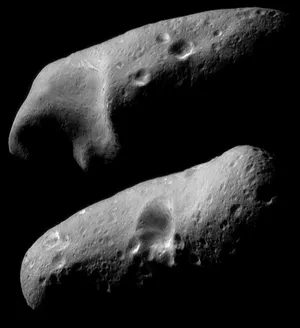
The S-class asteroids, like Gaspra and Ida (observed by the Galileo spacecraft) or Eros (visited by NEAR Shoemaker), have moderate albedos. Their surfaces contain mixtures of olivine, pyroxene, and metallic iron. These are the same minerals found in ordinary chondrites. The problem? These minerals appear in other meteorite types too, making them poor unique identifiers.
The C-class asteroids, like Mathilde (also visited by NEAR Shoemaker), have low albedos. Their spectra are featureless, suggesting light-absorbing materials. At least half show signs of iron-bearing hydrous silicates. This makes them plausible sources for certain carbonaceous chondrites but unlikely candidates for ordinary chondrites. The low albedo and presence of water-bearing minerals simply don’t fit the dry, metallic profile of ordinary chondrites.
The S-Class Puzzle
When scientists zoomed in on S-class asteroids, the easy fit with ordinary chondrites fell apart.
Their mineralogies varied too much, specifically the ratios of olivine to pyroxene. This led to dividing them into seven subclasses. The S(IV) subclass seemed to be the best match.
This hypothesis got a boost from the NEAR Shoemaker mission. An X-ray spectrometer measured the elemental composition of Eros, an S(IV) asteroid. Except for a notably low sulfur content, Eros’s surface composition aligned perfectly with that of an ordinary chondrite.
But here is the catch. The spectra of the S-class asteroid surfaces did not match the spectra of ordinary chondrites. There was a glaring discrepancy between what the instruments saw in light and what the rock samples should have looked like.
Space Weathering Solves the Mystery
The gap between theory and observation wasn’t closed until 2010.
The Japanese spacecraft Hayabusa returned to Earth from the S(IV) asteroid Itokawa. It brought back over 1,500 particles of dust. The results were definitive. The particles had surfaces that looked like typical S-class asteroids. But inside? The composition was identical to ordinary chondrites.
The surfaces had been altered.
This alteration is known as space weathering. It is a collective term for processes that change the chemical and physical properties of airless bodies over time.
What drives this weathering?
- Impacts from meteorites and micrometeorites.
- The impingement of energetic solar wind particles.
- Exposure to solar radiation and galactic cosmic rays.
These forces act on Mercury, the Moon, planetary satellites, comets, and asteroids. You can see the effects by comparing younger surfaces around craters to older terrains. NEAR Shoemaker saw this on Eros. Galileo saw it on Gaspra and Ida.
Other Associations
Space weathering doesn’t just confuse S-class links. It likely affects the spectra of asteroidal sources for all meteorite groups. Despite this, scientists have built convincing associations for others.
The CV and CO groups of carbonaceous chondrites are proposed to come from K-class asteroids.
Vesta, a prominent asteroid in the main belt, is the source of the howardite-eucrite-diogenite link. Spectral measurements also point to Vesta as the source of mesosiderites.
For iron meteorites, the most likely parent bodies are M-class asteroids. However, enstatite chondrites and mesosiderites have also been linked to this class.
Finally, pallasites may originate from A-class asteroids.
The connection between the sky and the soil is there. It is just hidden beneath layers of cosmic static and impact debris.
The clock started ticking for the solar system roughly 4.5 billion years ago. When planets and asteroids first coalesced, they were seeded with radioactive isotopes. These unstable atoms decay at specific, predictable rates. We measure that rate by half-life—the time required for half of a sample to break down.
Some of these radionuclides live longer than our sun. We call them long-lived radionuclides. They are still here. You can find them in meteorites and deep within the Earth’s crust. Scientists use them to date rocks because their longevity provides a stable baseline for measuring deep time.
But how do you actually pin down a number?
The Isochron Method Explained
Most geochronologists rely on the isochron method. It’s a graphical technique that removes a lot of the guesswork. Let’s look at the rubidium-strontium system as a working model.
It’s straightforward.
Rubidium-87 is the parent. Strontium-87 is the stable daughter. The half-life for Rubidium-87 is massive: 48.8 billion years. Strontium also has stable siblings, like Strontium-86. That isotope doesn’t change. It acts as the reference point.
When a rock crystallizes, every mineral inside it starts with the same Strontium-87 to Strontium-86 ratio. But the ratio of Rubidium-87 to Strontium-86 varies from mineral to mineral. Some grab more rubidium. Some ignore it.
As time passes, Rubidium-87 decays into Strontium-87. The ratios shift. They shift faster in minerals that had lots of rubidium to begin with.
If you plot the current Strontium-87/Strontium-86 ratios against the Rubidium-87/Strontium-86 ratios for different minerals in that same rock, the data points line up. They form a straight line.
That line is the isochron.
The slope of that line tells you the age. Steeper slope? Older rock. The intercept where the line hits the axis (where rubidium is zero) gives you the initial strontium ratio at the moment of formation.
Internal vs. Whole-Rock Isochrons
When you use minerals from a single rock, it’s an internal isochron. You can also scale up. Take multiple rocks that formed at the same time and place but had different initial chemical compositions. Plot those. You get a whole-rock isochron.
It’s elegant. It’s robust. It’s also ambiguous.
An isochron dates a moment. But which moment?
Did it date when the minerals originally formed? Or did it date when the rock was heated up later, causing the strontium isotopes to mix and rehomogenize? Heat resets the clock. Without other geological evidence, you can’t always tell which event the isochron is capturing.
If the data points don’t form a straight line, the system is broken. It’s been disturbed. In meteorites, this is usually due to shock. A massive impact shakes the rock apart, scrambling the isotopes. The data scatters. The clock stops working.
The Ghost of Short-Lived Isotopes
Long-lived isotopes give us absolute dates. Short-lived ones are trickier.
Many short-lived radionuclides had half-lives of only a few million years. They decayed away eons ago. You can’t measure them directly anymore. They are ghosts.
But their chemical fingerprints remain. Scientists can infer their original abundances using the isochron method on daughter products. By comparing these original abundances across different meteorites, researchers can determine relative ages. Which object formed first? Which came later?
If you have an absolute date from a long-lived isotope for one object, you can calibrate the relative timeline for the others. You turn “older than” into “X million years old.”
This has been the focus of intense modern research. It is difficult. Why? Because short-lived radionuclides behave chemically in wildly different ways. They don’t stick to the same rules as long-lived isotopes or each other. Aligning the timeline is a puzzle with missing pieces.
Still, the picture is remarkably clear given the constraints.
Refractory Inclusions and Chondrule Timing
The oldest objects we have are refractory inclusions. They are found in meteorites. Their age is pinned at approximately 4,567 million years. These are the first solids to condense from the solar nebula.
They also contain the highest traces of short-lived radionuclides. It makes sense. They formed when the solar system was youngest and most radioactive.
Chondrules are next. But their absolute ages are fuzzy. We don’t have precise numbers.
We do know this: chondrules in ordinary and carbonaceous chondrites show traces of Aluminum-26. This suggests they formed over an extended window. The window opens 1 million years after refractory inclusions. It stretches to 3 million years. Some interpretations push it to 10 million years.
There is debate here.
Are we measuring when chondrules melted and solidified? Or are we measuring when later heating events reset the isotopic clocks in already-formed chondrules? The later dates are suspect. They might reflect thermal metamorphism, not initial formation.
This metamorphism ended at different times depending on the chondrite type. In ordinary chondrites, it stopped between 5 and 55 million years after inclusions formed. In enstatite chondrites, it ceased between 9 and 34 million years later.
Why the variance?
It comes down to physics and geometry. Larger parent bodies cool slower. They hold heat longer. So do deeper regions inside those bodies. The age span isn’t just about time. It’s about depth and mass. The meteorites we hold in our hands are fragments of a complex, cooling engine that took tens of millions of years to wind down.
We have the dates. We have the methods. But the exact sequence of melting and cooling in those dark, ancient stones still holds onto some of its secrets.
Timing the First Rocks
The clock for ordinary and enstatite chondrites is fuzzy. We do not know their exact birth dates. But the end of their metamorphism sets hard limits. They formed no more than five million years after refractory inclusions appeared. Enstatite chondrites likely waited just two million years.
Carbonaceous chondrites are even older mysteries. Water altered their minerals. That alteration happened quickly. Evidence shows they formed within three to seven million years of those inclusions. It could have been less than one million years.
Achondrites tell a different story. Their magma crystallized between 4.558 billion and 4.399 billion years ago. Vesta is the outlier here. Its parent body started melting at 4.565 billion years. That is earlier than most.
Iron and stony iron meteorites crystallized 10 to 20 million years after inclusions formed. Yet metal-silicate differentiation happened in less than 1.5 million years.
The speed is the point. Many asteroids melted, differentiated, and solidified almost instantly.
Why does this speed matter? It changes how we view the early solar system. Planets did not grow slowly from dust. They reacted. Heat was available immediately. Differentiation was not a slow drift. It was a rapid response to local conditions. The timeline forces us to rethink accretion rates. The first rocks were not waiting around. They were processing material at maximum capacity.
The journey from the asteroid belt to our atmosphere is not instantaneous. Figuring out how long a rock takes to make that trip helps scientists identify the mechanisms responsible for delivering space debris to Earth. We cannot measure this travel time directly. However, we can deduce it using cosmic-ray exposure ages. This metric tells us how long a meteorite spent as a small object—less than a few meters across—floating in space or near the surface of a larger parent body.
The Physics of Cosmic Bombardment
High-energy galactic cosmic rays, mostly protons, penetrate meteoroidal material up to a few meters deep. If a meteoroid is smaller than that range, it gets irradiated throughout. These protons smash into atomic nuclei, knocking out other protons and neutrons. This process, called spallation, creates many rare isotopic species. Both stable and radioactive elements are produced.
The concentration of radioactive isotopes monitors the bombardment rate, while stable species like neon-21 measure the total time since exposure began.
Specific isotopes include stable noble gases: helium-3, neon-21, argon-38, and krypton-83. Radioactive isotopes with varying half-lives are also formed. These include beryllium-10 (1.6 million years), aluminium-26 (730,000 years), chlorine-36 (300,000 years), calcium-41 (100,000 years), manganese-53 (3.7 million years), and krypton-81 (210,000 years).
The stable isotopes accumulate over time. Neon-21, for example, measures the total duration since the meteoroid was excavated by a collision. Before that collision, the object was shielded inside a larger body.
Age Distributions by Meteorite Type
Most meteorites have exposure ages exceeding one million years. The distribution varies significantly by type. For chondritic meteorites, the count drops off quickly as age increases. Most ordinary chondrites are less than 50 million years old. Carbonaceous chondrites tend to be younger, often less than 20 million years. Achondrites cluster between 20 and 30 million years.
Iron meteorites tell a different story. Their exposure ages span a much broader range, extending up to two billion years. Peaks in these distributions likely reflect major impact events that disrupted their parent bodies.
Orbital Dynamics and Collisional Lifetime
These age ranges reveal the dynamic evolution of meteoroid orbits and their collisional lifetimes. There are almost no meteorites with exposure ages under one million years. This suggests orbits do not become Earth-crossing in less than a million years.
Computer simulations support this timeline. They also predict orbital lifetimes should decline faster than cosmic-ray exposure ages. This discrepancy led to a new theory. Meteorites likely spend significant time as small objects migrating within the asteroid belt. They wait until their orbits intersect a resonance.
Resonances are regions where planets, especially Jupiter, exert strong gravitational perturbations. These forces push meteoroids into Earth-crossing trajectories.
The drop-off in older stony meteorites aligns with collision estimates. Half of any given population is eliminated by collisions in 5 to 10 million years. The upper limit for most stony meteorites is 50 million years. Iron meteorites survive longer. Their greater strength allows them to persist in space for billions of years. The mechanisms that eject these rocks remain a key area of study in understanding how the solar system delivers material to our planet.
Short-Lived Radionuclides and the Solar Nebula
We know stars are born when dense pockets of interstellar gas collapse under their own gravity. The solar nebula likely followed this same path. Meteorites provide the physical proof, containing preserved material from before and during that collapse. But here is the sticky part. We still do not know what triggered the collapse in our specific corner of the galaxy.
It could have been random density fluctuations. Or something more specific.
The evidence points to the latter. Meteorites, especially their refractory inclusions, contain short-lived radionuclides. These isotopes were present when the solar system formed, not added later by cosmic rays. The most damning piece of evidence is calcium-41. Its half-life is roughly 100,000 years. To detect it now, it had to be incorporated into these inclusions within a few half-lives of its creation. Less than a million years. That is an眨眼 in astronomical terms.
Other short-lived radionuclides have longer half-lives, so they are less urgent. But their ratios matter. Scientists compare these natural abundances against what we expect from stellar sources.
Triggers from Dying Stars
Two main candidates dominate the search for the source of these radionuclides. First, supernovas. Massive stars that explode at the end of their lives. Second, asymptotic giant branch (AGB) stars. These dying stars also blast off massive, fast-moving winds rich in the very isotopes we see in meteorites.
Computer simulations support this theory. When a supernova or AGB wind slams into a molecular cloud that isn’t ready to collapse on its own, it compresses the gas. The cloud becomes gravitationally unstable. It collapses. And crucially, the wind’s material—loaded with radionuclides—gets mixed into the forming cloud.
In this scenario, the radionuclides in meteorites act as fingerprints. They trace the specific stellar wind that kicked off the formation of the Sun and planets.
There is an alternative, though it is less convincing. Some models suggest the early, active Sun itself produced these radionuclides through intense radiation within the solar nebula. It struggles to explain the exact absolute and relative abundances we find. Neither model is perfect. But the stellar wind theory has the edge.
The Thermal History of the Asteroid Belt
Once the collapse began, the first solids to appear were those refractory inclusions. They formed in brief, violent heating events about 4.567 billion years ago. This timing aligns with the temperature gradient of the early solar system. Mercury is dry and rocky. Jupiter is gas-rich and cold. The inner system was hot. The outer system was cold. Astrophysical models predict this, even if the exact numbers vary.
One idea for the inclusions is that they formed in convection currents at the edge of the hottest part of the inner nebula.
The asteroid belt tells a different story. It was a tranquil place. Presolar material survived there. Water-bearing minerals exist. Volatile elements are abundant in chondrites. This argues against widespread heating in that region. It fits current astrophysical models of a cool outer zone.
But it wasn’t entirely quiet. Chondrules appear in most chondritic meteorites, except for the CI chondrites. This proves there were local, transient spikes in temperature. Brief moments of extreme heat in an otherwise cold environment.
Why Chondrules Matter
If chondrules were rare, we might dismiss them. But they are not. They make up the bulk of ordinary chondrites—the most common meteorites falling to Earth. They are a major part of other chondrites too. This mass indicates that chondrule formation was central to the early solar system’s evolution.
Even if the parent bodies of these meteorites formed in a restricted zone of the asteroid belt, that zone still represents about 10 percent of the total belt. And likely, other chondrule-bearing asteroids formed further out, even if they are in the inner belt today.
So how did they form? Electrical discharges. Shock waves. Collisions between molten asteroids. Outflows from the young Sun. The list is long. None has won general acceptance yet.
The key might be time. The ages of chondrules could distinguish between these theories. If they formed over a span of 1 to 10 million years after the inclusions, some models break down. But if their measured ages just reflect when they were reheated or altered inside their parent bodies, the problem vanishes.
The record is still being written. The radionuclides gave us a starting date. The chondrules give us a messy, complex middle. What happened next remains partially obscured by the dust of 4.5 billion years.
The Mystery of Asteroid Heating
Asteroids didn’t just appear. They started forming maybe a million years after the first solid materials condensed in the solar nebula. Within five to ten million years, they were already hot enough to melt. Some underwent aqueous alteration. Others saw volcanic activity last for up to 170 million years. We still don’t know exactly what powered this heat.
The leading theory points to short-lived radioactive isotopes like aluminum-26 and iron-60. These decay rapidly, releasing intense heat. But it wasn’t just radioactivity. Electric currents induced by early solar winds likely played a role. Gravitational potential energy released during accretion added more heat. The exact mix remains a mystery.
Rapid Planetary Aggregation
This wasn’t just happening in the asteroid belt. Asteroid-sized bodies were forming everywhere. They began aggregating into larger chunks. This process eventually built the rocky inner planets. It happened fast.
The Moon likely formed when a Mars-sized body slammed into the growing Earth. The oldest dated Moon rocks are about 4.44 billion years old. Evidence suggests the Moon actually formed within 30 million years of the first solids appearing. Mars formed even faster. Its oldest meteoritic material is 4.5 billion years old, but the planet itself solidified about 13 million years after those initial solids.
Within 30 million years, tiny particles had become full-fledged rocky planets.
Missing Mass in the Asteroid Belt
For asteroids to form and evolve in such short timeframes, the original matter density must have been high. It likely resembled the density in the regions of the giant planets. Today, the asteroid belt contains very little mass. Perhaps only one ten-thousandth of the original material remains.
Something removed almost everything. What cleared out the debris?
Jupiter’s Gravitational Sweep
The most likely culprit is Jupiter. The formation of the giant planets, especially Jupiter, quickly evacuated most of the matter from this region. Meteorites show mineralogical and chemical records that don’t fit with having been part of a planet the size of the Moon. This implies Jupiter formed rapidly. It grew before asteroids could become full-fledged planets.
Before Jupiter reached its current mass, asteroids moved in nearly circular orbits. Then, as Jupiter and Saturn finished forming, the shifting mass distribution sent waves of gravitational resonance through the belt. These waves increased the eccentricity and inclination of asteroid orbits to the moderate values we see today.
Given the ages of asteroids and their current size limits, proto-Jupiter must have begun capturing massive quantities of hydrogen and helium from the solar nebula within about one million years of the solar system’s formation. This rapid growth required a more complex formation mechanism than that of the rocky planets. It wasn’t just accretion. It was something more dynamic.
Meteorites as Probes
This scenario of early solar system evolution is likely wrong in some details. Perhaps many. Without samples of asteroids and primitive materials provided by meteorites, we would have no observational basis for these models. Meteorites are effectively “poor man’s space probes.” Until spacecraft missions bring back diverse samples from asteroids and comets, meteorites will remain the most precise source of data for understanding how the solar system evolved.
The story isn’t finished. New samples will rewrite the timeline. The gaps in our knowledge are just as important as the facts we have.