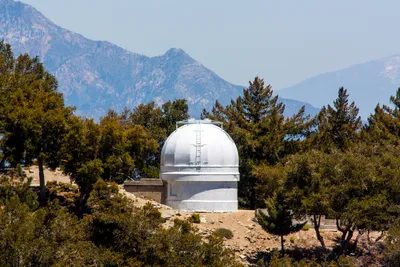
The view from Mount Wilson is deceptive. It looks like a quiet ridge in the San Gabriel Mountains, about 10 miles northeast of Pasadena. But in 1904, the air up there was thick with ambition. George Ellery Hale didn’t just want to look at the sun. He wanted to build the best solar-observing station in the world.
He started with Yerkes Observatory in mind. Funding came from the Carnegie Institution of Washington. Hale had a clear vision. He would build larger telescopes. And he did.
The First Giant Mirror
In 1908, everything changed. Hale installed a 60-inch reflector. At the time, it was the largest telescope on Earth. This wasn’t just a bigger tube. It was a leap into a new era of astronomy. Now, scientists could observe stars and galaxies with unprecedented clarity.
Hale didn’t stop at hardware. He needed data. He used both his solar telescopes and laboratory experiments to prove a radical idea. Sunspots weren’t just dark patches. They were magnetically active regions in the Sun’s photosphere. This discovery linked astronomy directly to physics.
A Stratified Model
Mount Wilson became the first stratified observatory complex. Hale built a complementary physics laboratory in Pasadena. Administrative offices sat nearby. Maintenance crews had their own spaces. This separation of functions allowed for efficiency. It set a standard for how observatories would operate for decades.
The 60-inch telescope remained the largest in the world for a time. It proved that Hale’s model worked. Science required not just lenses, but infrastructure. It required a place where light, magnetism, and human intellect could intersect.
Years later, larger telescopes would arrive. But the foundation was laid here. On a hill. In the dry air. With a mirror that captured more light than anything before it. The sky felt closer.
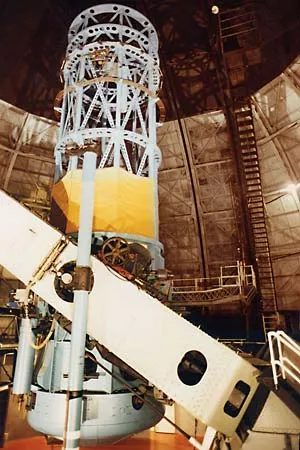
The 100-inch Telescope’s Legacy in Astronomical Discovery
The 100-inch reflecting telescope at Mount Wilson Observatory became operational in 1918. It wasn’t just the most powerful telescope on the planet. It served as a versatile test bed for new observational techniques. By 1920, astronomers used an interferometer on this instrument to measure the angular diameter of a star for the first time.
Soon, the telescope was deployed for astronomical spectroscopy. This exploited the massive light-gathering power of its 100-inch mirror. It also leveraged the innovative subterranean Coudé focus. This unique design accommodated a wide range of spectroscopic devices.
Hubble’s Breakthroughs and the Expanding Universe
The most critical discovery made with this telescope came in 1924. American astronomer Edwin Hubble determined the distance to the Andromeda Nebula. His measurements proved the nebula lay far beyond the boundaries of the Milky Way Galaxy. It was a galaxy in its own right.
Five years later, in 1929, Hubble and his assistant Milton Humason built on the work of Vesto Slipher. They demonstrated that galaxies were moving away from each other. This movement is the expansion of the universe.
Throughout the 1930s and 1940s, Hubble and his team used the 100-inch reflector to refine the extragalactic distance scale. They also probed the large-scale structure of the cosmos.
Stellar Populations and Galaxy Evolution
In 1944, German-born American astronomer Walter Baade successfully resolved the inner regions of the Andromeda Galaxy with the 100-inch reflector. He performed photometric studies that revealed two distinct populations of stars. These populations differed in age and composition.
The difference between these groups, known as Populations I and II, provided a critical clue to the evolution of galaxies. This finding helped astronomers understand how stellar communities change over time.
From Palomar to Modern Adaptations
The 100-inch telescope held the title of the world’s largest until 1949. That year, the Palomar Observatory’s 200-inch (504-cm) Hale Telescope surpassed it. Hale was designed largely by staff from Mount Wilson.
Palomar was initially operated jointly by Mount Wilson and the California Institute of Technology. Eventually, the two observatories merged as the Hale Observatories. Today, they are separate entities. Mount Wilson is still owned by the Carnegie Institution of Washington. However, it is operated by a consortium called the Mount Wilson Institute (MWI).
MWI has updated the instrumentation on the 60- and 100-inch reflectors as well as the solar telescopes. These upgrades took advantage of excellent seeing conditions. They successfully applied adaptive optics and interferometric techniques to problems in solar and stellar astrophysics.
Why the 100-inch Telescope Matters Today
The 100-inch telescope played a pivotal role in shaping our understanding of the universe. It enabled Hubble to discover the expansion of the universe. Baade’s work with it helped astronomers understand galaxy evolution. These discoveries were possible because of the telescope’s advanced design and the innovative techniques developed around it.
Even though it is no longer the largest telescope in the world, its legacy endures. The Mount Wilson Institute continues to operate it. Adaptive optics and interferometric techniques are still being applied to solar and stellar astrophysics. The 100-inch telescope remains a testament to human curiosity and ingenuity.
What other secrets might the stars hold? The 100-inch telescope has given us many answers. It is likely to provide more. The sky is vast. We are only beginning to understand it.