
Dick Grayson is the only one left who can bring justice to Gotham. Batman is dead. Commissioner Gordon is compromised, working for corrupt forces that even Superman and Wonder Woman are too busy enforcing to question. Robin has hung up the tights, but he has no choice but to return. The Joker is back, leading an entourage of karate-chopping, hipster Jokerettes. And lurking in the shadows? The Penguin.
This isn’t a comic book panel. It’s the opening act of “Grayson,” a proof-of-concept trailer that looks like it cost millions. But it didn’t.
Director John Fiorella and cinematographer Gabriel Sabloff spent 18 months working nights and weekends to create this extended preview. They had zero studio support. No script. No budget. No guarantee that a feature-length version would ever see the light of day. Just a shared obsession with DC Comics superheroes and a desperate need to make something tangible.
The Approach
Fiorella isn’t hiding his motives. He wanted to make a film he could be proud of, something worth sharing. For a filmmaker, that’s the baseline. But let’s be real: it’s also a demo reel. A high-stakes portfolio piece designed to show passion and capability.
“I realize the odds are a billion-to-one of the actual film getting made, but I’m not afraid of those odds.”
The vision is gritty. It reimagines the Bat-family dynamics in a world where the icons are sidelined or corrupted. Grayson stands alone. The aesthetic is cinematic, leveraging the gravity of the source material to mask the lack of resources. It’s a testament to what independent creators can pull off when they care enough to bleed for the project.
Is it likely to become a full movie? Probably not. The odds are steep. But the trailer stands on its own as a striking piece of fan-made cinema. It proves that you don’t always need a studio stamp to tell a compelling story about Gotham’s last hope. You just need the right lens, the right lighting, and the willingness to work when everyone else is sleeping.
The rest is just noise. Or maybe, just maybe, it’s the start of something real.
The math was brutal. Fiorella and Sabloff had exactly $18,000 to create a five-and-a-half-minute trailer that looked like it cost ten times that. We are talking about convincing motorcycle chases, underwater escapes, pyrotechnics, and strength feats that defy physics. But when the receipts came in, most of that cash vanished into the black hole of film stock, processing, and transfers. There was nothing left for catering, let alone extra crew.
This financial stranglehold dictated their workflow. They couldn’t afford daily or weekly checks of their footage. Instead, they waited. Large batches of developed film arrived only every three months. You can imagine the tension.
“There was only one re-shoot… I attributed it to luck, but after the second and third batch came back… that’s just a tribute to how talented Gabe Sabloff is.” — Fiorella
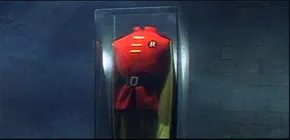
That single error? The Robin costume sitting in the Bat-cave. Everything else landed perfectly. First take. That isn’t luck. That is Gabe Sabloff knowing exactly what he’s doing.
Shooting Analog in a Digital Age
Sabloff ran a standard 16mm Bolex camera. He slapped an anamorphic lens on it to fake a wide-screen look without the wide-screen price tag. Why go analog when digital is cheaper? Fiorella had reasons.
She loved the Bolex because it had no battery. You wind it up. You shoot. All day. If you have the film. Digital sensors overheat. Digital cameras have limits. The Bolex? It’s mechanical. It doesn’t care.
But there was a bigger reason. Slow motion.
“I haven’t seen anyone on a low budget level achieve the slow motion that I was looking for… unless you’re George Lucas.”
Digital slow-mo exists, sure. But on a budget? It’s a compromise. The Bolex gave them that specific, fluid look they wanted. It wasn’t just about saving money. It was about aesthetic control.
Guerilla Tactics

The pair didn’t just break the rules of production. They ignored them entirely.
Weekend shoots only.
Locations scavenged.
Permits? Non-existent.
They needed a scene for Batman’s funeral. A public golf course seemed the obvious choice. It was until they were chased off the green. And then chased off again. And again. By the time they wrapped that sequence, they’d been kicked out of more fairways than they could count.
The Los Angeles public library saved the day. Or rather, the librarian’s assumption did.
On the day of the shoot, a legitimate feature film had rented the space later that afternoon. The librarian saw the crew setting up cameras and assumed they were part of that production. Fiorella and Sabloff didn’t correct her. They didn’t ask for permission. They just rolled.
The scenes went up without interruption.
Then there was the tracking shot. Robin sprinting down a busy street. Full superhero suit. High speed.
Blocking a city street costs money. Hiring extras costs more. Sabloff had a cheaper idea.
He jumped in a car. Cued Fiorella. Told him to run.
They hit a crowded downtown sidewalk on a weekend. Fiorella, dressed as Robin, sprinted past confused pedestrians. Sabloff filmed from the passenger seat. No permits. No police. Just motion.
The locations list reads like a cheat sheet for broke filmmakers:
– Public beach
– Dark alley
– The 405 freeway
– Interior of their apartment
– Apartment complex pool
But the real magic? It wasn’t digital.
According to Fiorella, the entire trailer relied on analog tricks.
Four digital effects total. That’s it.
Four.
The rest was practical. Physics. Timing. Smoke.
Take the scene where Robin blocks a hail of machine-gun fire with a metal door.
They didn’t generate sparks in post. They strapped fireworks to the outside of the door. Lit them in sequence. The camera captured the explosions hitting the metal. Real fire. Real impact.
Then Superman.
The script called for him to lift a heavily armored tank.
Lifting a real tank? Impossible.
So they used forced perspective.
A tiny toy tank in the extreme foreground. Superman standing in the background.
Align the shot perfectly. The brain fills in the gaps. The tank looks massive. Superman looks strong. It works.
Shooting Under Water
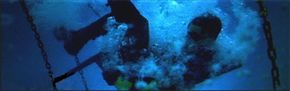
The scene where Robin gets shackled to a chair and tossed into the deep end required a level of DIY ingenuity that borders on reckless. Instead of just filming in a tank, the production built a literal submersible. They took two massive garbage cans, welded them together, installed Plexiglas viewing ports, and weighed it down with 350 pounds of ballast to keep the contraption anchored to the bottom.
It was either brilliant or stupid. Probably both.
Fiorella remembers the pressure testing with a mix of disbelief and amusement. Her initial design failed immediately. She hadn’t fully grasped how intense the water pressure gets just three and a half feet down. So they improvised. They used the garbage cans. It worked, but barely.
Gabe was inside.
“The water pressure was trying to crush the barrels. It was so strong.”
The thing was leaking. Gabe was trapped inside while the casing pinched down around him. The camera was also in there. Everything was in the can. It was terrifying.
“And we had sprung a couple of leaks. And not only was Gabe in there, and the thing was pinching down on Gabe, but the camera’s in there — everything’s in the can. So it was a pretty hair-raising experience.”
Despite the fear of drowning or being crushed, Fiorella liked it. It was fun. Jumping in with the chains felt like a game.
What comes next remains uncertain.

The production team didn’t just cut a trailer; they built an educational toolkit. They released a thirty-minute behind-the-scenes featurette that dissects their methods with surgical precision. Fiorella is adamant about the value of dissecting how other filmmakers work. He has a specific dream: releasing a DVD where viewers can toggle between the polished feature film and the raw footage, stripped of all special effects.
But getting Grayson from a fan-made trailer to a theatrical release is a different beast entirely.
Fiorella and Sabloff want to see this concept hit the big screen. They know the hurdles. The plot is sprawling. It requires licensing an unwieldy roster of characters, each owned by a different corporate entity. Negotiating rights for even a handful of these properties is a nightmare. Doing it for the whole cast? Nearly impossible.
Then there is the scope. The Grayson trailer isn’t just a teaser. It contains the narrative weight of several full-length movies packed into a few minutes.
And let’s be real about the studio machine. Influencing Warner Brothers release calendar as an independent outsider is like trying to steer an aircraft carrier with a spoon. The schedule is set in stone, long before fan enthusiasm can even knock on the door.
Yet, momentum is shifting.
In just a few months, the trailer’s success has materialized into tangible career moves. Fiorella now represents an agent actively pitching both the Grayson trailer and a graphic novel adaptation. He isn’t waiting for permission; he’s generating demand.
The internet hasn’t slept. Hundreds of emails pour in daily from fans. Superhero forums and movie message boards are still buzzing. The project has transcended its origins. It’s no longer just a proof of concept. It’s a movement.
The real test isn’t making the trailer. It’s convincing the gatekeepers that a fan-driven vision can survive the corporate licensing maze.
For those still tracking the chaos, the resources to dig deeper are available online.
Related HowStuffWorks Articles
- Adapting Hellboy
- Creature Effects Makeup: An Interview with Matt Rose and Chad Waters
- How Centropolis FX Creates Visual Effects
- How Industrial Light & Magic Works
More Great Links
- Grayson Trailer and Featurette
- Untamed Cinema Official Site
- TheForce.Net Fan Films
- SuperheroHype.com Grayson Interview
- Come For The Chicks, Stay For The Clips
- CHUD.com Message Board Thread on Grayson