Charles Darwin was right.
It sounds like a statement from a history book, not a breaking scientific update. But more than 150 years after the naturalist first guessed it, researchers have finally gathered the proof. He wasn’t just seeing what he wanted to see.
The plant in question belongs to the genus Saxifraga. For decades, botanists wondered if these plants ate bugs. Darwin thought they did. Now, we know he did too.
The Original Hypothesis
Back in 1875, Darwin had just spent years outlining natural selection in On the Origin of Species. He was looking for mechanisms beyond just photosynthesis.
He became fascinated by two Saxifraga species known to catch insects. But his experiments failed to prove they actually digested the prey. He could show they caught flies. He couldn’t show they ate them.
His hunch sat in the void for a century and a half.
Modern Methods in Yunnan
Enter Doug Soltis at the University of Florida and his team. They didn’t try to replicate Darwin’s exact experiments on the exact same plants. That would be impossible without a time machine.
Instead, they went to Wufeng Mountain in Yunnan Province, China.
They studied Saxifraga candelabrum.
It’s a different species than the ones Darwin observed. It lives in the alpine and Arctic regions of the Northern Hemisphere, plus the South American Andes. The genus has about 450 species. Some are carnivorous. Some aren’t.
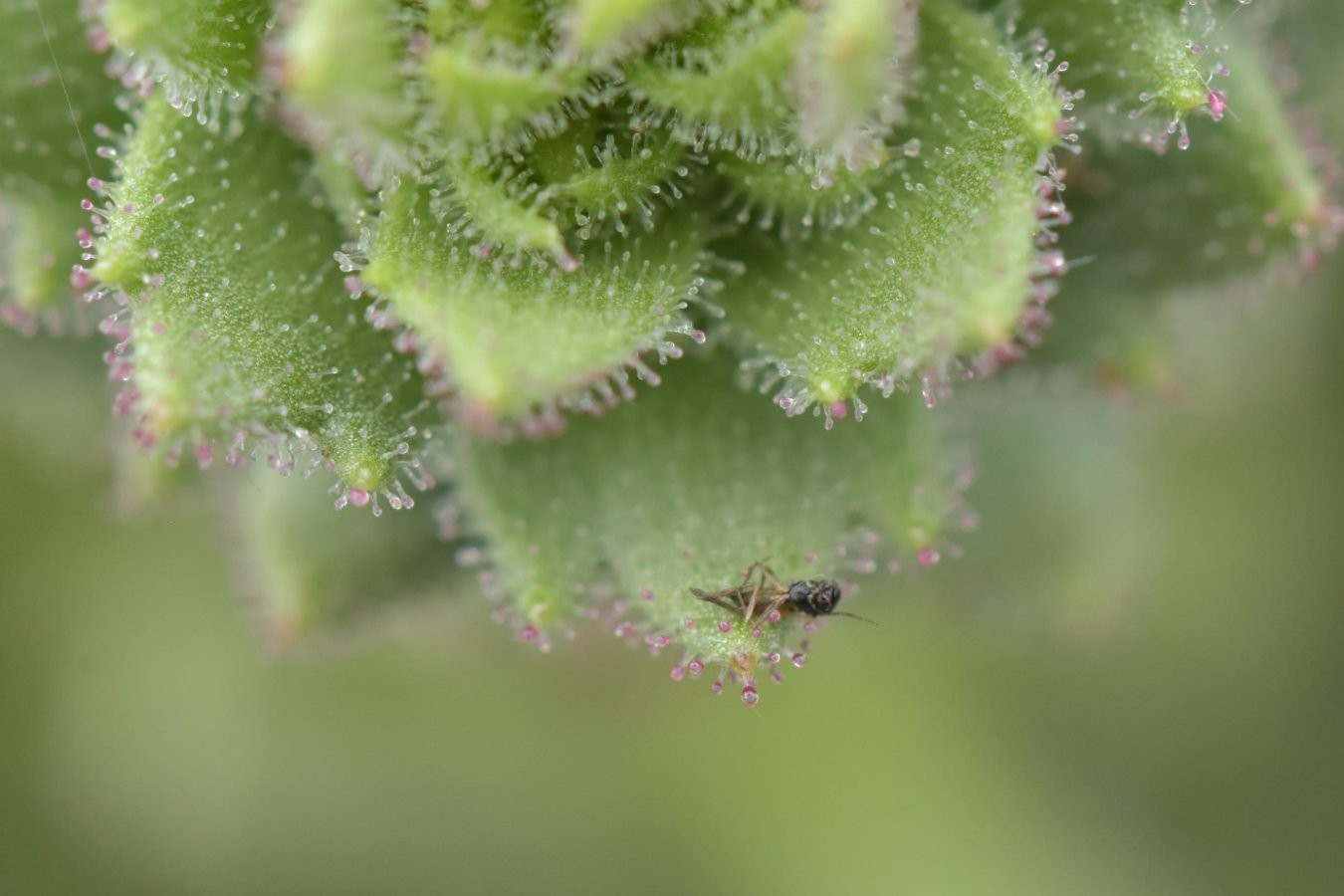
The team found S. candelabrum covered in tiny hairs.
These hairs secrete a sticky substance. It traps small insects. Not all insects. Big ones—pollinators—are left alone. The plant is smart. It only eats what it doesn’t need for reproduction.
Confirming It Is a Carnivorous Plant
To be classified as carnivorous, a plant must do three things:
1. Attract prey.
2. Capture prey.
3. Digest prey and absorb nutrients.
Darwin missed the digestion part. His team nailed it.
First, the scientists tested the sticky secretion. It contained digestive enzymes. These enzymes break down the insect’s body.
Second, they fed the plants insects infused with a nitrogen isotope. When the plant later analyzed its tissues, the isotope was there.
The nutrients from the digested bug were inside the plant.
“To have the opportunity to confirm a predictiction of Darwin is both humbling and very excited,” says Soltis. “I would like to think Darwin would be pleased and say I was right again.”
Third, genetic analysis revealed something surprising. Saxifraga shares specific genes with other known carnivorous plants, like the sundew (Drosera spatulata ) and the flycatcher bush (Roridula gorgonias ). These genes control attraction, digestion, and uptake.
“The genomic data provide independent evidence that S. candelabrum is a true carnivorous plant,” explains Hang Sun of the Chinese Academy of Sciences.
Why This Matters Now
Darwin was studying Saxifraga. He saw the hairs. He saw the bugs. But he lacked the tools to prove the chemistry.
Today’s technology changed the game. Isotope tracing proved uptake. Genomic sequencing proved evolutionary links.
Soltis expects this to trigger a wave of re-evaluations. Many Saxifraga family members have those same sticky hairs.
Could they be carnivorous too?
Probably.
Soltis says he wouldn’t be surprised if more species in the family are found to eat gnats. The line between plant and predator just got a little blurrier.
And Darwin, sitting somewhere in the ether, probably just nodded.