


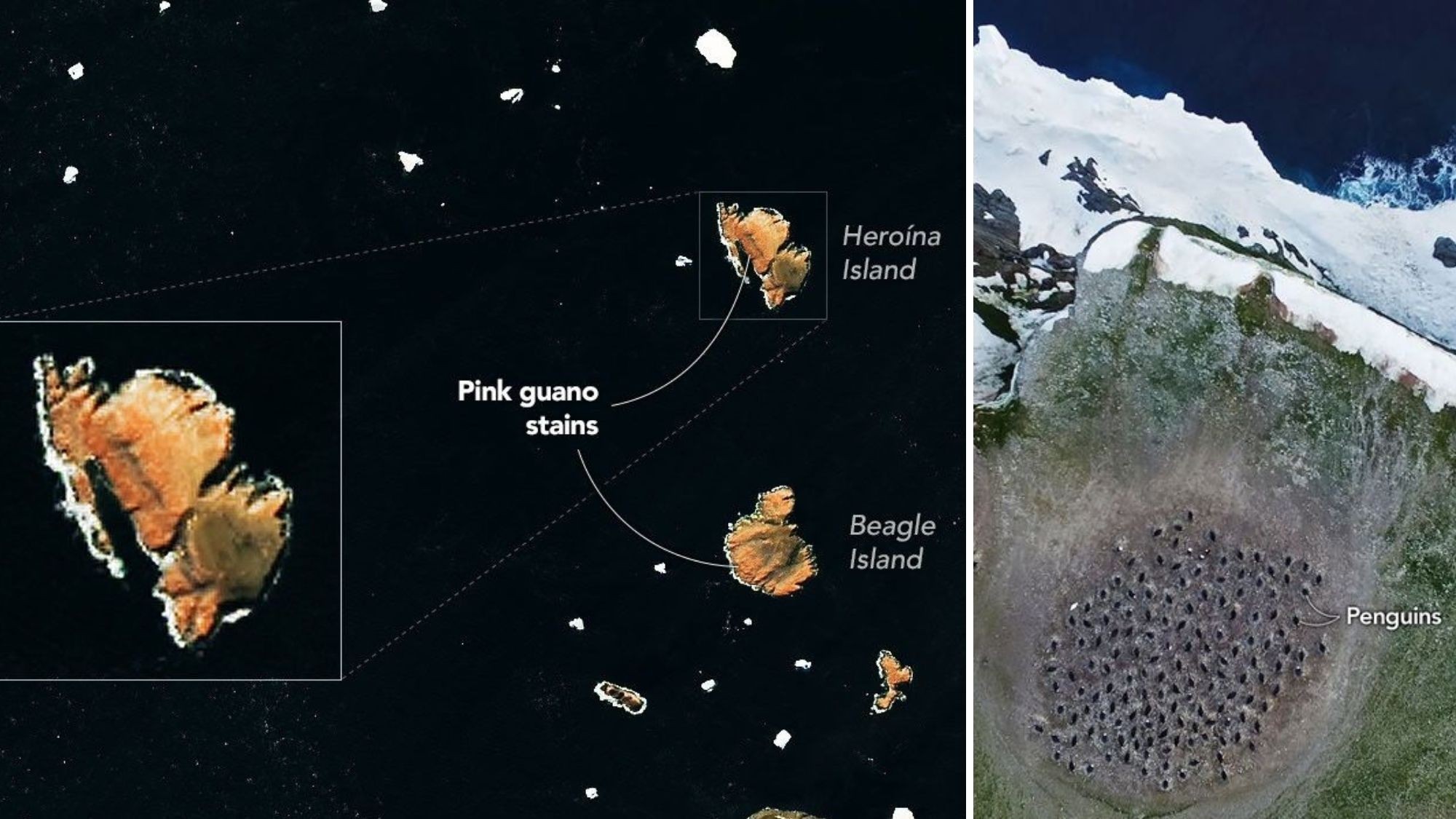
You won’t find a penguin peering back from this image. Instead, you’re looking at the messy aftermath of their lunch.
Satellites can now spy on the dietary habits of Adélie penguins living on Antarctica’s Danger Islands. Not by watching them hunt. But by watching where they poop.
Indirectly, at least.
Scientists are using Landsat 8, a spacecraft run by NASA and the US Geological Survey, to monitor these birds from space. They track changes in the Adélie penguin population and their diet by analyzing the color of the guano staining the ice.
The results are striking. Large swathes of Heroína Island and Beagle Island are streaked with pinkish-orange droppings.
This isn’t dirt. It’s food.
The local penguins eat a diet heavily rich in krill. These small marine crustaceans feed on a specific type of algae. That algae turns their shells bright pink. When the penguins digest the krill, that color remains. The guano acts as a biological record of what the colony has been eating.
Why does this matter?
The bright pink staining stands out sharply against the white ice and dark rock in satellite imagery. This contrast allows researchers to locate penguin colonies from 438 miles (about 705 kilometers) away. They didn’t just stop at space observation, though.
Once Landsat-8 flagged the likely locations, teams flew drones closer. They collected ground-truth samples. The goal? To verify what the birds were eating over time. The droppings contain evidence of their long-term dietary patterns.
Now, researchers are combining these satellite visuals with physical samples for a bigger picture. They want to know how climate change impacts the food web. Specifically, how shifting sea ice conditions affect the availability of krill. If the ice melts, the algae change. If the algae change, the krill move. And if the krill move, the penguins starve—or shift their diet entirely.
Tracking these changes from orbit gives scientists a broader, more frequent view than ground teams alone could manage. It connects the microscopic algae to the massive ice sheets in real-time.
Is there a cleaner way to monitor ecosystem health? Probably not. The pink stain on the ice tells a story about ocean chemistry, ice cover, and bird survival that no thermometer can capture alone.
The ice doesn’t lie. But it does need help being read.


