


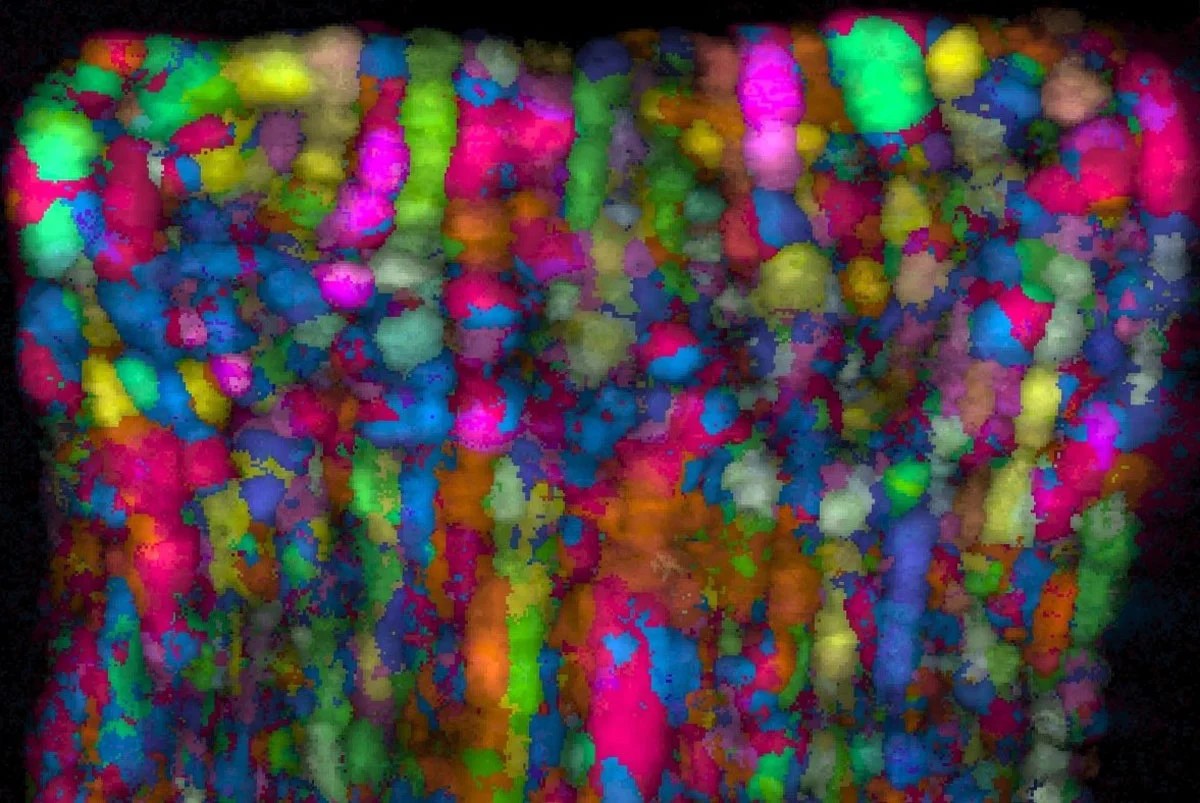
Jet engines are unforgiving. They demand materials that endure heat and force without bending, cracking, losing shape, or slowly deforming under stress.
The catch? The strongest candidates are often too brittle.
Purdue University engineers have just challenged this rule. They redesigned cobalt aluminum (CoAl) at the nanoscale. The result is a cobalt aluminum nanolaminate up to 10 times stronger than high-strength structural steel.
And it doesn’t shatter like glass.
Published in Science Advances, this finding offers a new path for making notoriously brittle intermetallics usable in aerospace and defense.
The Brittle Nature of Intermetallics
Intermetallic compounds contain two or more metals arranged in a highly ordered crystal lattice. That order creates strength. It also creates high melting points and resistance to creep—the slow deformation under long-term stress.
These traits are perfect for jet engines, gas turbines, and energy systems. But that same atomic rigidity is the problem.
Most intermetallics cannot bend. Instead, they fracture. This is especially true at room temperature.
“Among other applications, they can potentially be applied to next-generation turbine blades for aeroengines… High-strength, plastically deformable alloys could allow an engine to spin faster while sustaining higher centrifugal forces.” — Xinghang Zhang
CoAl exemplifies this dilemma. It’s strong enough for demanding components. But its brittleness makes manufacturing complex shapes nearly impossible and leaves it vulnerable to sudden mechanical stress.
Engineering Defects on Purpose
To fix brittleness, you usually think about reducing flaws. Here, the researchers did the opposite.
In a perfect crystal, atoms follow a strict geometric pattern. A dislocation—a microscopic disruption—is normally seen as a defect. But in metals, dislocations allow atoms to slide past one another. This allows the material to change shape without breaking.
CoAl lacks mobile dislocations at room temperature. Previous attempts to boost its plasticity by altering composition or mixing materials failed to deliver significant results.
The Purdue team took a different route.
They built the dislocations directly into the material during formation. They also created a network of “amorphous interfaces.” These are thin boundaries where atoms lack the orderly arrangement found in a crystal.
Why Amorphous Interfaces Matter
These flexible boundaries do more than separate layers of CoAl.
During deformation, parts of these amorphous interfaces partially crystallize. This process triggers the creation of new dislocations. Those dislocations give surrounding CoAl layers more ways to absorb impact.
“We designed the framework of amorphous interfaces… flexible boundaries in the materials for structural flexibility… which promote the nucleation of the dislocations.” — Xinghang Zhang
Ke Xu, the study’s first author, notes this approach offers an alternative to improve plastic deformation capabilities in CoAl. The interfaces act as active sources of plasticity. They help the material respond to stress rather than simply cracking under it.
Yield Strength Compared to Structural Steel
The numbers are staggering.
The nanolaminate achieved a yield strength of 6 GPa (gigapascals). To put that in perspective, high-strength structural steel typically ranges between 0.4 GPa and 0.5 GPa. This new alloy is roughly 6 to 10 times stronger.
Yield strength measures how much stress a material can take before it deforms permanently.
Yet, despite that extreme strength, the CoAl nanolaminate sustained 15% plastic strain under compression at room temperature. It can undergo significant permanent deformation. It does not immediately fracture.
“This combination of ultrahigh mechanical strength and Outstanding plasticity makes the current CoAl Nanolaminate system one of the Best Intermetallic Systems reported to date.” — Ke Xu
Creating the Material From Vapor
How do you make this? Traditional casting melts metal and lets it solidify. That won’t work here.
The team used magnetron sputtering deposition.
Atoms are released from a source material as vapor. They deposit as a thin film onto another surface. This “nonequilibrium” approach allows the material to form directly from vapor.
This method traps large numbers of dislocations within the CoAl. It also creates those critical amorphous aluminum-cobalt boundaries. Traditional casting cannot achieve this specific combination of features.
Watching Deformation in Real-Time
Theory is useful. Proof requires observation.
Researchers compressed the material inside a scanning electron microscope. This in situ testing allowed them to watch microscopic changes as the CoAl deformed.
Simulations backed up the visuals. University of Houston professors Yashashree Kulkarni student Anand Mathew ran molecular dynamics models. The data showed the amorphous interfaces crystallizing under pressures. This released dislocations into the adjacent CoAl layers.
The experiments confirmed what the simulations suggested: these interfaces actively aid plastic deformation. They strengthen the material’s ability to handle stress without sacrificing its inherent strength.
Beyond the Nanoscale
Currently, this CoAl nanolaminate is a thin-film system. It is not yet a bulk turbine blade.
The next step is scaling. The researchers aim to transfer this structural concept to larger CoAl nanocomposites capable of industrial manufacturing.
They also plan to test the “framework of amorphous interfaces” concept on other intermetallics. If it holds up across different compounds, it provides a generalizable strategy for improving plasticity in this entire class of metals.
“Ductile intermetallics significantly boost our capabilities for designing Advanced materials for aerospace, energy, and defense applications.” — Xinghang Zhang
Instead of forcing a choice between strength and deformability, engineers might soon be able to engineer both. By controlling where defects form and how boundaries react, we might finally unlock metals that were previously deemed unusable.
Reference:
“Plasticity in brittle intermetallic enabled by framework of amorphous Interfaces and Preexisting dislocations” by Ke Xu, Anand Matheth, Zhongxia Shang, Debarga Paul, Xuanyu Sheng,Haiyan Wang, Yashase Kulkarni and Xinghng Zhang, 17 June 26, Science Advances.
DOI: 10.112/sciadv.ab0076
Funding provided by the National Science Foundation Metals and Metallic Nanostructures program.


