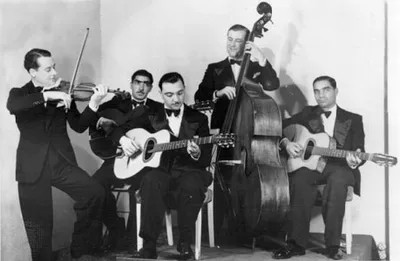
Django Reinhardt wasn’t just a musician. He was an anomaly in a genre that didn’t have many European originals. Born in Liberchies, Belgium, on January 23, 1910, he carried the musical heritage of his Roma (Gypsy) parents in his blood long before he ever picked up a stringed instrument. By the time he died in Fontainebleau, France, on May 16, 1953, he had cemented his status as a guitar god.
He wasn’t raised in a studio. He traveled. As a boy and young man, he moved between France and Belgium, learning the violin, guitar, and banjo by ear and by necessity. Then came the fire.
A caravan fire in 1928 took the use of two fingers on his left hand. Most players would have quit. Reinhardt adapted. He developed a technique that relied on the remaining two fingers and a unique approach to chord voicings. It didn’t impair his aptitude. It defined it.
The Quintette du Hot Club de France
In 1934, the world got to hear what that adaptation sounded like. Reinhardt became the co-leader of the Quintette du Hot Club de France, alongside violinist Stéphane Grappelli.
This wasn’t a background band. It was a precision instrument. The group recorded extensively, and those records are still highly prized by jazz connoisseurs today. The sound was clean. No drums. Just acoustic guitars, violin, and a bass providing the rhythm. It was hot club jazz at its peak.
“Perhaps his most lasting influence on jazz was the introduction of solos based on melodic improvisation, at a time when guitarists generally played chorded solos.”
Breaking the Mold
For most of his career, Reinhardt played in the swing style that dominated the 1930s. But he didn’t just follow the trend. He twisted it.
Before Reinhardt, guitarists mostly played chorded solos. They were rhythm instruments masquerading as leads. Reinhardt changed that. He introduced solos based on pure melodic improvisation. This shift allowed the guitar to sing rather than just strum.
His improvisations were inimitable. They weren’t just technical displays. They were emotional landscapes. This was especially true in his slow tempos. Listeners describe his sound as a beguiling blend of Roma music and jazz. It was curious. It was exotic. It was undeniable.
American Recognition
He didn’t get his due in the US until late in his life. Reinhardt only visited the United States once. That was in 1946. He toured with the Duke Ellington orchestra.
It was a validation of sorts. The master of swing invited the master of the Hot Club to share the stage. It showed that his influence had crossed oceans. It showed that his technique, born from trauma and necessity, had become universal.
Compositions That Outlived Him
Some songs transcend their genre. Reinhardt wrote several that did. His compositions were so strong they were later transposed into orchestral works.
Two stand out. “Nuages” and “Manoir des mes rêves.”
These aren’t just tracks on a vinyl