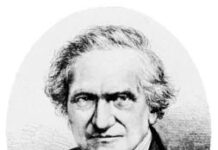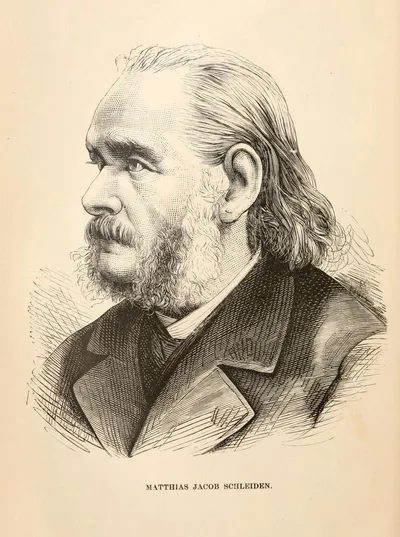
Matthias Jakob Schleiden didn’t set out to change biology forever. He was just a guy in 19th-century Germany who hated taxonomy. Born in Hamburg on April 5, 1804, Schleiden studied law at Heidelberg before realizing his true passion lay elsewhere. Botany wasn’t just a hobby anymore. It became a full-time obsession.
The scientific community of the time was obsessed with filing plants into neat categories. Schleiden found this tedious. He wanted to know how plants actually worked. So, he turned to the microscope. This shift in focus changed everything.
The Birth of Cell Theory
In 1838, while serving as a professor of botany at the University of Jena, Schleiden published a paper titled “Contributions to Phytogenesis.” It was a short, sharp manifesto that challenged the status quo. His argument was simple but radical: every part of a plant is made of cells. Or, they are derived from them.
Before this, the idea that cells were the fundamental building blocks of life was just an informal belief. Schleiden turned that hunch into a biological principle. He placed it on the same pedestal as the atomic theory in chemistry. Atoms make up matter. Cells make up plants. It was a parallel that resonated.
Schleiden also zeroed in on the cell nucleus. Botanist Robert Brown had discovered it in 1831, but Schleiden saw its true importance. He recognized that the nucleus was key to cell division. This insight laid the groundwork for understanding how life reproduces at a microscopic level.
A Broader Impact
Schleiden wasn’t working in a vacuum. He collaborated with Theodor Schwann, a zoologist. Together, they co-founded cell theory, extending Schleiden’s plant-based findings to animals. The universe of biology suddenly had a common denominator.
He was also ahead of the curve on evolution. Schleiden was among the first German biologists to accept Charles Darwin’s controversial theories. This open-mindedness likely helped him connect disparate biological facts into a cohesive framework.
His career took him far from Germany. In 1863, he became a professor of botany at the University of Dorpat in Russia. He died in Frankfurt am Main on June 23, 1881.
“Schleiden became the first to formulate what was then an informal belief as a principle of biology equal in importance to the atomic theory of chemistry.”
Why does this matter today? Because every time you look at a leaf, or a skin cell, or a drop of blood, you are looking at the legacy of a man who refused to just name things. He wanted to understand the machinery. The cell is not just a building block. It is the unit of life. And Schleiden taught us how to see it.