


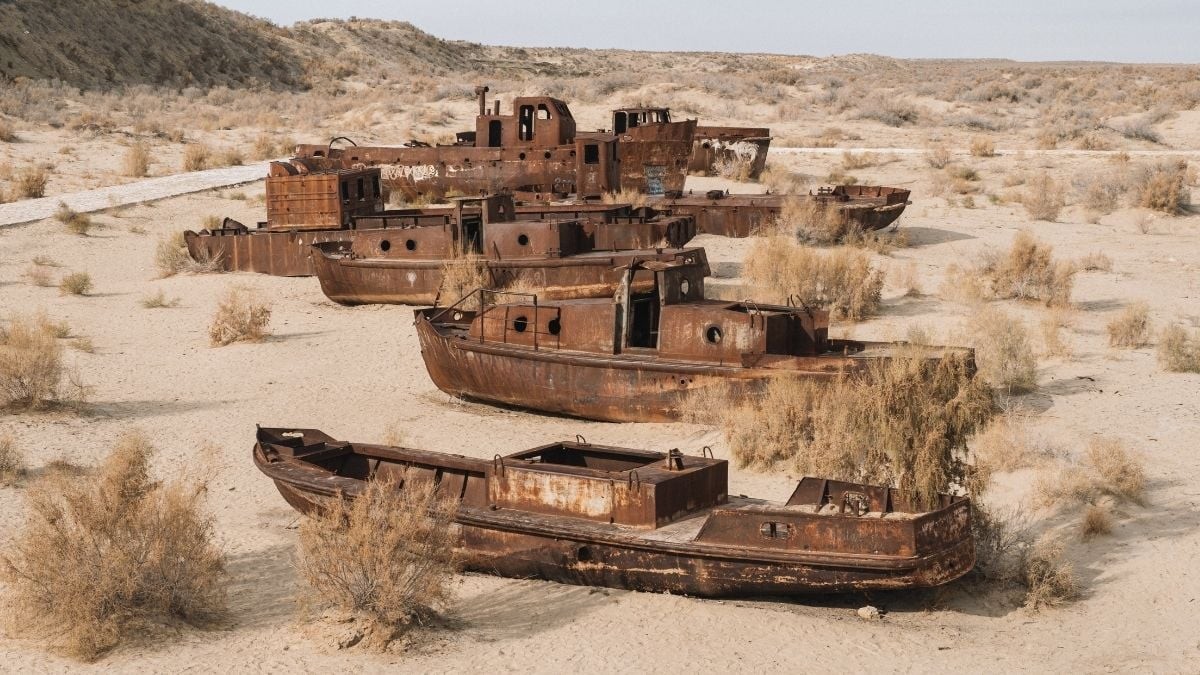
The smell of a drying lakebed in peak summer is unmistakable. It hits you before you see it. A pungent, sulfurous cloud rising from cracked mud. It’s not just decay. It is the Earth exhaling its secrets.
Underneath that muck lies a rich sludge. Algae. Dead plants. Pond scum. And poop. Lots of it. When this organic matter dries out, it releases gases. On a small scale, it smells bad. On a massive scale, it’s a climate catastrophe.
Lakes across the globe are vanishing. Scientists are now warning that these drying beds may emit greenhouse gases rivaling fossil fuel combustion. The Aral Sea, the world’s largest desiccated water body, is the poster child for this disaster. A new study published in Science reveals that since its draining in the 1960, the Aral has emitted 204 megatons of CO2. That’s 225 million US tons of carbon dioxide.
But there is a glimmer of hope in the salt dust.
The Cotton Cost of a Disappearing Sea
The Aral Sea wasn’t always a desert. Once the fourth-largest lake on the planet, it had plenty of water. The collapse began in the Soviet era. Engineers diverted its two main tributary rivers—the Amu Darya and the Syr Darcy—to irrigate Uzbekistan’s cotton fields. Cotton is thirsty. The sea was not.
By the 1990, the lake had vanished into the horizon. In its place sits a wheezing, saline desert. A giant wound in the earth that rots in the sun.
The new research quantifies the damage. Between 196 and 202, site surveys and core samples confirm that 204 megatons CO2 escaped into the atmosphere as the sea evaporated. This is not just a local ecological tragedy. It is a global carbon accounting error.
Wind, Sediment, and the Forgotten Emissions
The study uncovered a nasty twist. Nearly 20 percent of the Aral’s emissions don’t come from chemical decomposition in the mud. They come from wind.
As the lakebed dries, fine, carbon-rich sediments blow away. These particles become airborne. They carry their carbon payload directly into the atmosphere. Researchers had never accounted for this wind-driven loss. It was invisible. Until now.
“When a lake dries up, we are facing a hydrological, ecological, and socio-economic problem,” says ecologist Núria Catalán of the Spanish National Research Council. “But we are also altering the carbon cycle in ways that remain largely absent from climate accounting.”
Can Reflooding Turn the Tide?
The Aral Sea isn’t alone in its decline. The Great Salt Lake in the US. The Salton Sea. Iran’s Lake Urmia. Bolivia’s Lake Poopó. All are shrinking. All are potential carbon bombs.
But some recovery is visible in the North Aral. Kazakhstan’s government has implemented stricter water usage laws. They’ve ensured the Syr Darya still flows into the northern basin. It’s a small step, but it proves that human intervention can reverse the damage.
“There is a hidden carbon treasure beneath the Aray Sea,” says biochemist Rafael Marcé. “If these sediments remain exposed, carbon continues to be released. If the sea is re-flooded… it becomes part of the climate solution.”
Reflooding the basin could lock away the remaining 165 megatons of trapped carbon. It shifts the sea from a source of emissions to a carbon sink. That’s a massive value shift.
The Glaciers and The Money
Here is where it gets complicated. Climate change threatens the Aral’s recovery. The Amu and Syr Darya rivers are fed by melting glaciers in Tian Shan and Pamir mountains. Global warming is shrinking these ice reserves. Water evaporates before it ever reaches the lake.
Ironically, reflooding dried inland seas could help mitigate the very climate change driving glacier loss. It’s a feedback loop waiting to be broken.
The study authors suggest we look at this through the lens of carbon finance. Protecting buried sediments has monetary value. If we quantify that value, we can attract funding. Carbon markets could pay to re-flood the Aral. It’s a pragmatic approach to an environmental disaster.
The question isn’t whether we can afford to save the Aral. It’s whether we can afford to let it keep poisoning the sky.
The technology exists. The science is clear. The wind is blowing, carrying the dead lake’s secrets into our lungs.


