We think we know our ancestors. They carved things. They drew hands on stone.
But for years, it was just images. Pretty pictures. We could see what they did. We had no idea who actually held the brush.
Rock art is stubborn that way. It sticks to the wall. The rest of the site—the dirt, the bones, the tools—rot or scatter. No DNA connection. Just a beautiful, silent gap in the story.
“Rock art links us to our ancestors… but until now, it remained ‘beyond the reach of paleogenetists’.”
Then a team looked at the walls differently. Not as canvas. But as archive.
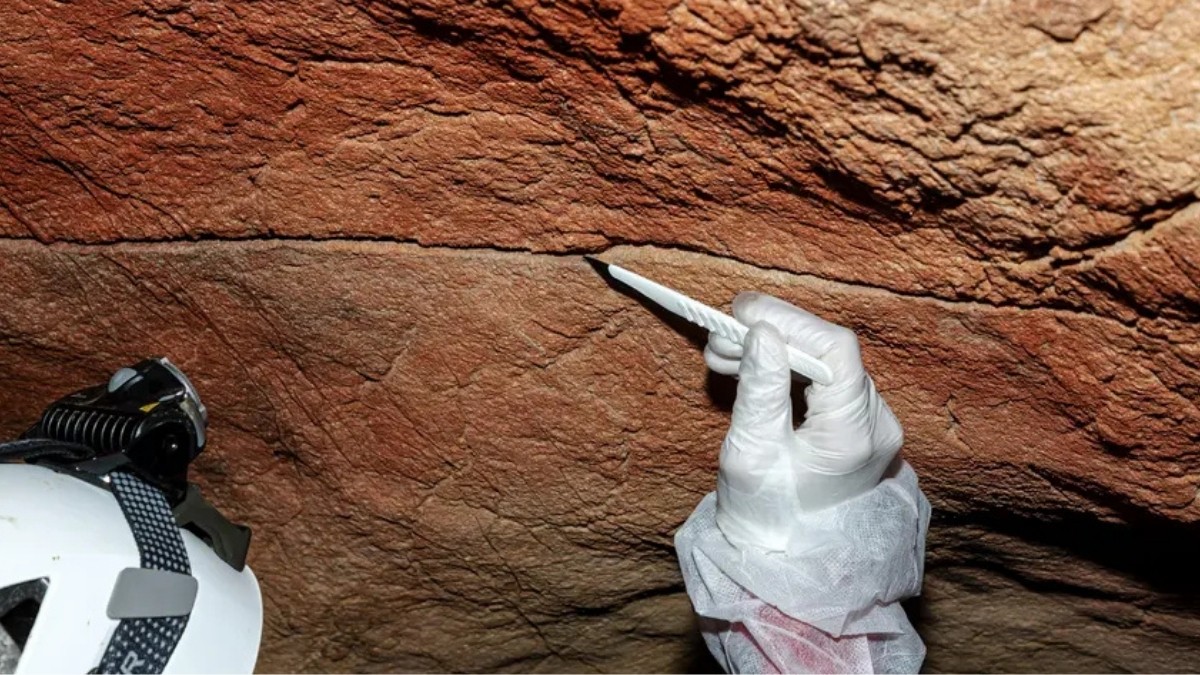
A study in Nature Communications proves human DNA can survive on limestone for thousands of years. Not buried under the floor. On the surface.
It was part of the First Art project. Researchers from Spain, Portugal, and the Max Planck Institute looked at 24 panels in 11 caves. Simple lines. Hand stencils. Some guy trying to scare off leopards with a stick because apparently, Neolithic humor hasn’t changed.
They sampled the art. They sampled the empty walls nearby as controls. They even analyzed a bird bone that looked suspiciously like a spray can—used to puff red ochre through hollow nostrils of prehistory.
The results were messy. Typical for this kind of science.
Out of 120 wall samples?
Five yielded human DNA.
That sounds promising until you read the footnotes. Two of those samples were pure human stuff. Sweat. Spittle from the bone-sprayer. Maybe blood.
The other three had animal DNA mixed in. Likely washed up by rainwater seeping in later. Contamination happens.
And here is the kicker.
Four of those five samples came from the blank walls. The controls. The parts that supposedly held nothing.
The painted parts? Mostly silent. One panel yielded a hit. The bone-airbrush? Useless. Modern DNA contamination swamped it. As if the lab technician sneezed on it.
Why?
Calcite.
A silver lining formed from limestone. That hard, white crust that coats old paintings acts like a shield. It locks the DNA away. Protects it. Without it? The genetic signal evaporates.
The DNA that was recovered?
It told a story.
Modern humans. Western hunter-gatherers. The kind that hung around Iberia long before Romans bothered the lot.
Hipólito Collado Giraldo was hoping for exactly this.
“We were eager to see if contact could leave traces… potentially allowing us to obtain genetic profiles.”
They did. Sort of.
The success rate is low. The data is patchy. Alba Bossoms Mesa warns it is “highly variable.” But she isn’t crying about it.
Why?
Because it works at all.
Think about it. Before this, cave art was mute. Now it whispers.
We can ask who touched the wall. A man? A woman? What group did they belong to. How far into the dark did they venture?
Matthias Meyer calls these walls “genetic archives.” He’s probably right.
The method needs refining. They need to know when to expect results. But the door is open now.
We might not get a clear family tree from every painting. We won’t name every artist.
But the blank walls? They’re listening too. And they remember everything.