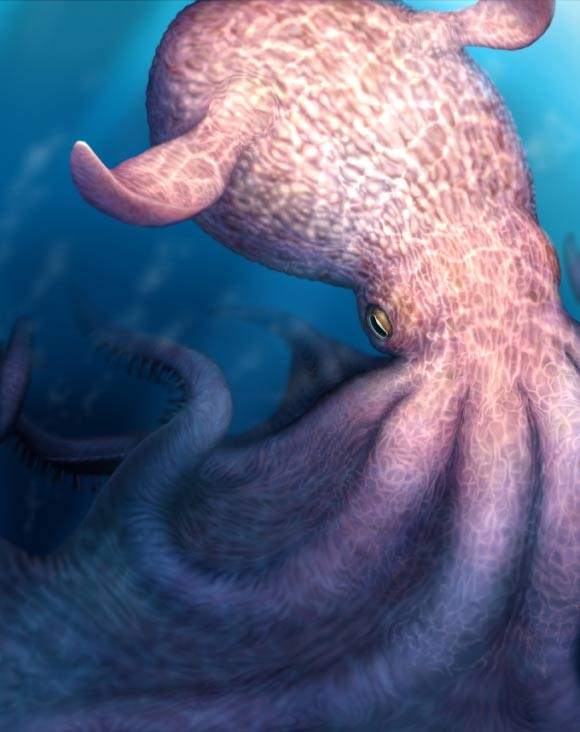
For hundreds of millions of years, the prevailing narrative of marine history has been one of vertebrate dominance. From massive sharks to colossal marine reptiles, the “top spots” in the ocean’s food chain were almost exclusively reserved for animals with backbones. However, new research published in the journal Science is challenging this long-held assumption, suggesting that massive, soft-bodied cephalopods once ruled the Cretaceous oceans alongside—and perhaps even rivaled—the era’s most feared reptiles.
Challenging the Vertebrate Monopoly
Traditionally, paleontologists viewed large invertebrates as mid-level players in the ecosystem—creatures that were often the prey for larger vertebrates rather than the hunters themselves. This view was largely shaped by the fact that most large ancient invertebrates, such as ammonites, relied on heavy shells for protection.
The evolutionary path of the octopus was different. By trading heavy, protective shells for soft bodies, these cephalopods gained a decisive evolutionary advantage: unprecedented mobility, superior vision, and high intelligence. This study, led by Professor Yasuhiro Iba of Hokkaido University, reveals that this agility allowed them to scale up to terrifying proportions.
The Evidence in the Bone—or Lack Thereof
Because octopuses lack hard skeletons, finding fossil evidence of them is notoriously difficult. Most researchers rely on the only hard part of the animal: the beak (or jaw).
By utilizing “digital fossil-mining” techniques, the research team identified 15 large fossil jaws from Cretaceous sediments in Japan and Vancouver Island, along with 12 additional jaws from finned octopuses. These specimens led to the identification of two primary species: Nanaimoteuthis jeletzkyi and Nanaimoteuthis haggarti.
The scale of these creatures is staggering:
– Size: Individuals of N. haggarti reached lengths of up to 19 meters (62 feet).
– Comparison: At this size, these octopuses rivaled the giant marine reptiles that shared their waters.
– Status: They potentially represent the largest invertebrates ever described in the fossil record.
Crushing Shells and Bones
The most significant breakthrough in this study wasn’t just the size of the animals, but the wear patterns found on their jaws.
In younger, smaller specimens, the jaws were sharp and well-defined. However, in the largest adults, the jaws showed extensive blunting and rounding. This wear is a biological “smoking gun,” indicating that these animals were not merely scavenging; they were active carnivores that routinely used their powerful beaks to crush hard shells and bones.
This suggests a sophisticated hunting method:
1. Seizing: Using long, flexible arms to capture prey.
2. Dismantling: Using high-pressure, powerful bites to break down armored victims.
3. Intelligence: This complex predatory behavior is a hallmark of advanced cephalopod intelligence.
Why This Matters for Marine Evolution
This discovery shifts our understanding of how apex predators evolve. It suggests that the “blueprint” for a top-tier predator—powerful jaws combined with a lack of a heavy external skeleton —is not exclusive to vertebrates.
The loss of a superficial skeleton, which might seem like a vulnerability, actually facilitated the growth of massive, intelligent hunters by allowing for greater movement and more efficient energy use. This research proves that for a significant period in Earth’s history, the ocean’s most formidable hunters weren’t just the giants with backbones, but the highly intelligent, soft-bodied giants of the deep.
“This study provides the first direct evidence that invertebrates could evolve into giant, intelligent apex predators in ecosystems that have been dominated by vertebrates for about 400 million years.” — Professor Yasuhiro Iba
Conclusion: By analyzing fossilized jaw wear, researchers have proven that giant Cretaceous octopuses were not mere bystanders, but sophisticated apex predators that occupied the highest levels of the marine food web.