


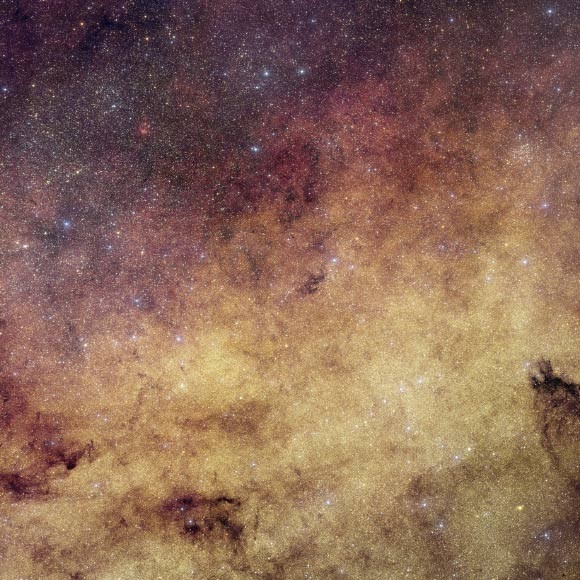
ESA’s Euclid telescope did something tricky recently. It looked at the Milky Way’s center. Not the edge, not some quiet dark spot. The bulge. The busiest, most crowded place in town.
And it took the best visible-light photo we’ve ever had of it.
60 million stars map out across the image. Nebulae drift between them, star clusters cling together in the chaos. It looks less like a void and more like a crowded city street shot from above. But this isn’t just pretty wallpaper.
It’s a tool.
Euclid wasn’t built to look close to home. Its job is cosmology. Deep space. Distant galaxies that don’t care about us at all. But its camera? Sharp. Really sharp.
“The visible light camera is sensitive enough to resolve individual stars in this super-crowded area without being blinded by the glare,” the Euclid team noted.
That specific skill opens a door for microlensing. It’s how we hunt planets around distant suns when the starlight bends through massive objects. If you can’t tell one star from another, the math breaks. Euclid solves that.
The timing was precise. Just 26 hours. March 23 through March 24, 2025. A short break from the long, boring survey of the deep universe.
“Pausing the main survey takes serious planning,” says Dr. Jason Rhodes from JPL. “It has to matter. It has to be high impact.”
He’s not wrong. Usually, telescopes grind away at the same patch of sky or move slowly. This was a targeted strike. A mosaic of nine snapshots, each wider than the full Moon.
Compare it to Hubble. The sharpness is similar. The sensitivity checks out. But Euclid sees an area 2700 times wider per frame. Do the math. Keck Observatory on Earth? They’d need 2,000 nights to match what Euclid did in a day. And ground telescopes struggle with atmosphere and fainter targets.
Speed is power.
This snapshot covers the exact patch NASA’s future Roman Space Telescope will watch for planets. Roman will stare at that spot for years. Euclid provides the before-picture. The context.
“It helps us map the Galaxy better,” adds Dr. Matthew Penny of LSU. He co-leads the exoplanet work on the project. “We can test our models. Spot rogue planets. Find isolated black holes that don’t blink.”
We tend to forget the center of our galaxy is a mess. We live in the suburbs, quiet and dark. But in the core? It’s dense. It’s bright. And now, finally, it’s clear.
Whether Roman will find what Euclid pointed to remains to be seen. But the stage is set.


