The idea of sprouting wings and taking to the sky is a staple of science fiction, epitomized by characters like Warren Worthington III from X-Men. While biological wing growth remains firmly in the realm of fantasy, recent neuroscience research suggests that the human brain is far more adaptable than previously thought. A new study reveals that through immersive virtual reality (VR) training, individuals can psychologically and neurologically incorporate virtual appendages into their body schema.
Rewiring Perception Through Virtual Training
Published in Cell Reports, the study demonstrates that after training with virtual wings, participants’ brains began processing images of these artificial limbs similarly to how they process real arms and hands. This finding highlights the remarkable plasticity of the human brain—its ability to reorganize itself by forming new neural connections in response to learning and experience.
“If the brain can incorporate something as unhuman as a wing, it may also be able to incorporate many other kinds of limb enhancements,” notes cognitive neuroscientist Jane Aspell of Anglia Ruskin University.
The research was sparked by a personal curiosity. Yanchao Bi, a cognitive neuroscientist at Peking University, long harbored a dream of experiencing flight firsthand. When she discussed this wish with Kunlin Wei, who leads the university’s Motor Control Lab, the conversation shifted from fantasy to experimental design. Wei’s lab had been using VR to study movement perception, leading to a pivotal question: Could humans learn to fly in VR, and how would that training alter their neural pathways?
The Mechanics of Learning to Fly
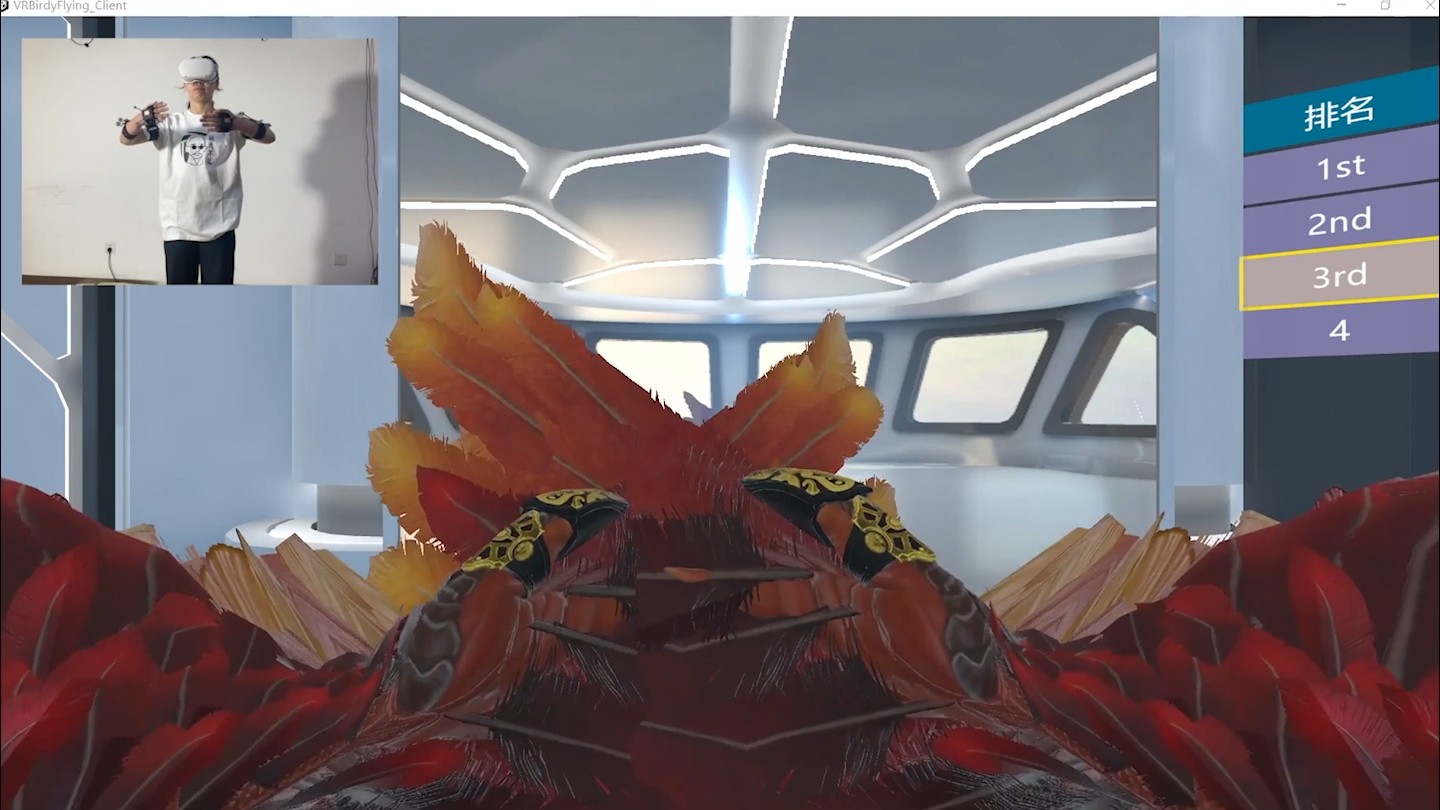
To test this, neuroscientist Yiyang Cai designed a week-long training program grounded in the mechanics of bird flight. Twenty-five participants donned VR headsets and motion-tracking gear. In the virtual environment, they viewed themselves as bird-like figures equipped with large, rust-colored, feathered wings.
The interaction was intuitive: rotating wrists and flapping arms in the real world caused the virtual wings to move in sync. Over the course of the week, participants engaged in a series of increasingly complex tasks:
* Deflecting falling airballs with their wings.
* Maintaining altitude over steep virtual cliffs.
* Navigating through aerial rings.
Progress varied among individuals. Some mastered the controls on their first attempt, while others required three or four sessions to achieve fluency. However, the improvement was consistent and observable across the group.
Neural Adaptation and Body Ownership
The core finding of the study lies in the changes observed in the participants’ visual cortex—the brain region responsible for processing images of body parts. After the training period, this region showed a significantly stronger response to images of wings. More importantly, the pattern of neural activity when viewing wings began to mirror the pattern used for processing upper limbs.
This shift indicates that participants had begun to perceive the wings not as external objects, but as integral parts of their own bodies. This phenomenon, known as “body ownership” or “limb incorporation,” suggests that the boundaries of brain plasticity are broader than once believed. The brain is willing to expand its definition of “self” to include virtual tools if the sensory feedback is consistent and interactive.
Beyond Novelty: Implications for Future Technology
The significance of this study extends beyond the novelty of virtual flight. It offers crucial insights into how humans might interact with future technologies, including artificial limbs, exoskeletons, and advanced sensory interfaces.
Kunlin Wei emphasizes that firsthand experience transforms understanding in ways that abstract knowledge cannot. By allowing users to “live” inside a new physical reality, VR can accelerate the adoption and intuitive use of complex technologies. As VR becomes an increasingly common medium for work, play, and therapy, understanding its impact on the human brain becomes essential.
“In the future, we may spend a great deal of time in VR,” Wei says. “We are very interested in what that could mean for the human brain.”
Conclusion
This research confirms that the human brain is capable of integrating virtual body parts into its sensory map, blurring the line between physical reality and digital simulation. As VR technology advances, our understanding of self and body may continue to evolve, opening new possibilities for medical rehabilitation, technological integration, and human experience.