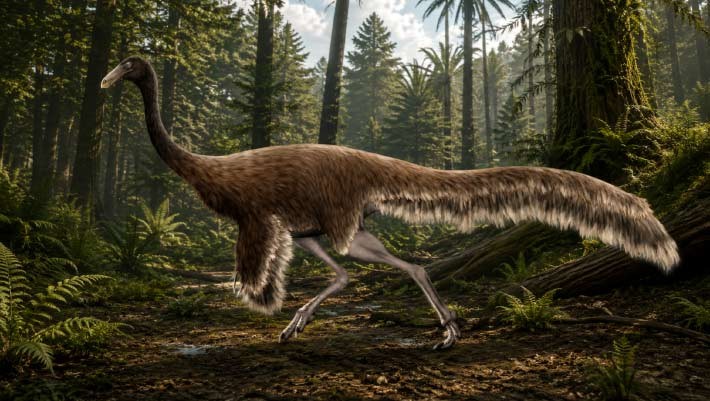
A bone washed up. Or rather it was found washing out, buried in the mud of a Canadian island. It belongs to an ornithomimosaur—a fast, bird-thing that ran on two legs and looked enough like an ostrich to make you squint.
This particular specimen is a single vertebra from the tail.
It was pulled from marine sediments on Denman Island, off the coast of British Columbia. The rock layer dates back to the Campanian stage of the Late Cretaceous. Roughly 75 to 80 million years ago.
Why is a dinosaur bone in the sea?
Dr. David Evans from the University of Toronto says it’s likely not native to the water. The animal probably died on the ancient coastline. Maybe it got dragged offshore by scavengers. Maybe currents carried the bone along the shore. Or perhaps the whole carcass floated away before breaking apart, spilling this tiny piece of history into the deep.
Ornithomimosaurs weren’t huge, but they were fast. We’re talking 50 to 60 kilometers an hour. Long legs, toothless beaks, small heads. They didn’t just run they fed on anything they could find—plants, eggs, small prey. Omnivores with no rules.
“The fossil is… the first from Canadian outcrops.”
That’s the key here.
Before this paper, only one other piece of dinosaur bone had ever been found in the Nanaimo Group. Now we have a second. It’s sparse. The Pacific coast fossil record is quiet. But it’s not silent.
Evans and his team, including Victoria M. Arbour, argue this bone suggests these dinos roamed further west than we thought. Specifically, the northern parts of North America that bordered the Western Interior Seaway.
Is it a lot of evidence?
No. It’s a single vertebra. But it aligns Denman Island with places like the Judith River and Two Medicine formations to the east. Same latitude, same time period, different rocks. The question remains: did mountains block their path? Did the Pacific coast host its own unique population of runners, evolving separately from those in the interior?
We don’t know.
Not yet. The paper landed in the journal FACETS in April 2026, marking it as the second known dinosaur fossil from this specific group. Two is better than one, sure. But two leaves plenty of room for more questions than answers.
Maybe the next one won’t be just a bone.
Maybe it will be a footstep. Or a nest. Or just another fragment drifting in the dark.
Source:
Arbour, V. M., et al. 2016. “An ornithomimosaur from the Cedar District Formation…” FACETS. 10.1371/journal.pone.0251752